
Steel Floors & Staircases
Walking surfaces in steel — from the composite floor to the spiral stair.
Steel makes the floors you stand on and the stairs you climb. This unit covers the floor systems — from a steel beam under an RCC slab to the composite floor where studs make the two act as one and the profiled metal deck that doubles as formwork — and the steel staircase, its parts, types and treads.
Learning objectives
By the end of this lesson, you will be able to — mapped to the course outcomes for Building Materials & Construction III:
Distinguish steel floor systems — RCC-on-beam, composite, metal-deck, grating.
Explain composite action and the role of shear studs.
Name the parts of a steel staircase and its types.
Select a tread material for a steel stair.
Steel floors
A composite floor ties the steel beam and concrete slab into one via shear studs (shallower, lighter); the profiled metal deck spans as permanent formwork plus reinforcement; and grating or chequered plate makes hard industrial floors.[1, 2]
Beam, slab and deck
A steel beam can carry a separately-designed RCC slab (non-composite), or — with headed shear studs welded to the flange — act together with the slab as a composite floor (shallower beam, longer span, less steel). A profiled metal deck spans as permanent formwork plus reinforcement, with concrete cast on top.[1, 2]
Steel staircases
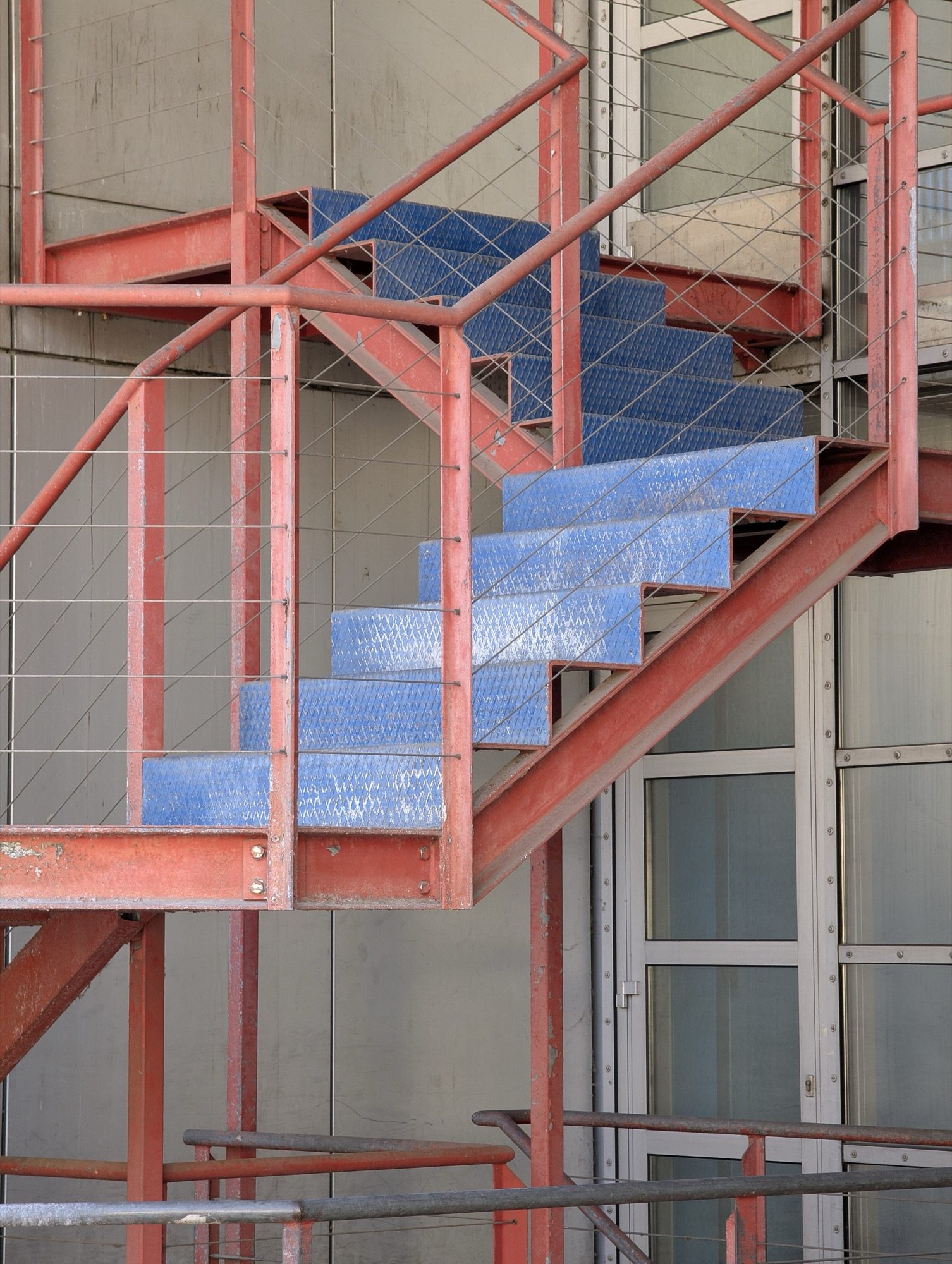
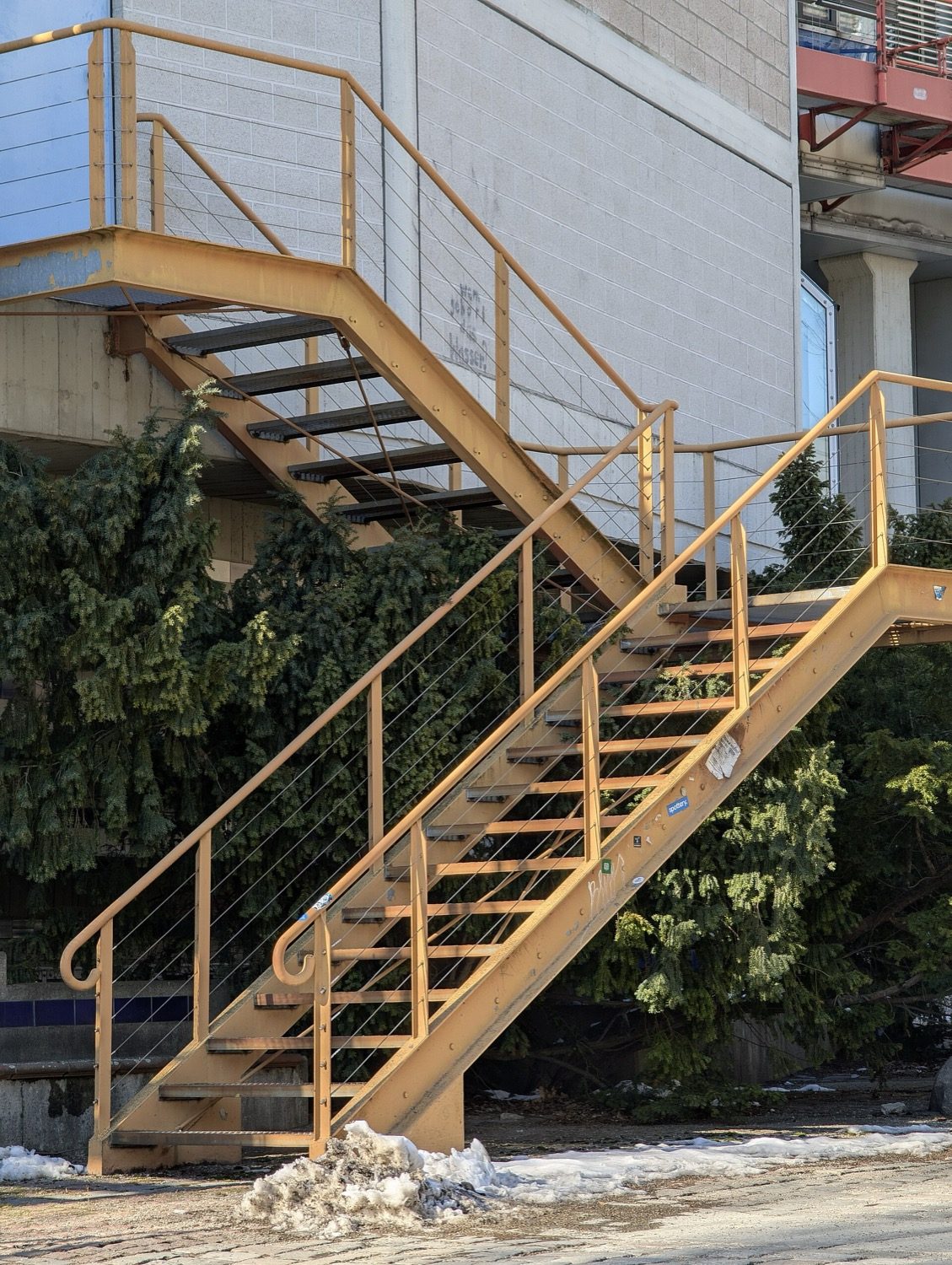
A steel stair is carried on inclined stringers, with treads, risers, going, newel and balustrade. It comes straight, spiral or open-tread; treads are chequered plate, grating or RCC-filled, set out for comfort.[2]
Floors & treads
| Aspect | One | The other |
|---|---|---|
| Floor action | Composite: beam + slab act as one (studs) | Non-composite: slab and beam act apart |
| Metal deck role | Permanent formwork + reinforcement | (RCC slab needs separate shuttering) |
| Industrial floor | Grating: open, drains, light | Chequered plate: solid, anti-slip |
| Stair type | Spiral: compact, central column | Open-tread: industrial, grating treads |
| Tread | Chequered plate / grating: anti-slip steel | Steel pan filled with RCC: solid |
Key terms
A steel beam and concrete slab made to act as one via shear connectors.
A headed stud welded to the beam flange that transfers interface shear (composite action).
A profiled steel sheet acting as permanent formwork plus tension reinforcement in a floor.
Open steel grating or raised-pattern plate for industrial floors and walkways.
The inclined beam(s) supporting a stair's treads and risers.
The step surface, the vertical face between treads, and the horizontal run of one tread.
A compact steel stair with treads cantilevered off a central column.
An industrial stair of grating treads with no risers.
Drafting task
Draw a composite-floor section showing the steel beam, the shear studs and the slab on a metal deck, and mark what makes it “composite”. Then sketch a steel stair flight, labelling the stringer, tread, riser and handrail.
Self-assessment
1. Composite action between a steel beam and a concrete slab needs —
2. In a profiled metal-deck floor, the deck primarily acts as —
3. The inclined member supporting a steel stair's treads is the —
Recap
References & further reading
- [1]IS 800:2007 — General Construction in Steel: Code of Practice. Bureau of Indian Standards.
- [2]B.C. Punmia, A.K. Jain & A.K. Jain, Building Construction. Laxmi Publications.
- [3]Roy Chudley & Roger Greeno, Building Construction Handbook. Routledge / Elsevier.
Further reading
- B.C. Punmia, Building Construction. Laxmi Publications.
- Roy Chudley & Roger Greeno, Building Construction Handbook.
- S.K. Duggal, Limit State Design of Steel Structures.
Sources gathered and fact-checked June 2026. Published values vary by source, sample and method — treat as indicative and confirm against the cited standard before structural use.
The author
Amogh N P
Architect, interior designer, and creative polymath. Studio Matrx began in his notebooks — his vision of design made honest, useful, and open to everyone. Its Academy is written and taught in his memory, and free, forever.
More about Amogh →