
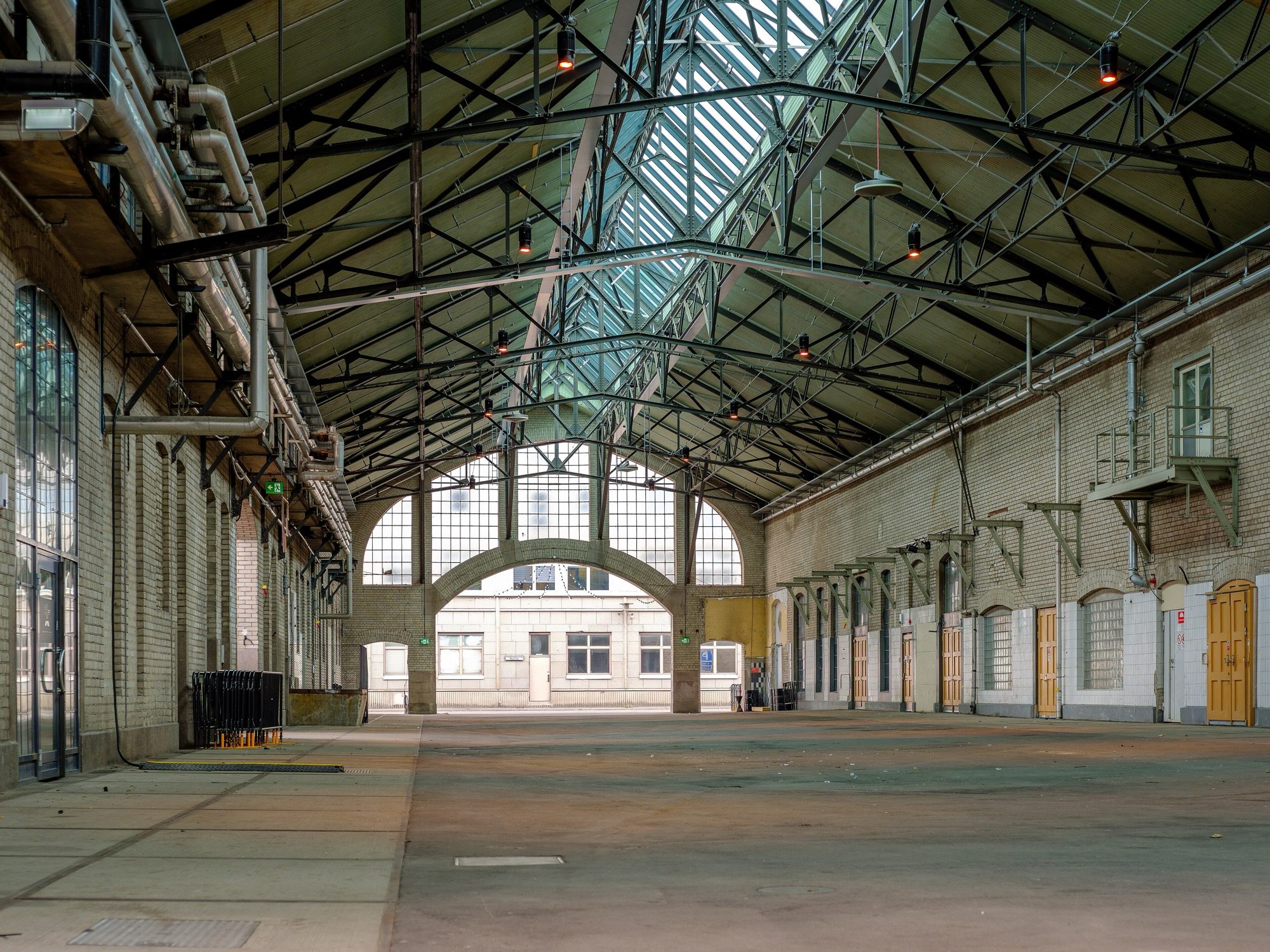
Steel Beams, Trusses & Roofs
Spanning wide — from the rolled beam to the space frame.
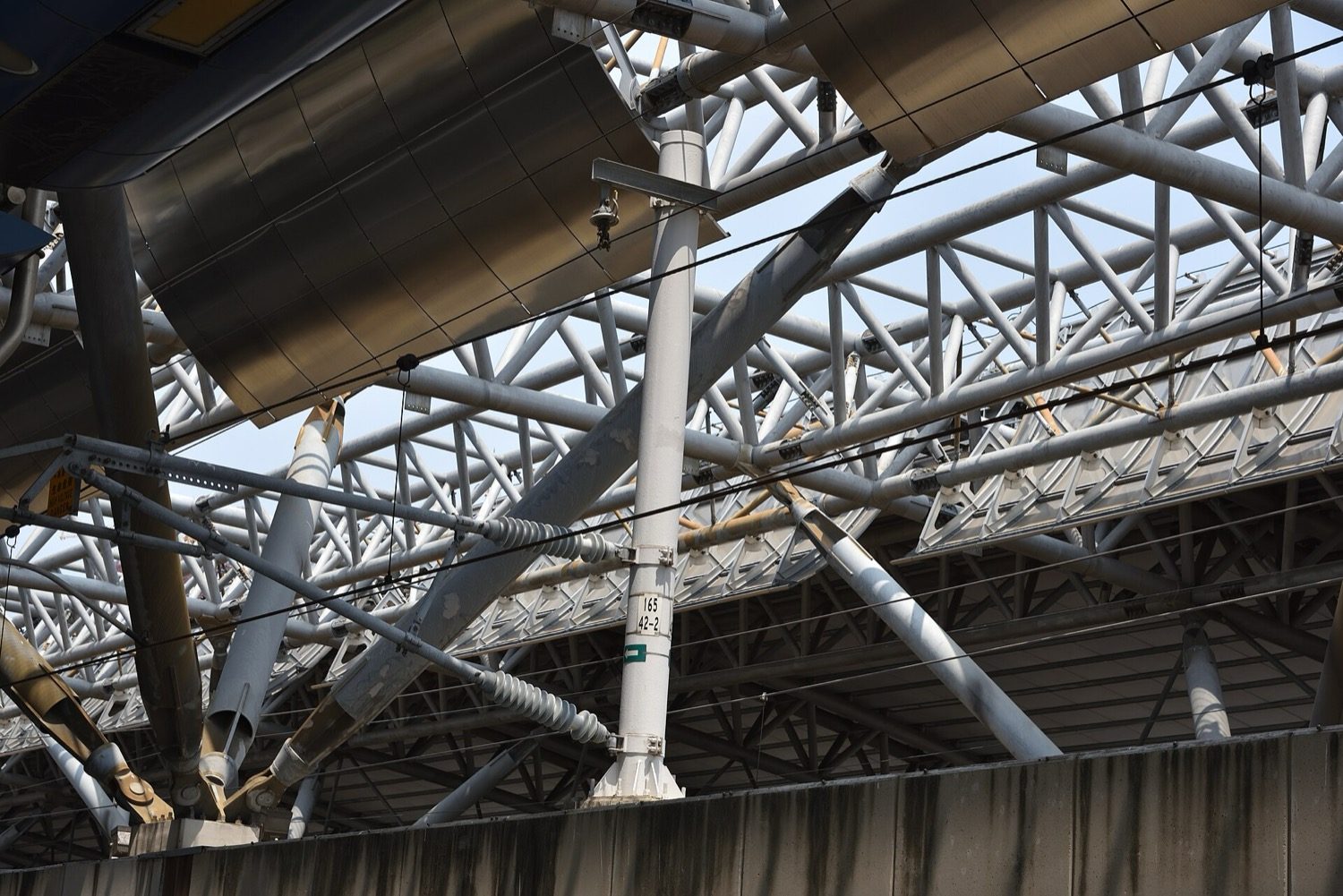
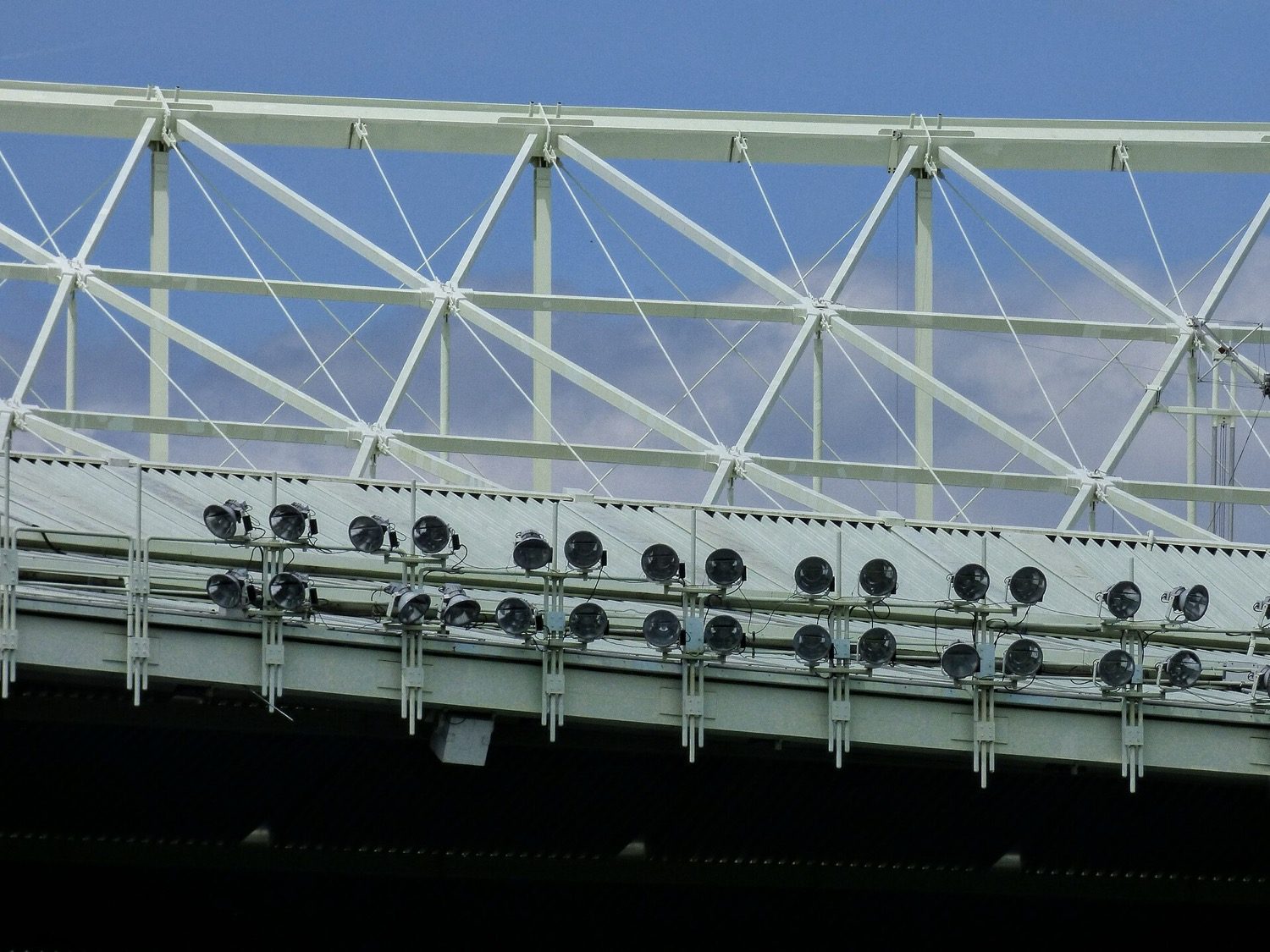
Steel's gift is the span. Where masonry and concrete grow heavy over distance, steel reaches across with triangulated trusses and three-dimensional space frames. This unit covers the beams, the roof trusses from the king post to the daylight-giving north-light, the space frame, and the coverings that finish the roof — with a live roof-truss explorer.
Learning objectives
By the end of this lesson, you will be able to — mapped to the course outcomes for Building Materials & Construction III:
Distinguish steel beam types — rolled, plate girder, castellated, gantry.
Identify roof trusses by form, span and the tension/compression of members.
Explain the north-light truss and the space frame.
Select a roof covering, purlin and fixing.
Beams & trusses
A truss spans by triangulation — top chord (rafter) in compression, bottom chord (tie) in tension, struts and ties between, carrying purlins. King and queen post for small spans; Pratt, Howe and Fink for pitched roofs.[1, 2]
Rolled to fabricated
An ordinary span uses a rolled I-beam; longer or heavier spans use a plate girder (web + flange plates). A castellated beam is a rolled beam cut and re-welded to ~50% greater depth with no extra steel; a gantry girder carries the rails of an overhead travelling crane under moving loads.[1, 2]
Roof-truss explorer
King post
Span: up to ~8 m
Small pitched roofs — sheds, garages, houses; one central vertical.
Orange = top chord (compression); blue = bottom chord / tie (tension). Span ranges are indicative.
North-light, space frames & roofs
The north-light truss glazes north for even factory daylight; the space frame gives vast column-free spans; and the covering — GI, profiled, standing-seam or metal deck — spans purlins to finish the roof.[1]
Daylight without glare
The north-light (saw-tooth) truss is asymmetric, with a steep glazed face. In the northern hemisphere that face points north, so factories get even, glare-free diffuse daylight without direct sun and heat.[1]
Truss quick reference
| Aspect | One | The other |
|---|---|---|
| Span | King post: up to ~8 m | Queen post: ~8–12 m |
| Pratt vs Howe diagonals | Pratt: diagonals in tension | Howe: diagonals in compression |
| Truss bias | North-light: glazed north, even daylight | Ordinary truss: symmetric, no daylight bias |
| Beam | Rolled: ordinary spans | Plate girder: long / heavy spans |
| Member force | Top chord: compression | Bottom chord (tie): tension |
Key terms
A built-up beam (web + flange plates) for long spans and heavy loads.
A rolled beam cut and re-welded to ~50% greater depth with no extra steel.
A beam carrying overhead-crane rails, designed for moving and impact loads.
The truss's outer members — top (rafter) in compression, bottom (tie) in tension.
A secondary beam (cold-formed Z/C) spanning between trusses to carry the sheeting.
A saw-tooth truss whose glazing faces north for even, glare-free daylight.
A 3-D triangulated grid for very large column-free spans (e.g. MERO node).
An economical W-web pitched truss — the commonest roof truss.
Drafting task
Draw a Fink truss and mark its top chord (compression), bottom tie (tension), and the purlin points. Then sketch a north-light truss and show, with an arrow, why its glazing faces north. Use the explorer to compare spans.
Self-assessment
1. A north-light roof truss faces its glazing north to —
2. In a Pratt truss under gravity load, the diagonals are mainly in —
3. A castellated beam is made by —
Recap
References & further reading
- [1]IS 800:2007 — General Construction in Steel: Code of Practice. Bureau of Indian Standards.
- [2]S.K. Duggal, Limit State Design of Steel Structures. McGraw-Hill Education.
- [3]B.C. Punmia, A.K. Jain & A.K. Jain, Building Construction. Laxmi Publications.
Further reading
- S.K. Duggal, Limit State Design of Steel Structures.
- N. Subramanian, Design of Steel Structures. Oxford University Press.
- Roy Chudley & Roger Greeno, Building Construction Handbook. Routledge.
Sources gathered and fact-checked June 2026. Published values vary by source, sample and method — treat as indicative and confirm against the cited standard before structural use.
The author
Amogh N P
Architect, interior designer, and creative polymath. Studio Matrx began in his notebooks — his vision of design made honest, useful, and open to everyone. Its Academy is written and taught in his memory, and free, forever.
More about Amogh →