
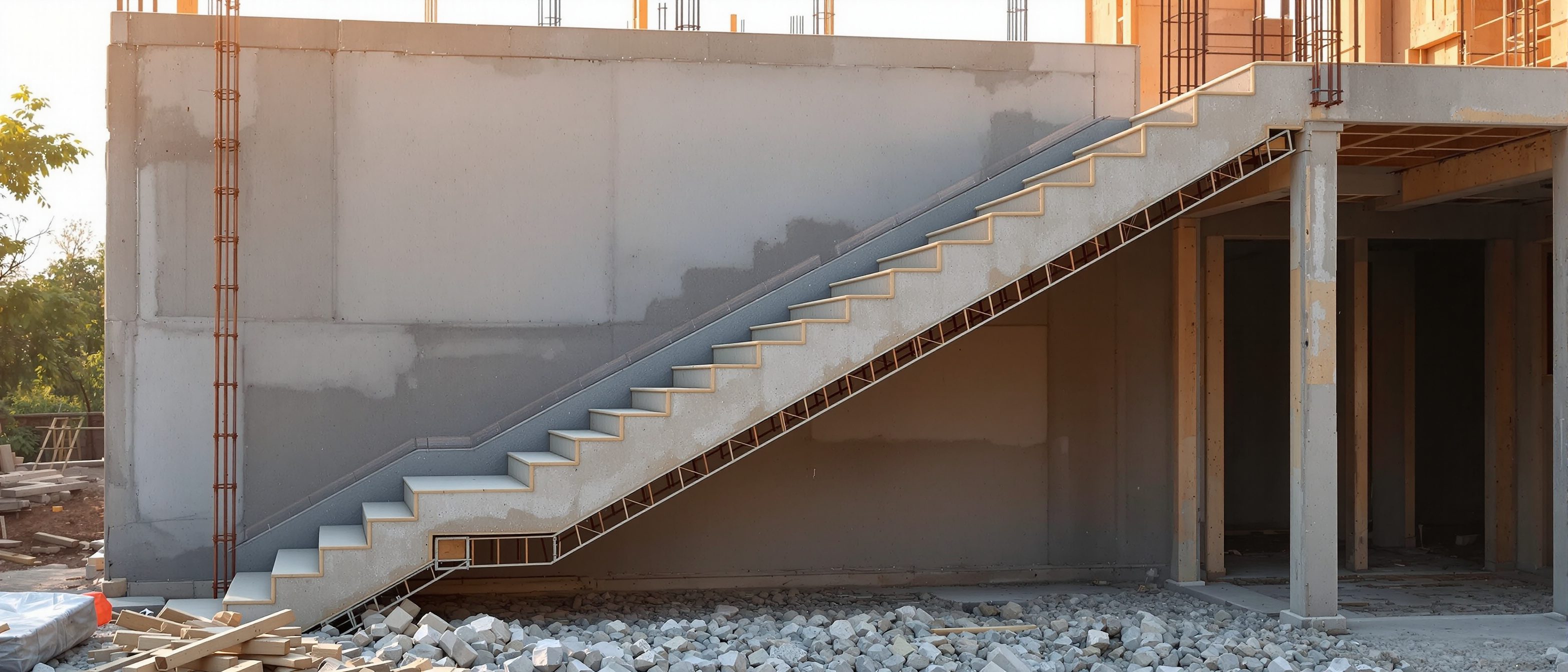
RCC Staircase
Connecting the floors — comfort, type and the inclined slab.
The staircase ties the floors together and is one of the most expressive elements an architect details. This final lesson covers the parts and the comfort rule that sizes every step, the family of types, the reinforcement of the inclined waist slab, and the floating and folded-plate stairs trending today.
Learning objectives
By the end of this lesson you will be able to — mapped to the course outcomes for Building Materials & Construction II:
Name a staircase's components and apply the 2R+T comfort rule.
Distinguish the staircase types — dog-legged, open-well, bifurcated, spiral, helical.
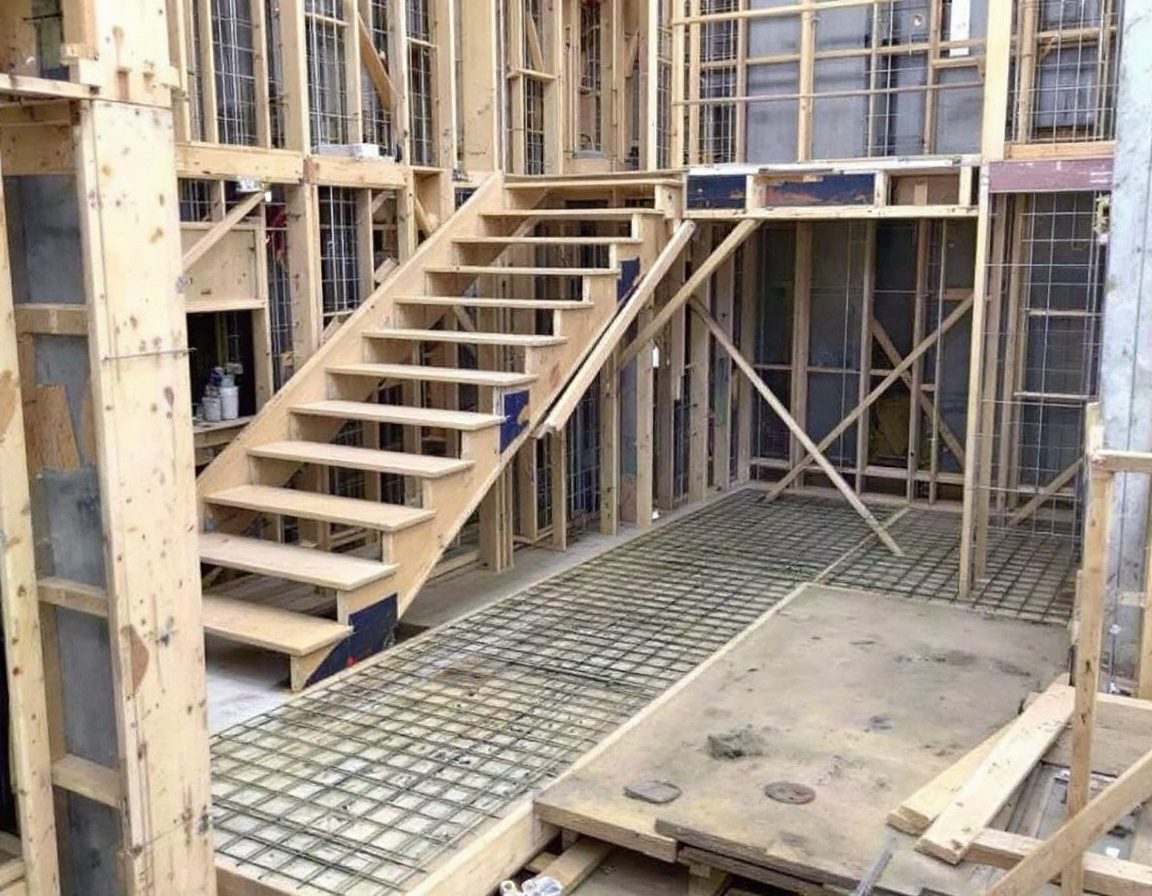
Detail the waist-slab reinforcement and the landing junction.
Apply the NBC limits and detail the handrail and baluster — and recognise current trends.
Parts & comfort
A flight is treads and risers on an inclined waist slab; the comfort rule 2R + T ≈ 600–635 mm tunes the step to the stride. Select a topic.[1, 2]
The parts of a stair
A flight is made of TREADS (the part you step on, ~270–300 mm going) and RISERS (the vertical face, ~150–190 mm), carried on an inclined RCC WAIST SLAB; flights meet at a LANDING; the NOSING is the projecting tread edge; HEADROOM (≥ 2.0 m) is the clear height above. The number of risers per flight is usually kept to 12 or fewer.[1, 5]
The family of stairs
From the everyday dog-legged to the sculptural helical — use the explorer to compare them in plan.[3]
| Type | In short |
|---|---|
| Dog-legged | Two flights, half-turn landing, no well — the everyday stair |
| Open-well | Flights around an open central well (room for a lift) |
| Bifurcated | One wide bottom flight splitting into two at a landing |
| Spiral | Steps winding around a central post — compact |
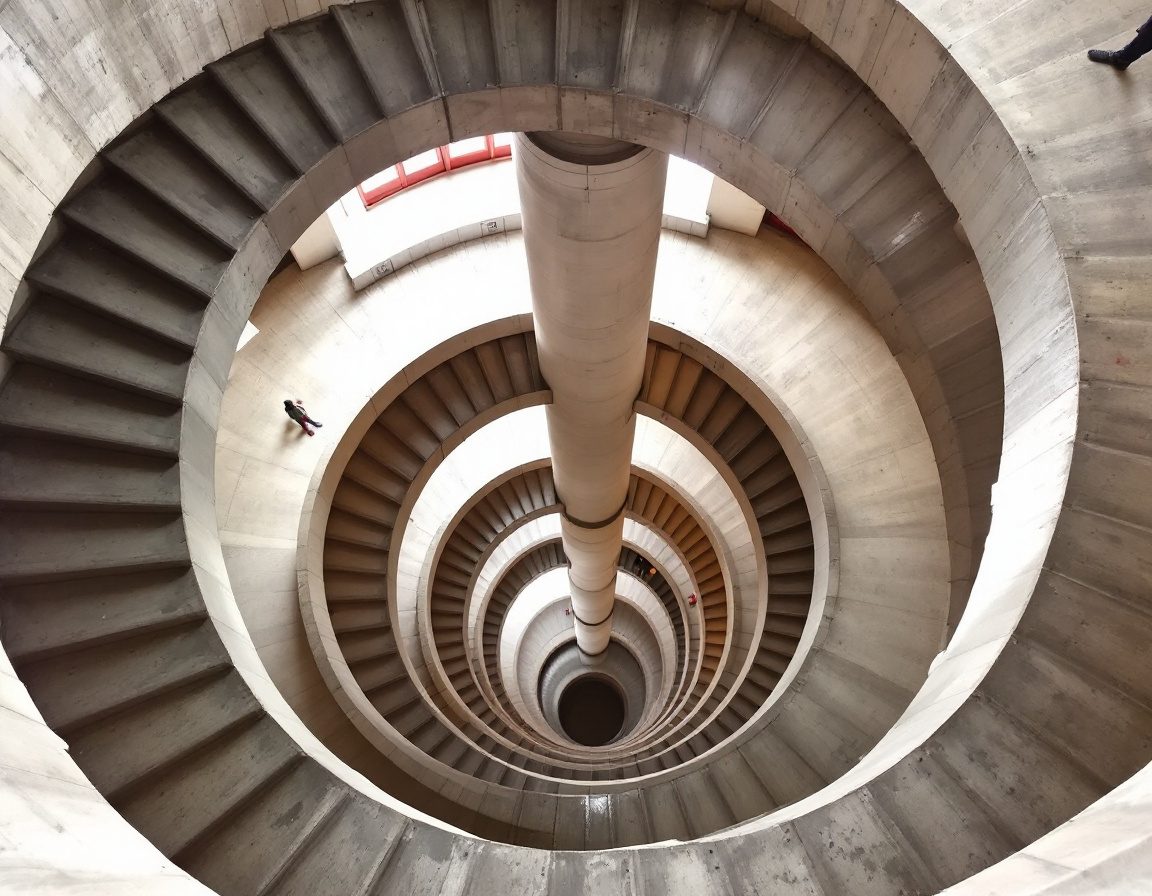
| Helical | A freestanding curved ribbon — no central column |
Staircase-type explorer
Pick a staircase type to see its plan and where it fits.
Dog-legged
Two flights in opposite directions meeting at a half-turn landing, with no gap (well) between them — the most common stair in Indian buildings.
Reinforcement & code
The waist slab is an inclined one-way slab; the landing junction must be fully anchored. The handrail sits ≈ 900 mm high, and the NBC sets the riser, tread and width.[4, 5]
Pushing the structure
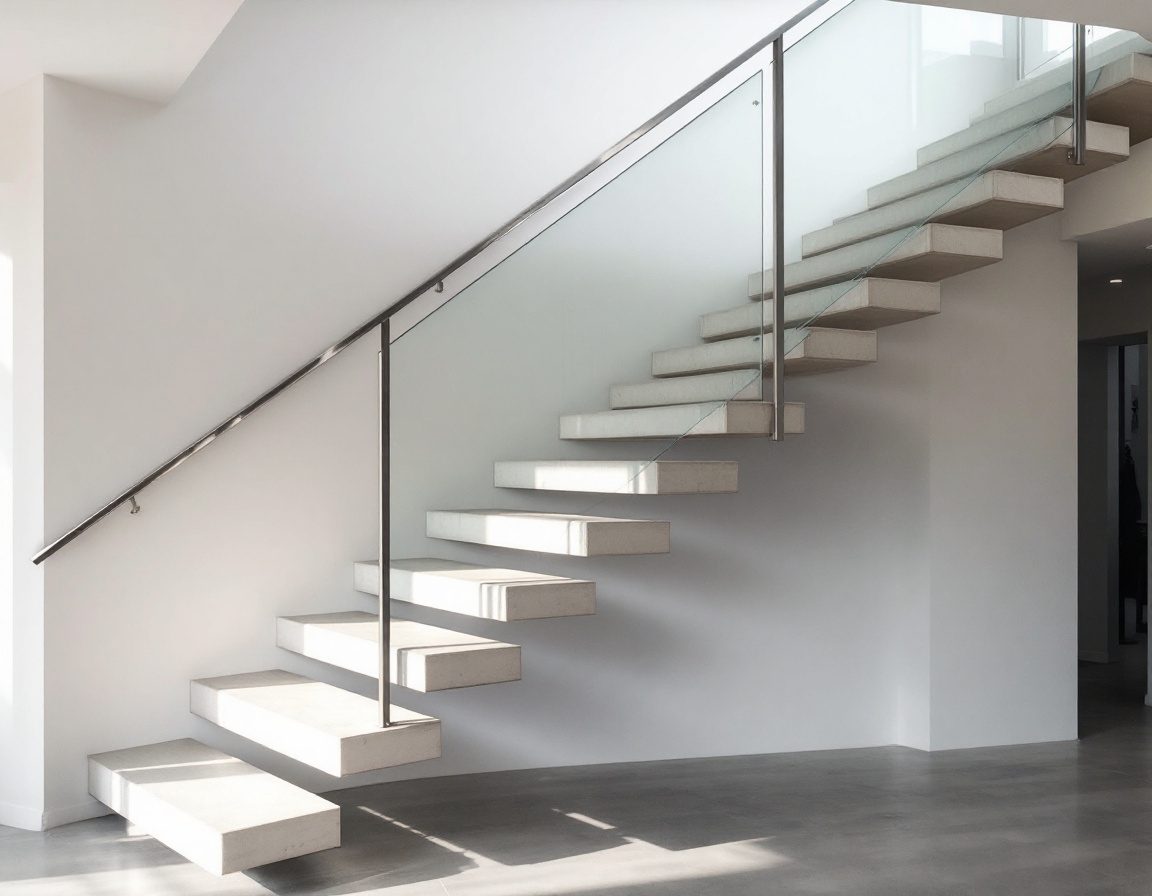
Today's stairs make the structure the show — floating, folded-plate and helical.[6]
Self-assessment
1. The staircase comfort rule (Blondel) is approximately:
2. A dog-legged staircase has:
3. At a staircase's landing junction, the reinforcement must be carefully anchored because:
Recap
References & further reading
- [1]Staircase components and dimensions — tread, riser, going, waist slab, landing, nosing, headroom. Civil Sir. https://civilsir.com/staircase-rise-run-formula-stair-formula-2r-t/
- [2]The stair formula 2R + T (Blondel's formula) and comfortable proportions. Engineer Fix. https://engineerfix.com/what-is-the-stair-formula-explaining-2r-t/
- [3]Types of staircases — dog-legged, open-well, bifurcated, quarter/half-turn, spiral, helical. Happho. https://happho.com/types-of-staircases-and-their-pros-and-cons/
- [4]RCC staircase design (IS 456) — waist slab as an inclined one-way slab; landing junction anchorage. Civil Eng Profile. https://civilengpro.com/how-to-design-a-straight-staircase/
- [5]NBC 2016 Part 4 (Fire & Life Safety) — stair riser/tread/width limits; handrail and baluster. BIS. https://fireandsafetyequipments.com/wp-content/uploads/2018/09/NBC2016-Part-IV.pdf
- [6]RCC staircase types incl. folded-plate and floating/cantilever stairs. Bricknbolt. https://www.bricknbolt.com/blogs-and-articles/construction-guide/rcc-staircase
Further reading
- BIS (2000). IS 456: Plain and Reinforced Concrete — Code of Practice. New Delhi: BIS — Clause 33 (stairs).
- Ching, F.D.K. (2014). Building Construction Illustrated (5th ed.). Hoboken, NJ: Wiley — stairs and stair construction.
- BIS (2016). National Building Code of India, Part 4: Fire and Life Safety. New Delhi: BIS.
Sources gathered and fact-checked June 2026. Published values vary by source, sample and method — treat as indicative and confirm against the cited standard before structural use.
The author
Amogh N P
Architect, interior designer, and creative polymath. Studio Matrx began in his notebooks — his vision of design made honest, useful, and open to everyone. Its Academy is written and taught in his memory, and free, forever.
More about Amogh →