
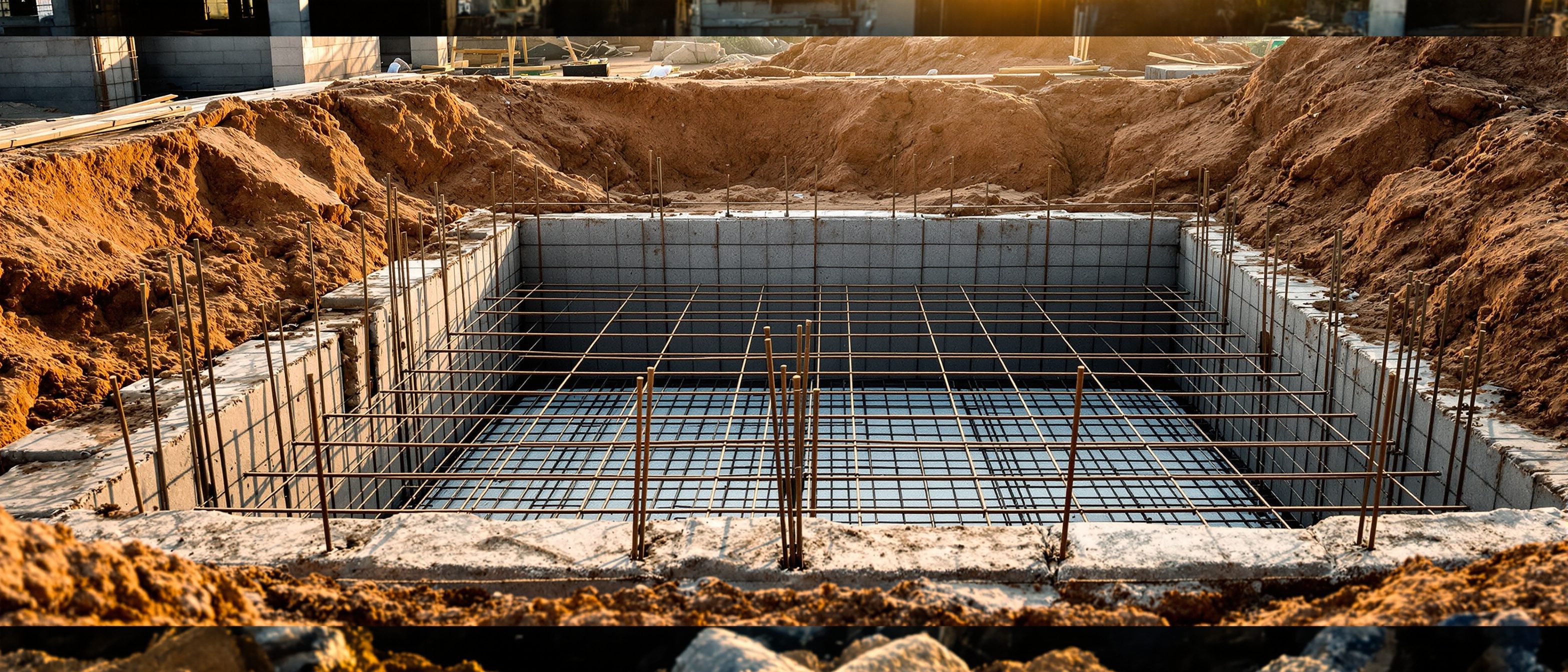
RCC Footings
Where the building meets the soil — concrete that grows steel.
Reinforced cement concrete is the workhorse of modern Indian building — and it begins at the bottom, where the footing carries the load down to the soil. This first lesson explains why concrete needs steel, the footings that spread the load, and the reinforcement, cover and bar bending that make them work.
Learning objectives
By the end of this lesson you will be able to — mapped to the course outcomes for Building Materials & Construction II:
Explain how concrete and steel act together in RCC, and why.
Identify footing types — isolated, combined, continuous and raft.
Detail an isolated footing — bottom mesh, dowels and nominal cover.
Read a bar bending schedule and the basics of a bill of quantities.
Concrete grows steel
Concrete is strong in compression but weak in tension, so steel is placed where the member is pulled apart — and the two act as one. India's RCC rules live in IS 456 and its companions. Select a topic.[1, 2]
Concrete grows steel
Concrete is strong in COMPRESSION but weak in TENSION. So steel reinforcing bars are placed where the member is pulled apart. The two act as one because ribbed bars BOND to the concrete and because steel and concrete expand almost equally with heat — so they share load instead of separating.[1]
Footings & the bottom mesh
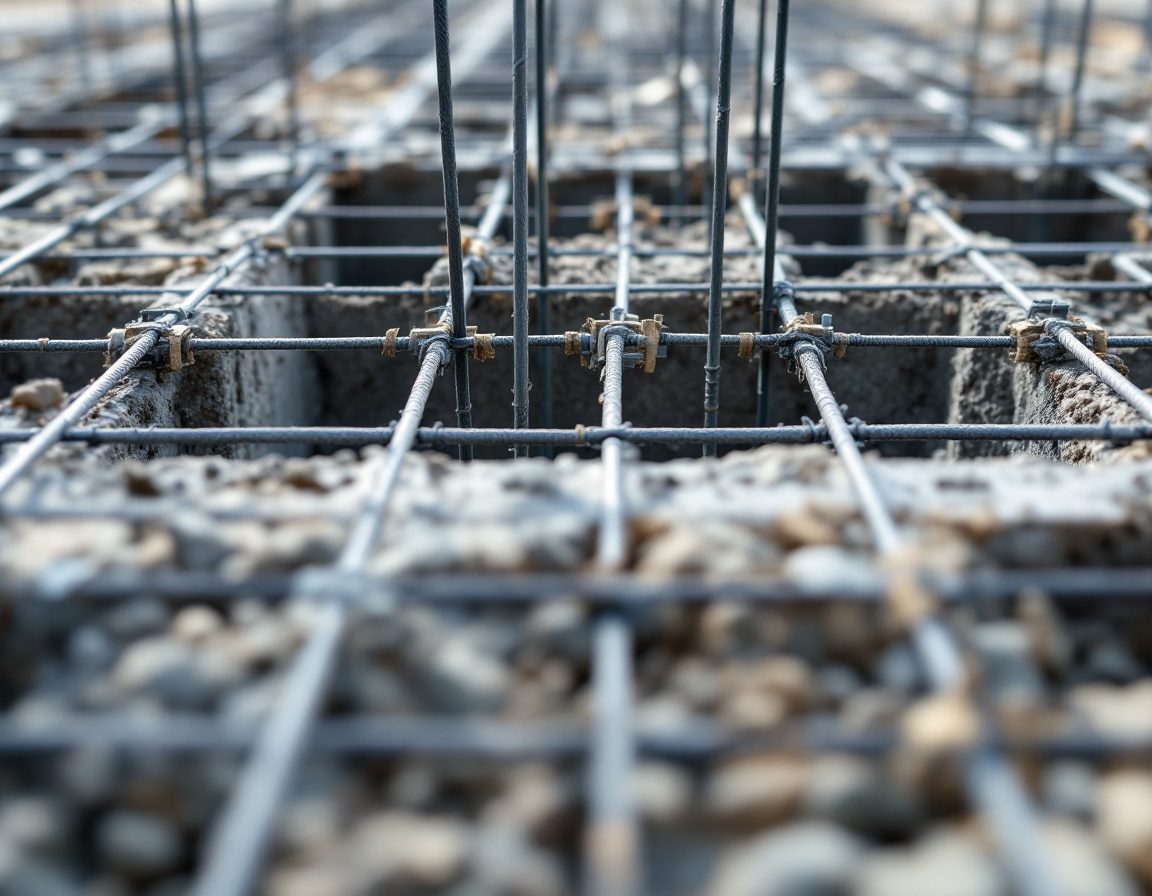
A footing spreads the column's load onto the soil; an isolated footing bends like an inverted cantilever, so its main steel is a grid near the bottom.[3]
Cover & the reinforcement explorer
Every bar needs enough concrete around it — the nominal cover — to resist rust and fire. Use the explorer to see where the steel goes in each RCC element, and the cover it needs.[4]
| Element | Nominal cover | Why |
|---|---|---|
| Footing | ≈ 50 mm | Cast against soil — most exposed to moisture. |
| Column | 40 mm | Protects vertical bars; fire and durability. |
| Beam | 25 mm | Protects main bars and stirrups. |
| Slab | 20 mm | Thin member; 15 mm allowed for small bars. |
Reinforcement explorer
Pick an RCC element to see where its steel goes and why. Sections are schematic, to IS 456 / SP 34 conventions.
0 mm
Nominal cover
Bottom mesh, both ways
Soil pushes up, so the footing bends with tension at the bottom — the main steel is a grid near the bottom face. Dowels project up to lap the column.
Self-assessment
1. Steel is added to concrete mainly because concrete is weak in:
2. The reinforcement in an isolated footing is mainly a mesh placed:
3. Nominal cover is the layer of concrete that:
Recap
References & further reading
- [1]Rebar / reinforced concrete — composite action: concrete in compression, steel in tension, bond and equal thermal expansion. Overview. https://en.wikipedia.org/wiki/Rebar
- [2]IS 456:2000 — Plain and Reinforced Concrete, Code of Practice (the master RCC code). BIS. https://law.resource.org/pub/in/bis/S03/is.456.2000.pdf
- [3]Types of footings (isolated, combined, strip, raft) and their reinforcement. CivilBlog. https://civilblog.org/2014/11/09/what-are-different-types-of-footings/
- [4]Nominal cover for slab, beam, column, staircase and footing (IS 456 Table 16). Civil Sir. https://civilsir.com/nominal-cover-for-slab-beam-column-staircase-and-footing/
- [5]Bar Bending Schedule — bar mark, shape, cutting length, hooks and laps (IS 2502). Civiconcepts. https://civiconcepts.com/blog/bar-bending-schedule
Further reading
- Bureau of Indian Standards (2000). IS 456: Plain and Reinforced Concrete — Code of Practice (4th rev.). New Delhi: BIS.
- BIS (1987). SP 34: Handbook on Concrete Reinforcement and Detailing. New Delhi: BIS.
- Punmia, B.C., Jain, A.K. & Jain, A.K. (2016). Reinforced Concrete Structures. New Delhi: Laxmi Publications.
Sources gathered and fact-checked June 2026. Published values vary by source, sample and method — treat as indicative and confirm against the cited standard before structural use.
The author
Amogh N P
Architect, interior designer, and creative polymath. Studio Matrx began in his notebooks — his vision of design made honest, useful, and open to everyone. Its Academy is written and taught in his memory, and free, forever.
More about Amogh →