
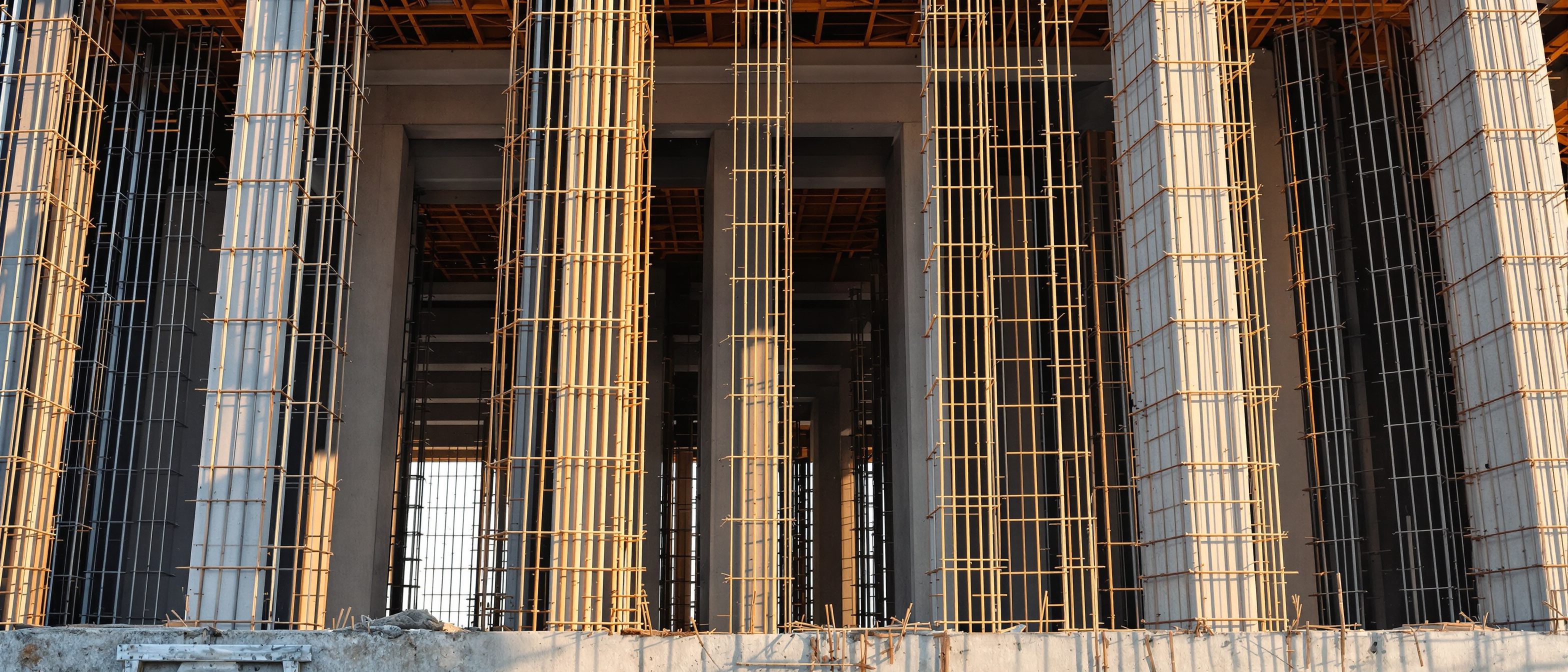
RCC Columns
The vertical load path — vertical bars held by ties.
The column gathers the building's load and carries it down to the footing. It looks simple — a box of concrete — but its reinforcement and its setting-out are exacting. This lesson covers the column families, the marking layout and the bars and ties inside.
Learning objectives
By the end of this lesson you will be able to — mapped to the course outcomes for Building Materials & Construction II:
Distinguish tied and spiral columns and their shapes.
Set out a column marking layout from the structural grid.
Detail column reinforcement — vertical bars and lateral ties.
Apply the IS 456 rules for minimum steel, bar size and tie spacing.
Tied & spiral columns
Columns are reinforced in two ways — separate ties, or a continuous spiral. Select a topic.[1]
Tied & spiral
Columns come in two reinforcement families. A TIED column has its vertical bars held by separate closed loops (ties / links) at intervals — the usual square or rectangular column. A SPIRAL column wraps the vertical bars in a continuous helix — usual for circular columns, and a little tougher under overload.[1]
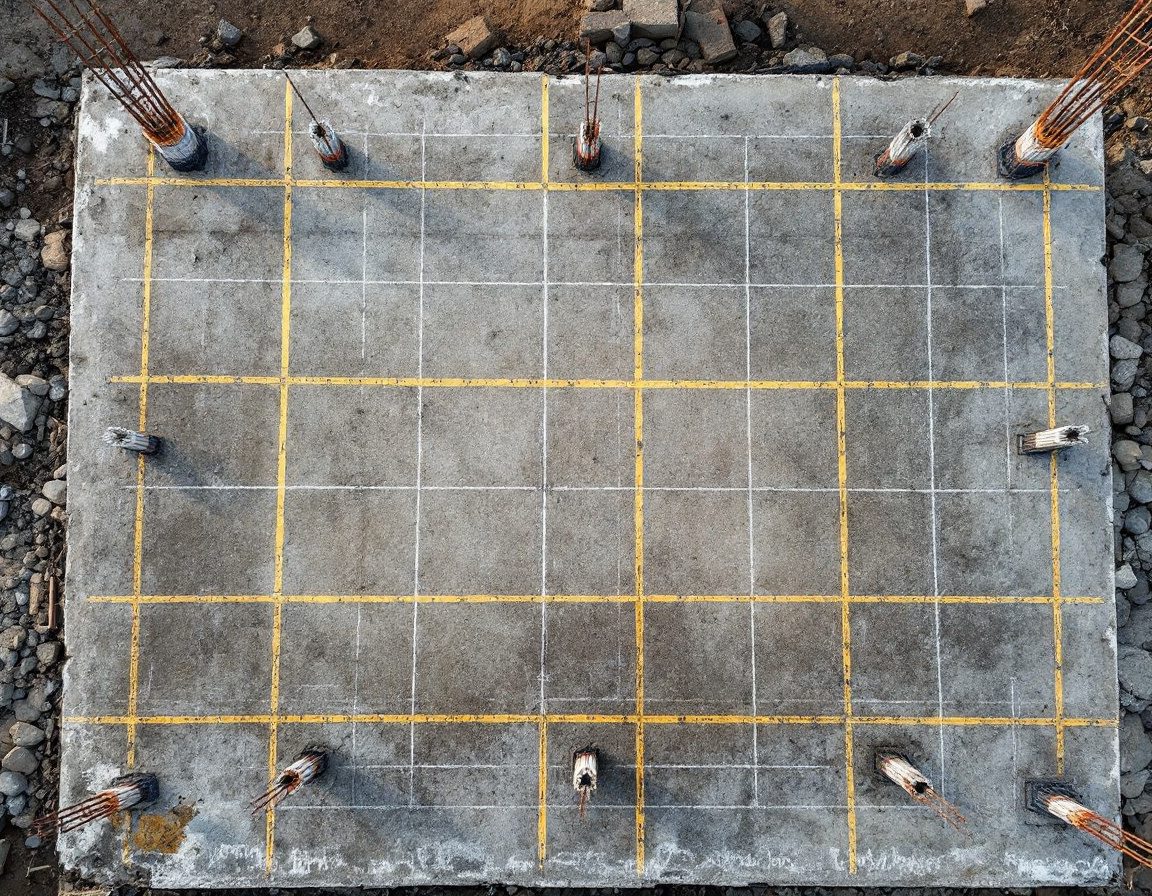
Marking from the grid
Before any steel, the columns are set out on site from the structural grid — get this wrong and the whole frame is out.[2]
The IS 456 rules
IS 456 fixes the limits that keep a column safe and buildable.[3, 4]
| Rule | Value | Note |
|---|---|---|
| Longitudinal steel | 0.8% – 6% of section | Minimum for safety; maximum to avoid congestion. |
| Minimum bars | 4 (rectangular) · 6 (circular) | One in each corner / round the spiral. |
| Minimum bar size | 12 mm | Smaller bars buckle too easily. |
| Tie spacing (max) | least of {side, 16·dia, 300 mm} | Closer ties confine better. |
Self-assessment
1. In a tied column, the lateral ties mainly:
2. Per IS 456, the minimum longitudinal steel in a column is:
3. ‘Column marking’ on site means:
Recap
References & further reading
- [1]RCC columns — tied vs spiral; longitudinal bars and lateral ties; detailing. Civil-engineering overview. https://theconstructor.org/structural-engg/reinforced-concrete-column/
- [2]Column marking / setting out from the structural grid on site. Construction practice. https://civiconcepts.com/blog/column-layout
- [3]IS 456:2000 column reinforcement — 0.8–6% steel, min 4/6 bars, tie pitch (Cl. 26.5.3). EduRev / BIS. https://law.resource.org/pub/in/bis/S03/is.456.2000.pdf
- [4]Concrete grades (M20/M25 = fck N/mm²) and steel grades (Fe415/Fe500 = yield N/mm²). Overview. https://testbook.com/question-answer/the-grade-of-concrete-m20-means-that-characteristi--671af1098de8c6fcb3276b9a
Further reading
- BIS (2000). IS 456: Plain and Reinforced Concrete — Code of Practice. New Delhi: BIS — Clause 26.5 (column detailing).
- BIS (1987). SP 34: Handbook on Concrete Reinforcement and Detailing. New Delhi: BIS.
- Pillai, S.U. & Menon, D. (2017). Reinforced Concrete Design (3rd ed.). New Delhi: McGraw-Hill Education.
Sources gathered and fact-checked June 2026. Published values vary by source, sample and method — treat as indicative and confirm against the cited standard before structural use.
The author
Amogh N P
Architect, interior designer, and creative polymath. Studio Matrx began in his notebooks — his vision of design made honest, useful, and open to everyone. Its Academy is written and taught in his memory, and free, forever.
More about Amogh →