
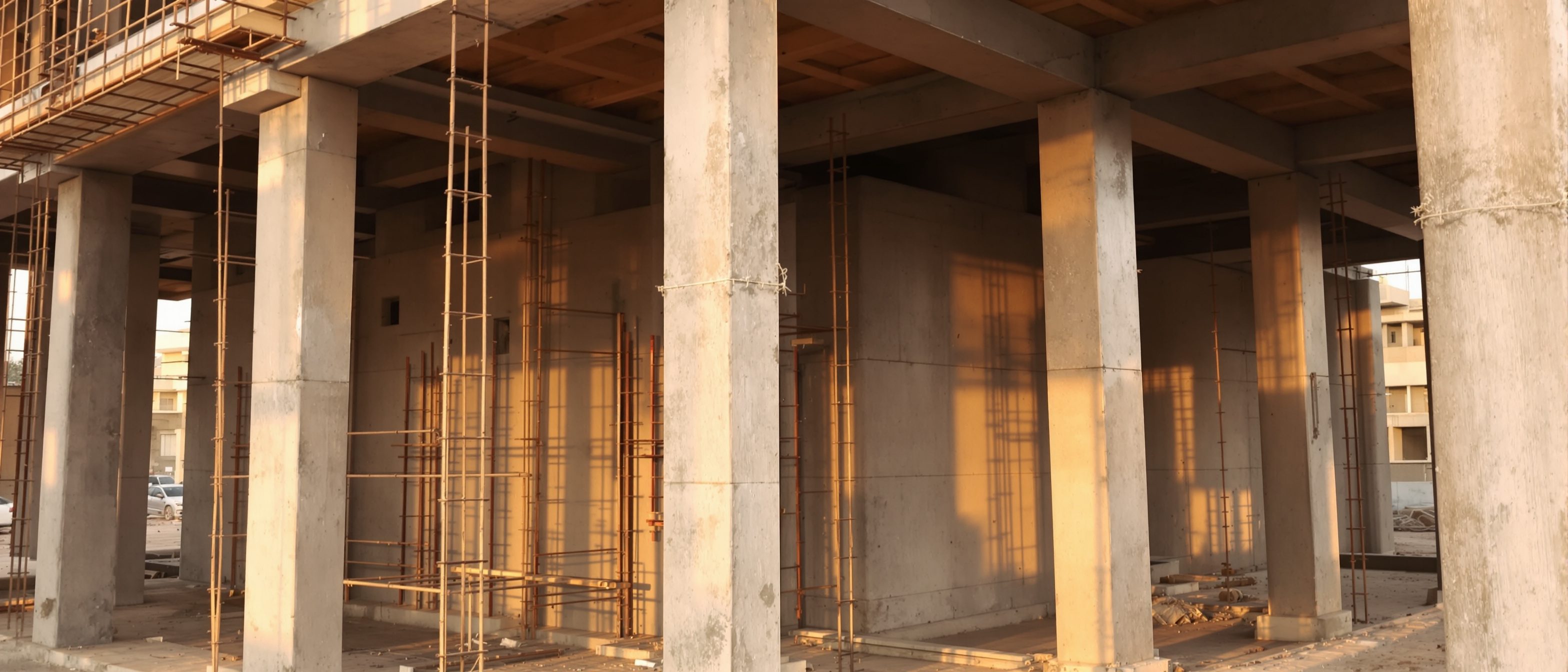
Plinth, Grade & Lintel Beams
The beams that tie and span at the lower levels.
Not every beam holds up a floor. Three quieter beams do vital jobs at the lower levels — tying the columns, linking the footings, and spanning the openings. This lesson covers each, and separates the general-arrangement drawing from the detailed one.
Learning objectives
By the end of this lesson you will be able to — mapped to the course outcomes for Building Materials & Construction II:
Explain the role of the plinth beam in tying columns and carrying the wall.
Distinguish the grade / tie beam and where it is used.
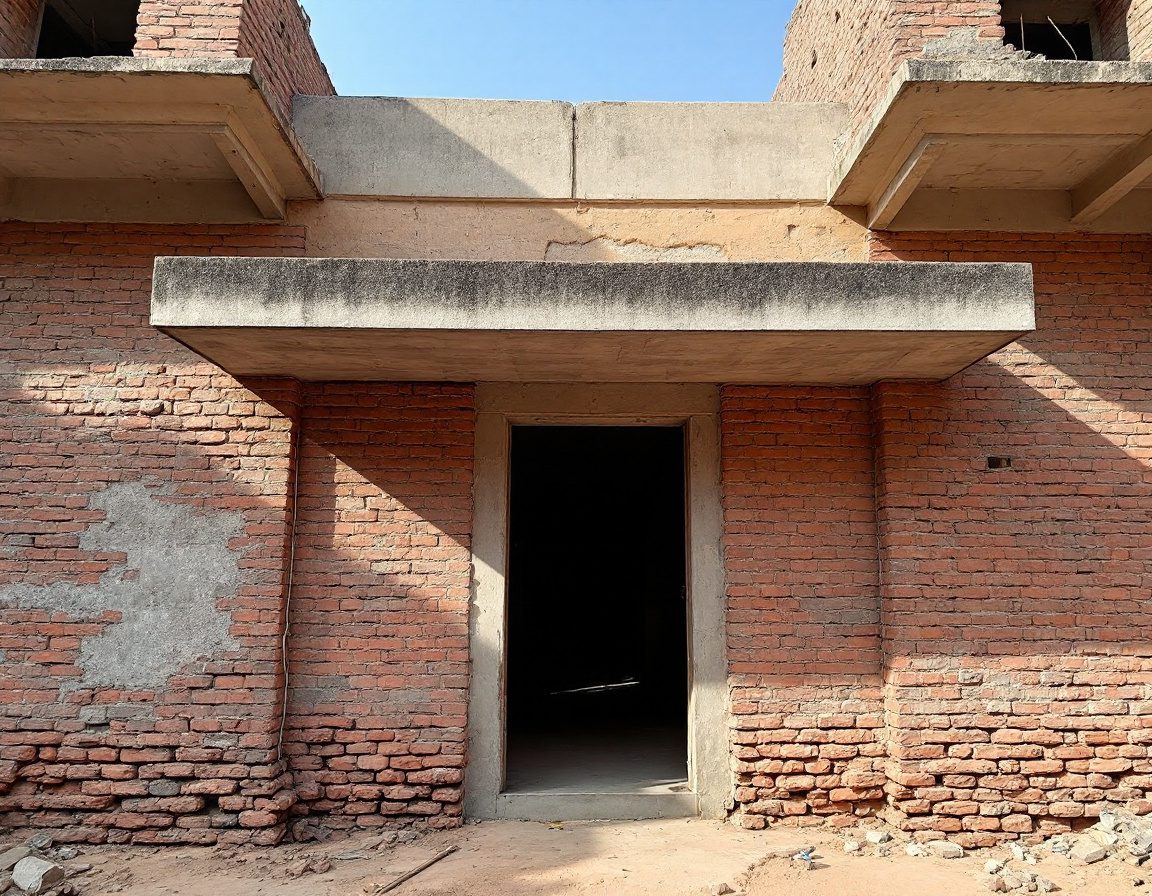
Describe the lintel beam and its sunshade over an opening.
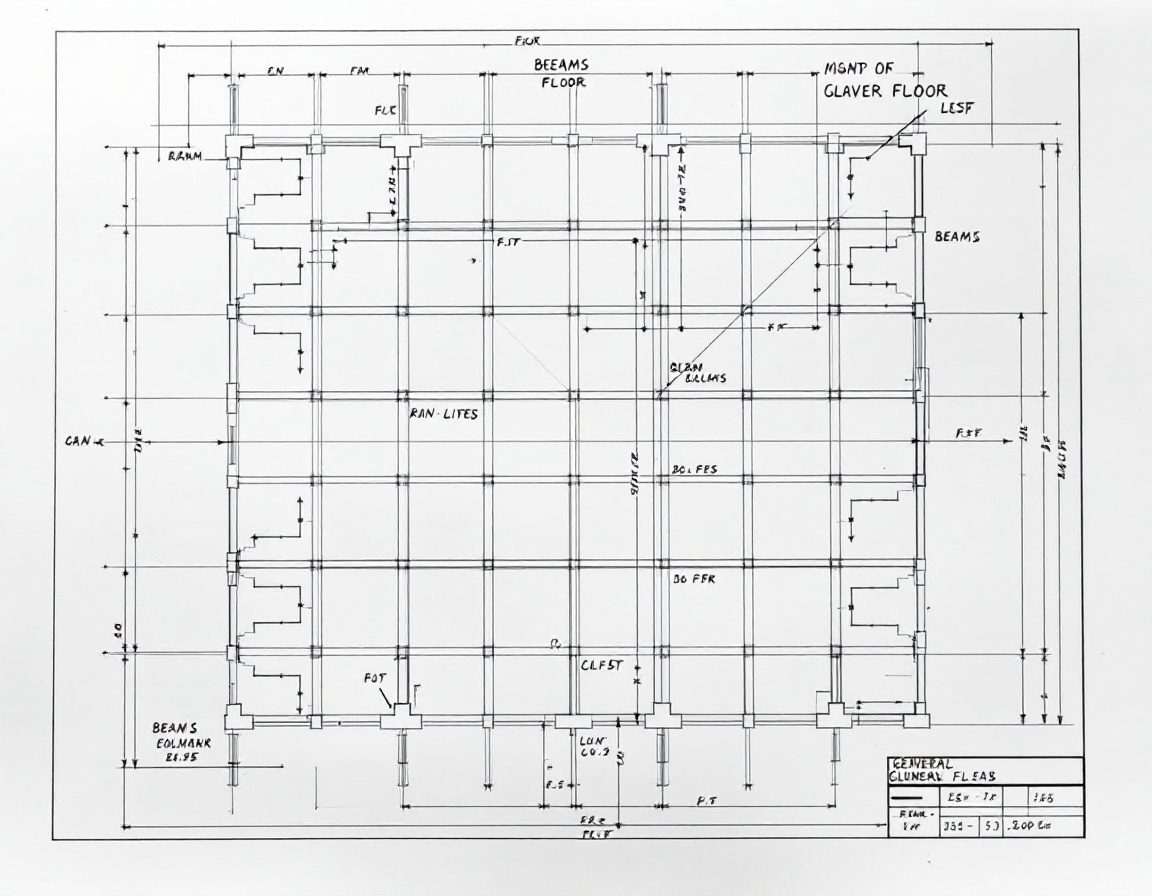
Tell a general-arrangement drawing from a detailed drawing.
The quiet beams
The plinth beam ties the columns and carries the wall; the grade/tie beam links the footings; the lintel spans an opening. Select a topic.[1, 2, 3]
Tie at plinth level
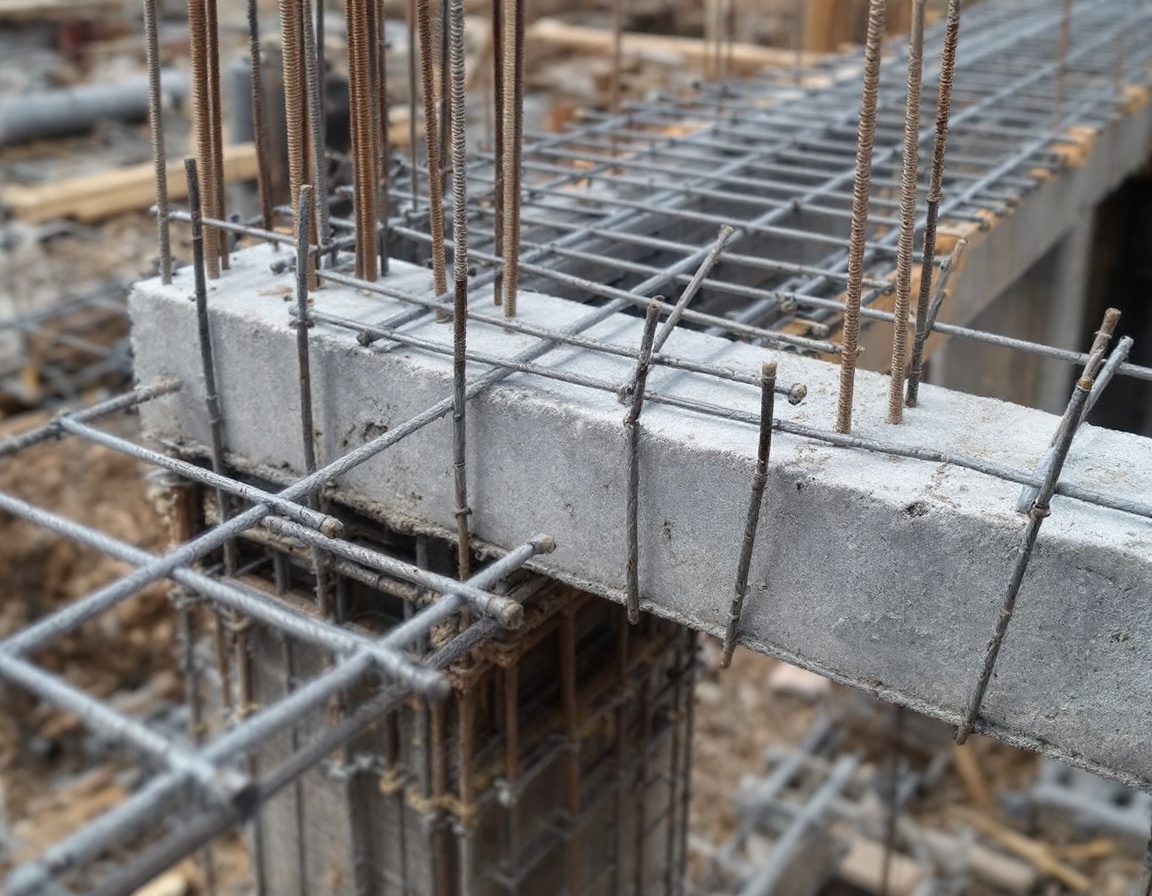
The PLINTH BEAM runs at plinth level — the first beam above the footings — connecting all the columns. It spreads the wall load evenly onto the foundations, stops cracks travelling from the foundation up into the wall, resists differential settlement, and carries the ground-floor wall above it.[1]
| Beam | Where | Role |
|---|---|---|
| Plinth beam | Plinth (just above ground) | Ties columns, carries the wall, spreads load, stops cracks |
| Grade / tie beam | At / near ground | Links footings or pile caps on weak soil; even settlement |
| Lintel beam | Over openings | Carries the wall above a door/window to the sides |
| Floor beam | Each floor | Carries the slab and its loads to the columns (Unit 4) |
The lintel & its sunshade
An RCC lintel carries the wall above a door or window across to the sides — and is often cast in one with a projecting sunshade.[3]
GA vs detailed drawing
The general-arrangement drawing is the overall layout; the detailed drawing shows the actual reinforcement.[4]
Self-assessment
1. The main job of a plinth beam is to:
2. A lintel beam is placed:
3. A general-arrangement (GA) drawing shows:
Recap
References & further reading
- [1]Plinth beam — role: tying columns, carrying the wall, preventing differential settlement and cracks. Testbook. https://testbook.com/civil-engineering/differences-between-plinth-beam-and-tie-beam
- [2]Grade beam vs plinth beam — the grade/tie beam links footings/pile caps on weak soil. Civil Tutorials. https://civiltutorials.com/grade-beam-vs-plinth-beam/
- [3]Lintel and its types — RCC lintel over openings; cantilever sunshade / chajja. UltraTech. https://www.ultratechcement.com/for-homebuilders/home-building-explained-single/descriptive-articles/what-is-lintel-and-its-types
- [4]Reading structural drawings — general-arrangement vs detailed reinforcement drawings. Sheer Force Engineering. https://sheerforceeng.com/2021/09/14/how-to-read-structural-drawings-a-deep-dive-from-a-to-z/
Further reading
- Ching, F.D.K. (2014). Building Construction Illustrated (5th ed.). Hoboken, NJ: Wiley — beams, lintels and the building frame.
- BIS (2000). IS 456: Plain and Reinforced Concrete — Code of Practice. New Delhi: BIS.
- Sushil Kumar (2015). Building Construction. New Delhi: Standard Publishers Distributors.
Sources gathered and fact-checked June 2026. Published values vary by source, sample and method — treat as indicative and confirm against the cited standard before structural use.
The author
Amogh N P
Architect, interior designer, and creative polymath. Studio Matrx began in his notebooks — his vision of design made honest, useful, and open to everyone. Its Academy is written and taught in his memory, and free, forever.
More about Amogh →