
Maintenance Fundamentals
Why buildings need care — and why it is the bulk of their cost.
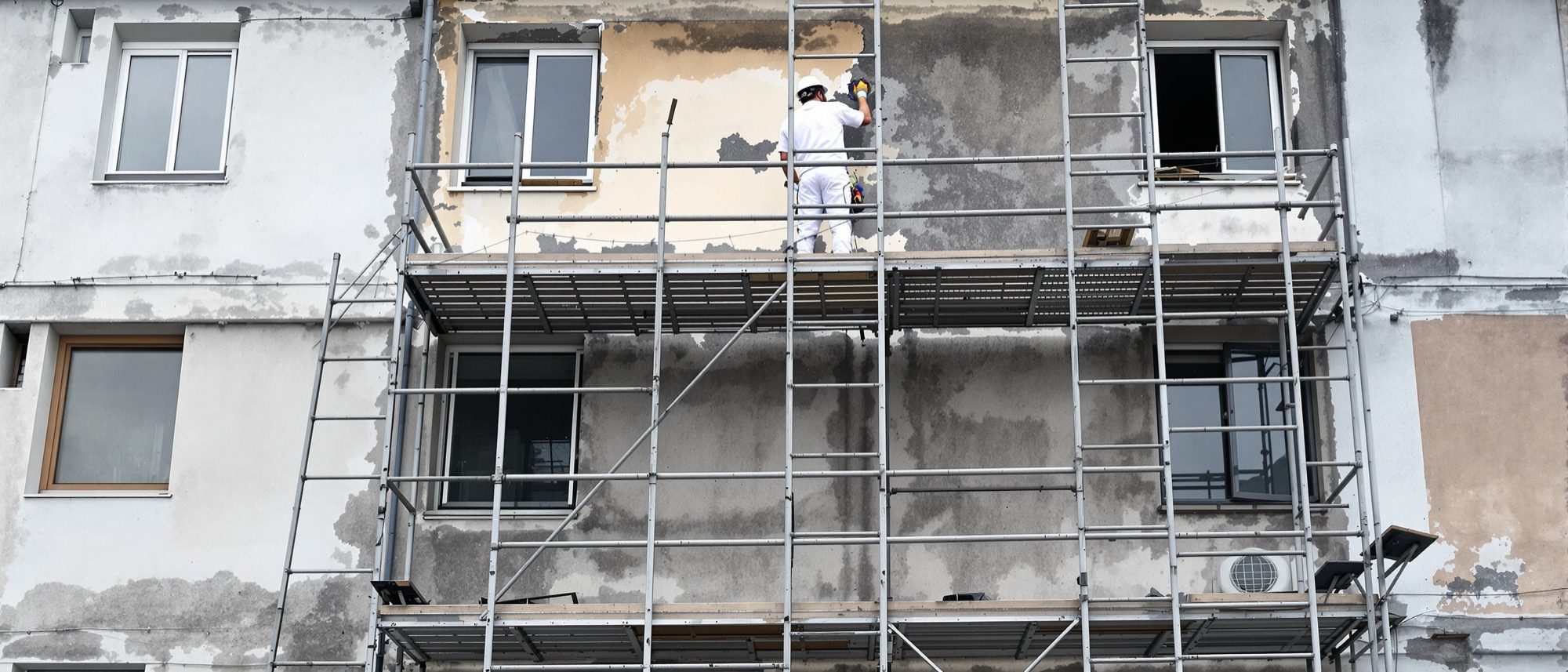
A building is not finished when it is built; it must be kept. Maintenance is all the work that retains a building in, or restores it to, a state where it performs its function — and over a long life it costs far more than the original construction. Learn the types of maintenance and the economics that make the “stitch in time” the central principle.
Learning objectives
By the end of this lesson, you will be able to — mapped to the course outcomes for Building Maintenance & Repair:
Define maintenance and explain why buildings need it.
Distinguish preventive, corrective, predictive and cyclic maintenance.
Explain why maintenance is the bulk of life-cycle cost.
Apply the 'stitch in time' principle to a maintenance plan.
What maintenance is, and its types
Maintenance preserves structural life (not just appearance); its types are preventive, corrective, predictive and cyclic.[1]
Keeping the building
MAINTENANCE is, in the classic definition, 'the combination of all technical and administrative actions intended to retain an item in, or restore it to, a state in which it can perform its required function'. Buildings begin to decay the day they are finished — from weather, use and time — so without maintenance their service life and value fall. FLAG THE MYTH: maintenance is NOT just cleaning or cosmetic upkeep; it preserves the structural life of the building.[1, 7]
The economics
Operation and maintenance exceed the construction cost over a building's life, and the “stitch in time” makes preventive the economic and sustainable choice.[7, 1]
At a glance
| Aspect | One | The other |
|---|---|---|
| Timing | Preventive: before failure (planned) | Corrective: after failure (reactive) |
| Trigger | Predictive: condition/monitoring | Cyclic: a fixed calendar |
| What it is | Myth: cleaning & cosmetics | Reality: preserving structural life |
| Cost over life | Construction: a fraction (~¼–⅓) | Operation + maintenance: the majority |
| The principle | Stitch in time: small repair now | …prevents a large failure later |
Key terms
All technical and administrative work to retain or restore a building to a functioning state.
Planned, scheduled work done before failure, regardless of current condition.
Reactive work done after a breakdown or defect, to restore function.
Condition-based work, using monitoring to act just before failure.
Planned work on a fixed calendar cycle — a sub-set of preventive maintenance.
Total cost over a building's life — operation and maintenance exceed initial construction.
The principle that a small timely repair prevents a large, costly failure later.
The period a building (or element) performs its function — extended by maintenance.
Studio task
Draw up a one-year preventive-maintenance calendar for a small building — list the cyclic tasks (gutters, painting, servicing) and say which neglected one would cause the worst cascade of failures.
Self-assessment
1. Maintenance carried out on a fixed schedule before any failure occurs is —
2. Over a building's whole life, the initial construction cost is —
3. The 'stitch in time' principle means —
Recap
References & further reading
- [1]Barry A. Richardson, Defects and Deterioration in Buildings (2nd ed.). Spon/Routledge, 2001.
- [7]CPWD Maintenance Manual 2019. Government of India. https://cpwd.gov.in/Publication/MAINTENANCE_MANUAL_2019.pdf
Further reading
- Barry Richardson, Defects and Deterioration in Buildings. Routledge.
- Ivor Seeley, Building Maintenance. Macmillan.
- CPWD Maintenance Manual 2019. Govt. of India.
Sources gathered and fact-checked June 2026. Published values vary by source, sample and method — treat as indicative and confirm against the cited standard before structural use.
The author
Amogh N P
Architect, interior designer, and creative polymath. Studio Matrx began in his notebooks — his vision of design made honest, useful, and open to everyone. Its Academy is written and taught in his memory, and free, forever.
More about Amogh →