
Defects & Deterioration
How buildings decay — dampness, cracks and the rust that breaks concrete.
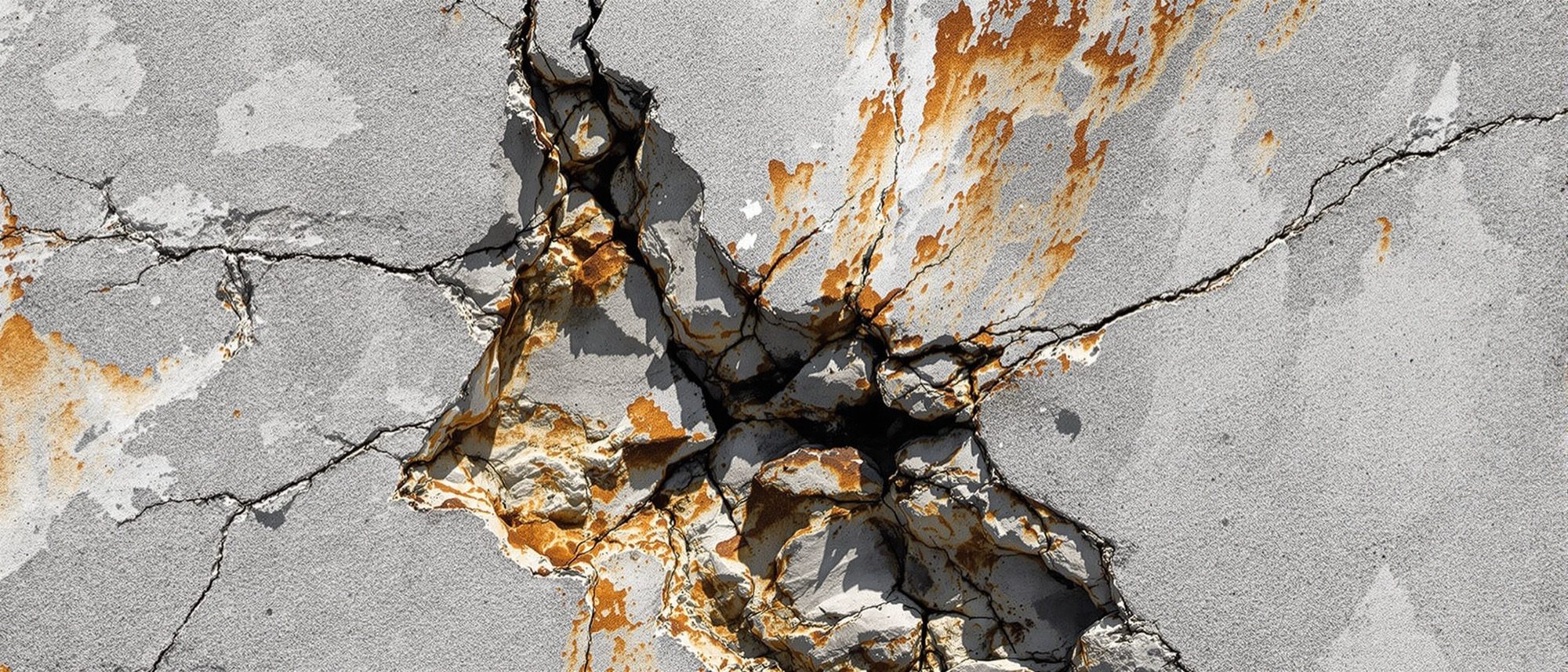
To cure a building you must first know what is killing it. The agents are few but relentless: moisture (the dominant one), cracks, weathering, biological growth and chemical attack. In reinforced concrete the great enemy is corrosion — and the key insight is that rust EXPANDS to several times the steel's volume, splitting the cover and spalling it off. Diagnose symptoms with the explorer below.
Learning objectives
By the end of this lesson, you will be able to — mapped to the course outcomes for Building Maintenance & Repair:
Identify the agents of decay — moisture, cracks, weathering, biological, chemical.
Explain concrete deterioration — carbonation, chloride, corrosion, spalling.
Classify cracks and distinguish active (structural) from dead (cosmetic).
Explain the role of cover and crack width (IS 456).
The agents of decay
Most decay starts with water; in concrete, carbonation depassivates the steel and then expanding rust spalls the cover.[1, 2]
Diagnose the defect · pick a symptom
Likely cause
Rising damp — ground moisture drawn up by capillary action because the damp-proof course is missing, bridged or failed.
Remedy
Insert or chemically inject a new damp-proof course; lower external ground level below the DPC; fix drainage.
Always treat the cause, not just the symptom — and confirm a crack is active before repairing it.
The dominant agent
Most building decay starts with water. RISING DAMP draws ground moisture up by capillary action (typically a tide-mark to ~1 m) where the damp-proof course is missing or bridged. PENETRATING (rain) DAMP enters laterally through defective pointing, render, flashings or cracks. CONDENSATION forms when warm moist air meets a cold surface — a ventilation problem, not a leak. Identify which of the three you have, because each has a different cure. Weathering, biological growth (mould, algae, termites) and chemical attack follow the water.[1]
Reading cracks
Distinguish an active (moving, structural) crack from a dead (cosmetic) one, and remember durability rides on cover and crack width (IS 456).[1, 3]
Active vs dead
Not every crack is structural. A DEAD (dormant) crack is stable — drying-shrinkage crazing in plaster, for instance — and can be rigidly filled. An ACTIVE ('live') crack is still moving — from settlement, overload or thermal cycling — and must be MONITORED to confirm movement and have its CAUSE addressed before repair, using a method that accommodates movement. FLAG THE MYTH: distinguish cosmetic shrinkage cracks from active structural ones — only the latter threaten capacity.[1]
At a glance
| Aspect | One | The other |
|---|---|---|
| Three damps | Rising (capillary) / penetrating (rain) | Condensation (ventilation, not a leak) |
| Carbonation vs chloride | Carbonation: pH drop depassivates | Chloride: pits even at high pH |
| The corrosion myth | Not just steel 'getting thinner' | Rust EXPANDS ~2.5–6× → spalls cover |
| Crack life | Dead: stable, fill rigidly | Active: moving, fix the cause first |
| Durability (IS 456) | Cover 20–75 mm by exposure | Crack width ≤ 0.3 mm (0.2 aggressive) |
Key terms
Ground moisture drawn up a wall by capillary action where the DPC is missing or bridged (~1 m).
Water entering laterally through defective pointing, render, flashings or cracks.
CO₂ lowering concrete pH (~13 → ~8–9), depassivating the steel so corrosion can start.
Chloride ions pitting the reinforcement even at high pH (sea air, salts).
Cover concrete cracking and falling away as expanding rust (~2.5–6× steel volume) splits it.
A moving (live) crack vs a stable (dormant) one — different repairs.
The protective concrete over the steel — 20–75 mm by exposure class.
White soluble-salt crystals left on a surface by evaporating water — a damp symptom.
Studio task
Walk a real building and photograph three defects; for each, use the diagnosis explorer above to name the likely cause and decide whether it is cosmetic or structural — and what you would check next.
Self-assessment
1. Reinforcement corrosion spalls concrete because —
2. Carbonation harms reinforced concrete by —
3. A fine 'map' crazing pattern in plaster is usually —
Recap
References & further reading
- [1]Barry A. Richardson, Defects and Deterioration in Buildings (2nd ed.). Spon/Routledge, 2001.
- [2]Peter H. Emmons, Concrete Repair and Maintenance Illustrated. RSMeans/Wiley, 1993.
- [3]IS 456:2000 — Plain and Reinforced Concrete, Code of Practice (durability, cover, crack width). BIS. https://law.resource.org/pub/in/bis/S03/is.456.2000.pdf
Further reading
- Barry Richardson, Defects and Deterioration in Buildings. Routledge.
- Peter Emmons, Concrete Repair and Maintenance Illustrated. Wiley.
- W. H. Ransom, Building Failures: Diagnosis and Avoidance. E&FN Spon.
Sources gathered and fact-checked June 2026. Published values vary by source, sample and method — treat as indicative and confirm against the cited standard before structural use.
The author
Amogh N P
Architect, interior designer, and creative polymath. Studio Matrx began in his notebooks — his vision of design made honest, useful, and open to everyone. Its Academy is written and taught in his memory, and free, forever.
More about Amogh →