
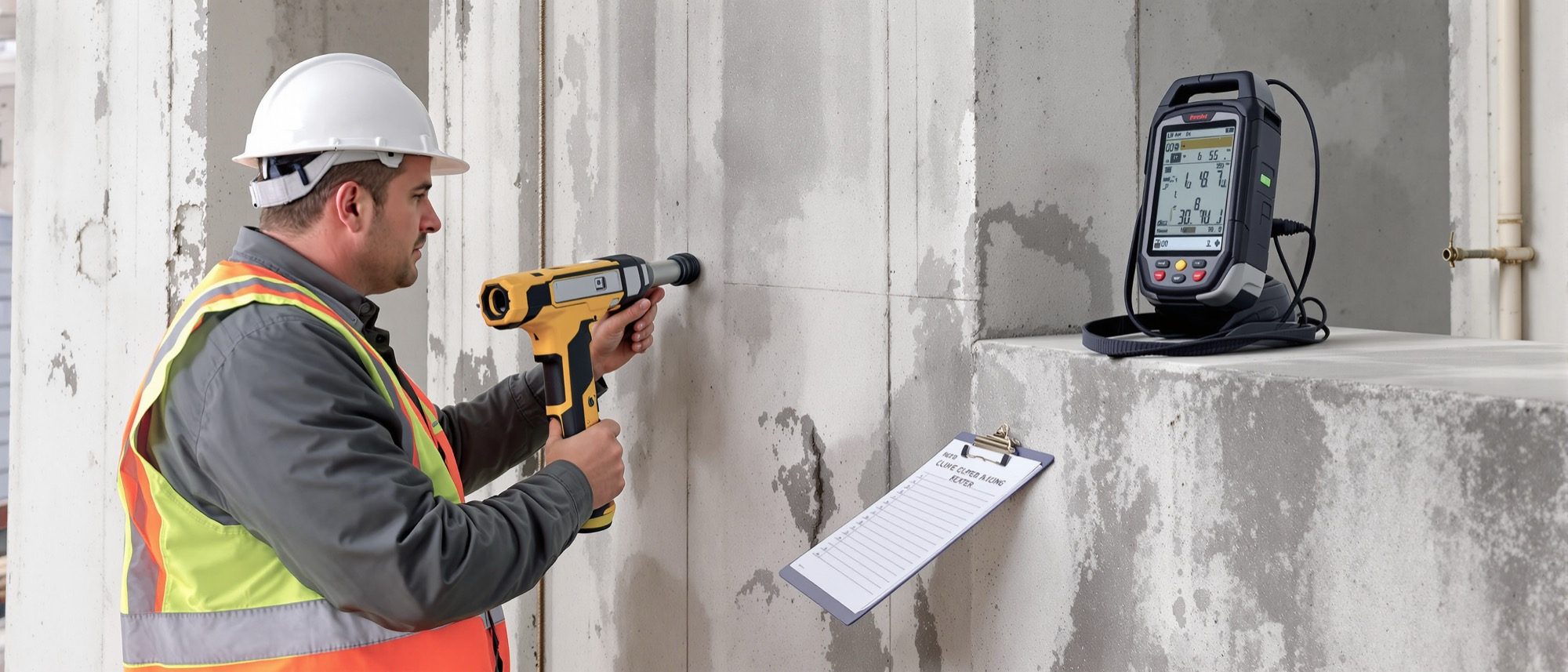
Diagnosis & Testing
Reading a structure without breaking it.
Before you repair, you diagnose. A condition survey starts with the eye, but the real power is the non-destructive test — reading a structure's health without breaking it. Learn to monitor a crack and the NDT toolkit: the rebound hammer, ultrasonic pulse velocity, half-cell potential, cover meter and carbonation test — plus the core that gives the true strength. Try the NDT selector below.
Learning objectives
By the end of this lesson, you will be able to — mapped to the course outcomes for Building Maintenance & Repair:
Carry out an inspection and condition survey.
Monitor cracks with tell-tales and the demec gauge.
Select the right non-destructive test for what you need to assess.
Interpret NDT results — and their limits — against IS codes.
Survey & why NDT
A visual survey comes first, then crack monitoring (tell-tale, demec gauge); NDT reads a structure without breaking it — but mostly gives an estimate, calibrated by cores.[1, 4]
Pick a non-destructive test
Rebound (Schmidt) hammer
Measures: Surface hardness → an ESTIMATE of compressive strength and uniformity
Standard / threshold: IS 13311 Part 2. An index, not the true strength — calibrate with cores.
Most tests give an estimate — calibrate against an extracted core, the one test that gives the true strength.
Start with the eye
Diagnosis begins with a VISUAL condition survey — mapping cracks, damp, spalling and movement — before any instrument. To tell whether a crack is LIVE, monitor it over time: a TELL-TALE (a glass slip or calibrated plastic grid cemented across the crack) gives a go/no-go reading if it moves; a DEMEC GAUGE (a demountable mechanical strain gauge) measures the change in distance between fixed studs to QUANTIFY the movement. Monitoring distinguishes an active structural crack from a dormant one.[1]
The tests
Rebound hammer and UPV read strength and quality (IS 13311); the cover meter, half-cell and carbonation test read the steel and its protection.[4]
Hammer, UPV, core
The REBOUND (Schmidt) HAMMER reads surface hardness to ESTIMATE compressive strength and uniformity (IS 13311 Part 2). ULTRASONIC PULSE VELOCITY (UPV) times a pulse through the concrete to judge its quality and find voids and cracks (IS 13311 Part 1) — above 4.5 km/s is excellent, 3.5–4.5 good, 3.0–3.5 medium, below 3.0 poor. The CORE, drilled out and crushed, gives the TRUE strength and calibrates the indirect tests. Use the selector below to match a test to a question.[4]
At a glance
| Aspect | One | The other |
|---|---|---|
| Eye vs instrument | Condition survey: map it first | NDT: read it without breaking it |
| Crack monitoring | Tell-tale: go/no-go (did it move?) | Demec gauge: how much it moved |
| Strength | Rebound/UPV: an estimate/index | Core: the true strength (calibrates NDT) |
| Steel health | Cover meter: where & how deep | Half-cell: probability of corrosion |
| Carbonation test | Pink = alkaline (un-carbonated) | Colourless = carbonated |
Key terms
The systematic visual assessment that maps a building's defects before instrumented testing.
A glass slip or calibrated grid across a crack that shows if it moves (a go/no-go telltale).
A demountable strain gauge that quantifies crack movement between fixed studs.
Reads surface hardness to estimate compressive strength (IS 13311 Part 2) — an index, not the truth.
Times a pulse to judge concrete quality and find voids (IS 13311 Part 1) — >4.5 km/s excellent.
Maps corrosion probability in mV (ASTM C876) — beyond −350 mV → >90% probability.
An electromagnetic device locating reinforcement and measuring its cover.
Phenolphthalein — pink = alkaline/un-carbonated, colourless = carbonated.
Studio task
For a suspect concrete column, write a testing plan using the selector above — which tests would you run to assess its strength, its cover and whether the steel is corroding, and how would you calibrate the estimates?
Self-assessment
1. Which non-destructive test estimates concrete's compressive strength from its surface hardness?
2. On a half-cell potential survey, a reading more negative than −350 mV indicates —
3. In a carbonation test, concrete that turns pink with phenolphthalein is —
Recap
References & further reading
- [1]Barry A. Richardson, Defects and Deterioration in Buildings. Spon/Routledge, 2001.
- [4]IS 13311 Part 1 (UPV) & Part 2 (Rebound Hammer), 1992; ASTM C876 (half-cell potential). BIS / ASTM. https://law.resource.org/pub/in/bis/S03/is.13311.1.1992.pdf
- [5]IS 456:2000 — durability and acceptance testing. BIS.
Further reading
- IS 13311 (NDT of Concrete), Parts 1 & 2. BIS.
- Peter Emmons, Concrete Repair and Maintenance Illustrated. Wiley.
- Bungey, Millard & Grantham, Testing of Concrete in Structures. Taylor & Francis.
Sources gathered and fact-checked June 2026. Published values vary by source, sample and method — treat as indicative and confirm against the cited standard before structural use.
The author
Amogh N P
Architect, interior designer, and creative polymath. Studio Matrx began in his notebooks — his vision of design made honest, useful, and open to everyone. Its Academy is written and taught in his memory, and free, forever.
More about Amogh →