
What it really costs & how long it really takes
Two honest numbers, before anyone sells you an optimistic one.
Lesson byAmogh N P· Architect & interior designer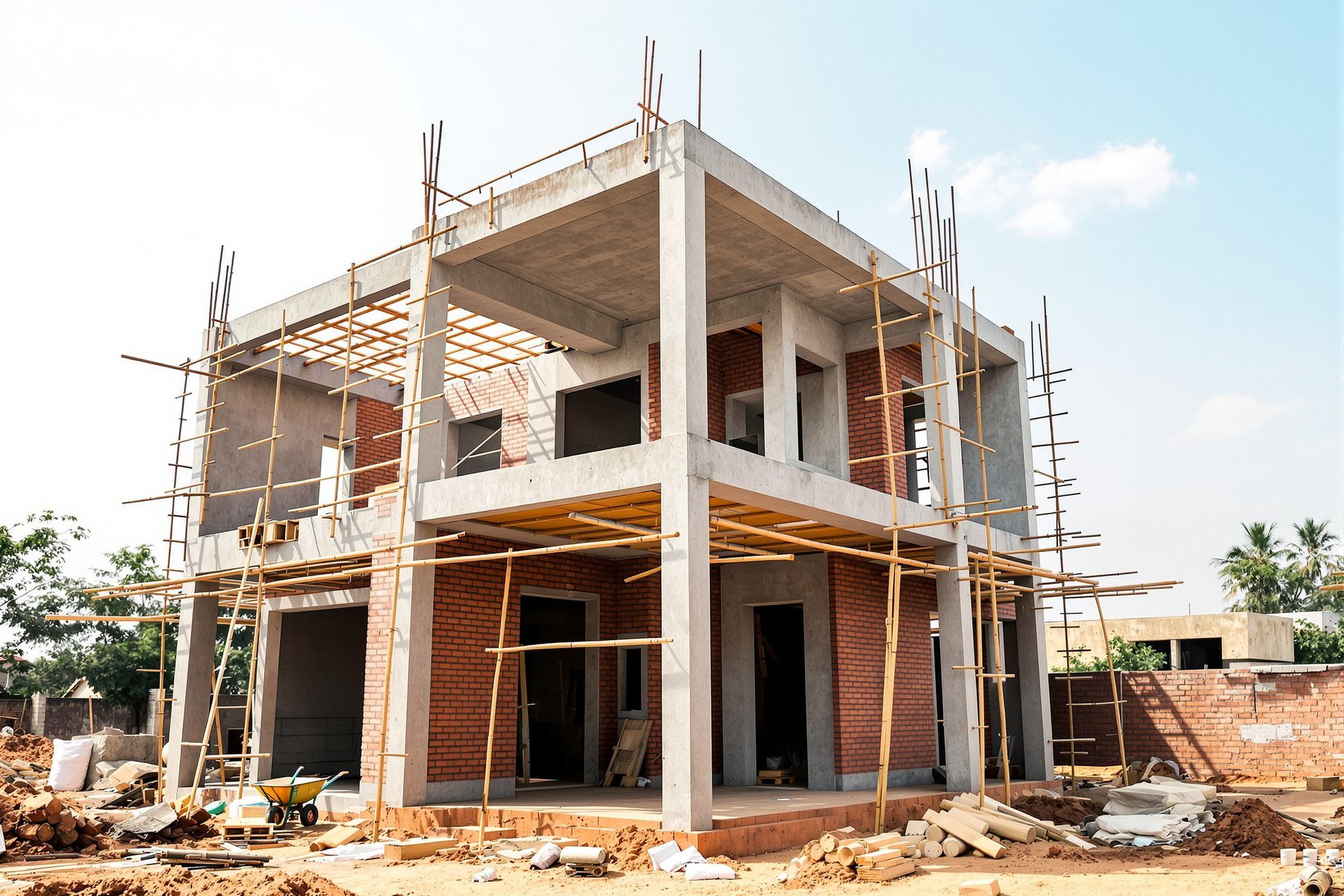
The quote said ₹1,600 a square foot. The house cost ₹2,600.
Nobody lied. The ₹1,600 was the grey structure — walls, slab, plaster, the bare shell. It left out the flooring you'd walk on, the kitchen you'd cook in, the wardrobes, the lights, the boundary wall, the approvals and the architect. That gap — between the number you're quoted and the number you'll pay — is the most common reason Indian builds end in stress. Let's close it.
Two numbers, set honestly: ₹ per square foot, and months
A 'construction cost' is five costs stacked on top of each other
Treat any headline ₹/sq ft rate with suspicion until you know what it covers. A typical 2026 finished house stacks up like this:
- Grey structure (the shell) — roughly ₹1,500–2,000/sq ft. This is usually the rate you're quoted. - Finishes — flooring, paint, false ceiling, waterproofing: another big slice. - Fixtures — modular kitchen, wardrobes, doors, sanitaryware, electrical fittings. - Soft costs everyone forgets — architect (~5–10% or a ₹/sq ft fee), structural engineer, plan sanction, boundary wall, water and power connections. - Contingency — 10–15% you will use.
Budget bottom-up from these layers, not down from one phone quote. A finished, move-in house usually lands at ₹2,200–3,500/sq ft — about 1.5–1.7× the grey-structure rate. A 2,000 sq ft home is commonly ₹45–70 lakh finished, before land.
The quote is the floor of your cost, never the ceiling. Plan from the ceiling.
Construction is the visible half. The invisible half is just as long.
People budget their patience for the brick-and-concrete months and forget the rest. A build has two halves.
Pre-construction — buying and registering land, design and drawings, structural design, plan sanction — quietly eats 3–6 months before a single brick is laid. You can't rush it much; the municipal corporation or panchayat approves at its pace, not yours.
Construction then runs 9–18 months, gated by steps no budget can buy past: the foundation and each RCC slab need about 21–28 days to cure, and the monsoon stops work for weeks. Add it up and the honest answer is 12–24 months, land to housewarming. Set that expectation now and the journey feels managed, not endless.
Budget the **finished** number, not the quoted one, and ring-fence a **10–15% contingency** you promise not to touch. On time, assume the longer end of every estimate. A build that finishes early is a delight; one that's 'late' against a fantasy date is stressful for the exact same actual duration.
Present cost as a banded estimate against a defined spec — never one figure — and state the finish grade and fittings allowance you've assumed. Tie payments to construction stages, and put the contingency line and the approval lead-times into the very first conversation. It protects the client and your reputation.
Cost and programme are design constraints, not a quantity surveyor's afterthought. The most elegant plan is worthless if it can't be built for the client's number in their time. Learn to estimate roughly but early — by area, by stage — so design choices meet money and months while they're still cheap to change.
“The per-square-foot rate the contractor quoted is what my house will cost.”
That's almost always the grey-structure (civil) rate — shell only. Your finished, move-in cost adds flooring, finishes, kitchen, wardrobes, fittings, approvals, connections, fees and contingency, and usually lands at **1.5–1.7×** the quote. Always ask, in writing, exactly what a rate includes and excludes before you trust it.
Pressure-test your own budget and timeline:
- 01Take any per-sq-ft rate you've been quoted and ask the quoter, in writing, exactly what it includes and excludes. Watch the number move.
- 02Use the cost calculator to build your figure bottom-up from area and finish level, then add 10–15% contingency.
- 03Draw your timeline as two halves — pre-construction and construction — and add a monsoon's worth of slack. That's your honest move-in window.
Almost every unhappy build traces back to a budget set from the floor and a timeline set from a fantasy. Flip both. Cost the finished house from its layers, with contingency. Time it as two halves, with slack. You will not regret being pleasantly surprised — and you'll make far calmer decisions all the way through when reality keeps landing inside the window you set.
A finished house costs ~1.5–1.7× the grey-structure rate — about ₹2,200–3,500/sq ft in 2026 — once finishes, fittings, soft costs and contingency are in. The timeline is two halves: pre-construction (3–6 months) and construction (9–18), for an honest 12–24 months land to move-in. Budget the ceiling; time the longer end.
What is the construction cost per square foot in India in 2026?
It varies by city, finish and spec, but the key point: a quoted grey-structure rate (~₹1,500–2,000/sq ft) is only the shell. A finished, move-in house typically runs ₹2,200–3,500/sq ft — about 1.5–1.7× the shell — once flooring, finishes, kitchen, fittings, approvals and contingency are added. Always cost it bottom-up for your own spec.
How long does it take to build an independent house in India?
Plan on 12–24 months from buying land to moving in: 3–6 months for land, design and approvals, then 9–18 months of construction. Curing times for RCC and the monsoon set a floor on how fast it can go, regardless of budget.
How much contingency should I keep when building a house?
Keep at least 10–15% of the construction budget as contingency, ring-fenced and untouched unless genuinely needed. Material price changes, design tweaks during the build and unforeseen site conditions almost always draw on it.
The author
Amogh N P
Architect, interior designer, and creative polymath. Studio Matrx began in his notebooks — his vision of design made honest, useful, and open to everyone. Its Academy is written and taught in his memory, and free, forever.
More about Amogh →You know roughly what and when. The next question is who — because the people you choose will determine whether those two numbers hold.