
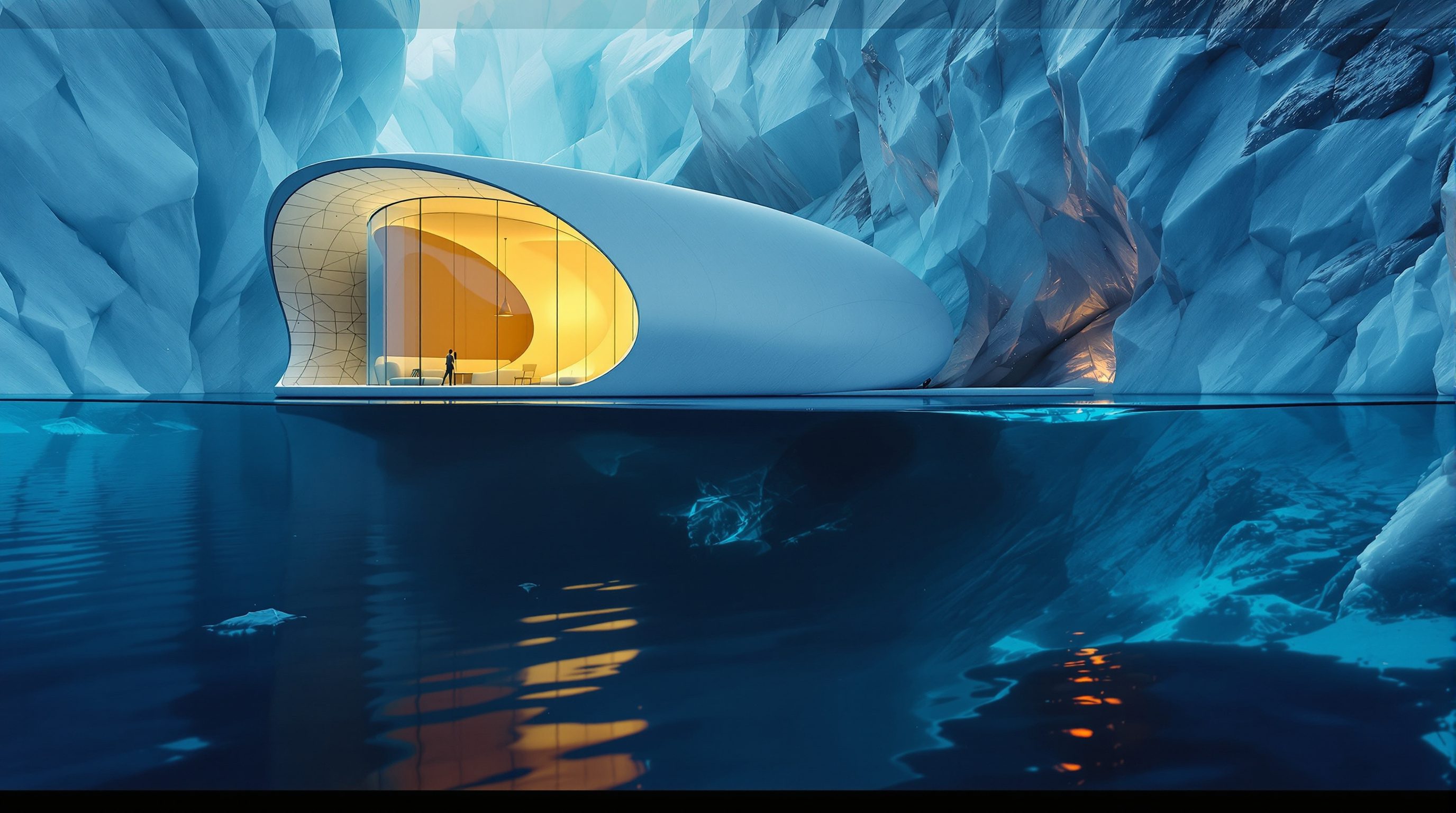
 Lesson 7.2
Lesson 7.2 · Below the Surface
Underwater Habitats
Living beneath the sea is one of the smallest and hardest-won corners of architecture - a tiny lineage of research and diving bases where a handful of people have truly stayed under water - and it is also one of the most relentlessly over-hyped, so the whole skill is telling the genuine scientific niche from the glossy render of the underwater hotel that will never open
For all the renders of glittering underwater cities, the honest count of places where humans actually live beneath the sea has only ever been a handful - and knowing why is the whole lesson.
Search for underwater architecture and you will drown in imagery: spiralling glass hotels on the reef, domed cities glowing on the seabed, restaurants and suites promising a night among the fish. It is one of the most seductive genres of render in all of architecture. Now ask a harder question - not what has been drawn, but where humans have genuinely lived under water, for days at a time, breathing engineered air on the seafloor - and the picture collapses to something tiny: a short lineage of research and diving bases stretching back to the 1960s, most long gone, with only a very small number ever operating and, at the serious end, a single station running more or less continuously into recent years.
That gap between the flood of images and the handful of real habitats is not an accident, and it is the point of this lesson. Underwater habitats are genuinely real, genuinely useful in a narrow scientific and operational niche, and genuinely fascinating as the moment architecture crosses fully off the land. They are also relentlessly over-hyped, wrapped in a fantasy of leisure living beneath the waves that the physics, the cost and the human body have never supported. The skill this lesson builds is to hold both at once: real respect for the small, hard-won thing that exists, and clear-eyed literacy about the glossy thing that mostly does not.
Renders of ocean cities = everywhere. People actually living under the sea = a handful (Conshelf/SEALAB 1960s -> narrowed -> Aquarius, last one standing). Real habitat = pressure hull + moonpool (live at sea pressure, dive out) + umbilical to surface (air/power/comms) = tip of a SYSTEM, not self-sufficient. Sort every project: built or render? how deep (almost all shallow)? who pays (science/defence, not tourism)? Astronauts train in one - deep sea = space logic. Defer pressure/life-support to engineers.
The small, real history of living under the sea
The genuine story of underwater habitats is short, heroic and mostly scientific. It begins in earnest in the 1960s, an age intoxicated with frontiers, when pioneers of diving and ocean exploration built the first stations meant to let people actually live on the seafloor rather than merely visit. Programmes with names now half-remembered - the Conshelf experiments led by Jacques Cousteau's team, the United States Navy's SEALAB series, and a scatter of others across several nations - put small crews under water for days and weeks, proving that humans could sleep, eat, work and stay sane in a pressurised box on the seabed. They were experiments in the fullest sense: some succeeded, some ended in tragedy, and all of them were about learning whether and how it could be done.
Through the following decades the field narrowed rather than grew. The romance of the 1960s did not turn into a wave of undersea towns; instead a smaller, sturdier practice of research and training habitats persisted, used by marine scientists to study reefs and by divers and space agencies to train for long, confined, high-consequence missions. The best-known survivor, Aquarius, sits on a reef off Florida and has served for years as a working ocean laboratory and analogue for the isolation and teamwork of a space mission - a genuine, continuously useful undersea base, and for a long time essentially the last of its kind still running. Today the honest global count of true, occupied underwater habitats is a handful, no more.
That trajectory - a burst of pioneering ambition, then a long contraction to a tiny, specialised core - is itself the lesson. It tells you the field found its real value and its real limits at the same time. The value is specific: a place from which divers can work long hours on the seabed without the punishing surface-and-back cycle, and a uniquely faithful setting in which to study the sea up close or rehearse the psychology of confinement. The limits are equally specific and, as the next sections show, rooted in unforgiving physics, cost and human biology. Naming the true lineage - small, scientific, hard-won - is the first defence against the fantasy, because it sets a factual floor under a subject that otherwise floats away on renders. And every one of these habitats rests on demanding pressure, marine and life-support engineering that belongs to qualified specialists and tested systems, never to a designer's confidence.
How an undersea base actually holds together
Strip away the glamour and a working underwater habitat is a surprisingly comprehensible machine, built around a few hard ideas. At its core is a pressure-resistant hull - typically a steel cylinder or set of chambers strong enough to hold a breathable interior against the water pressing in from outside. The habitat sits on legs or a base frame on the seabed, usually in relatively shallow water, because as later lessons show, depth is the enemy that multiplies every difficulty. Inside is a compact interior of bunks, a galley, science and communications stations, and storage - a small, sealed volume where a crew of a few can live for days or weeks.
The cleverest feature is often the way people get in and out. Many habitats are kept at the same air pressure as the surrounding water at that depth, which lets them use a moonpool - an open hatch in the floor through which divers simply climb down into the sea and back, without the water flooding up, because the interior air pressure holds it back like an upturned glass pushed into a basin. This is what makes a habitat so valuable to working divers: they live at depth pressure and can dive out repeatedly for long shifts, rather than paying the time and risk cost of descending from and returning to the surface each time. It also means the crew are saturated - their bodies fully adjusted to the pressure - which is efficient for work but binds them to a long, carefully-managed decompression before they can safely return to the surface, a serious constraint we take up in the next lesson.
Everything else is life support and supply. Because a sealed undersea box cannot make its own essentials, most habitats depend on an umbilical - a bundle of lines to a surface buoy or ship carrying air, power and communications down, and often data and monitoring back up. Air must be supplied and its carbon dioxide scrubbed; humidity and temperature must be controlled in a space the surrounding water is constantly chilling; power must be reliable and backed up; fresh water and food must be brought in. The habitat is therefore less an independent building than the visible tip of a system that reaches to the surface - a distinction that matters enormously when someone shows you a render of a self-sufficient undersea city. All of this sizing and certification is pressure, marine and life-support engineering, deferred entirely to qualified specialists, tested systems and the governing marine standards.
The underwater hotel and the city that never comes
Against that small, sober reality stands an enormous and glamorous fantasy: the underwater hotel, the seabed resort, the domed ocean city. It is one of the most persistent genres of never-built architecture, recycled every few years as a fresh headline, and reading it honestly is a core skill. The first thing to notice is the trick of depth. Almost everything actually built and marketed as underwater luxury sits in very shallow water - a submerged restaurant or a single hotel room a few metres down, essentially a large aquarium window pressed against a shallow reef, tethered to a completely ordinary building on the shore above. These are real, and can be delightful, but they are shallow novelty, not the deep undersea living the render implies. The moment a project claims real depth or true self-sufficiency, the physics and the cost explode, and the project reliably stays a render.
The second thing to notice is the gulf between a suite and a city. Even the genuine, serious habitats hold a handful of people for days, tethered by an umbilical to the surface, at a cost per bed that only science, defence or training can justify. A city implies thousands of people, permanence, self-sufficiency, and a benign economics that has never existed under water - where every wall fights immense pressure, every breath is engineered, every failure is potentially fatal, and there is no cheap way to build, expand, escape or evacuate. Nothing about the deep sea rewards the density and openness a city needs; it punishes them. So the honest sorting is a short decision tree: is the project built and occupied now, or a render? If built, at what depth - shallow novelty or genuine depth? And who pays, and how - tourist money on a shallow gimmick, or the science-and-defence budget that sustains the real niche?
This is exactly the field's defining discipline - excited literacy without credulity - applied to its most tempting subject. You are allowed to love the idea; you are not allowed to believe the render on sight. Ask where the people are, how deep, and who pays, and the glittering ocean city resolves into what it almost always is: a beautiful picture that the sea will never let anyone live in. Meanwhile the real, unglamorous handful of research bases keep doing genuine work, and deserve the respect the fantasy steals from them.
Where an underwater habitat genuinely earns its keep
None of this honesty means underwater habitats are pointless - only that their value is narrow, specific and worth stating precisely, so that enthusiasm lands where it belongs. The clearest genuine use is marine science. A reef laboratory like Aquarius lets researchers live beside their subject and work long, productive hours on the seabed that surface-based diving could never allow, gathering data on reefs, marine life and ocean processes with an intimacy no day-boat can match. For the study of the shallow sea, a habitat is not a gimmick but a superb, if expensive, instrument.
The second genuine use is operational and training. Saturation-diving techniques and habitats support serious underwater work - inspection and maintenance of offshore infrastructure, salvage, and defence - where living at depth is more efficient and, managed correctly, safer than endless surface cycling. And in a use that reaches straight across to the end of this course, undersea habitats serve as analogues for space: agencies send astronauts to live in Aquarius precisely because a small crew, sealed in a hostile environment, dependent on engineered life support, unable to simply step outside, and pressed together for a long confined mission, rehearses the exact human and organisational challenges of a space station or a Moon base. The deep sea and space, as the next lesson makes explicit, share one logic, and the habitat is where that logic is cheapest to practise on Earth.
What unites the genuine niche is that in every case a serious, well-funded institution needs to put people to work in the shallow sea for extended periods, and no cheaper arrangement will do. That is a real need, and the habitat meets it honourably - which is exactly why it should not be confused with leisure or settlement. For the architect and interior designer the lesson is doubly useful: it is a vivid case of designing a tiny, sealed, life-supporting interior for a crew under real psychological strain - the same craft the polar station and the space capsule demand - and it is a masterclass in reading hype, because no field offers more of it. Respect the small real thing; refuse the large fake one; and remember that every binding pressure, marine and life-support decision in a real habitat belongs to qualified engineers, tested systems and the codes, never to the person who draws the plan.
A habitat is the tip of a system, not a self-sufficient building
Reading how an undersea base works
A real underwater habitat depends on an umbilical to the surface for air, power and communications, and on continuous life support. Treat any claim of a self-sufficient undersea building or city as a signal to check hard. Pressure, marine and life-support engineering belongs to qualified specialists, tested systems and the governing marine standards. Module 7.3.
Depth multiplies everything - most genuine habitats are shallow
Judging an underwater claim
Almost everything genuinely built sits in shallow water, because pressure, cost and danger climb steeply with depth. A project claiming real depth or self-sufficiency reliably stays a render. Depth and pressure figures are engineers' calculations, not designers' assertions. Modules 7.3, 7.4.
Sort every project: built or render, how deep, who pays
Excited literacy without credulity
Apply three questions to any underwater project - is it built and occupied now, at what depth, and who pays and how - to separate shallow tourist novelty, the genuine science-and-defence niche, and the never-built city. Modules 0.4, 4.4, 7.2.
Workshop - sort the ocean floor from the render
This workshop drills the field's most useful reflex on its most tempting subject. You will take a set of underwater projects - real and imagined - and sort them honestly, then design the one small thing that actually matters: a liveable interior for a genuine habitat.
Found examples of underwater projects, sketch paper and a notebook. No engineering - the sorting is literacy and the interior is design; every binding pressure, marine and life-support result stays with qualified specialists, tested systems and the codes.
Goal: separate the genuine underwater niche from shallow novelty and pure render, then design a real interior
Inputs: three or four underwater projects you can find (a research base, a shallow hotel room, a rendered 'ocean city') + a notebook
Time: about 60 minutes
- 1Gather three or four underwater projects - ideally one genuine research/diving habitat, one shallow tourist room or restaurant, and one rendered 'underwater city' or deep resort.
- 2Run each through the three questions: is it built and occupied now or a render; at what depth; and who pays and how. Write a one-line verdict for each - genuine niche, shallow novelty, or render.
- 3For the genuine habitat, sketch its system, not just its shell: the pressure hull, the moonpool, and the umbilical to the surface carrying air, power and communications. Label what would kill the crew if it failed - and mark it as engineering to defer.
- 4Now design the interior of that habitat for a crew of four on a two-week mission: bunks, galley, a work and comms station, storage, a viewport. Show how you protect order, privacy-with-togetherness, a day-night rhythm and a connection to outside in a few square metres.
- 5Write an honest paragraph: what this genuine habitat is truly for (science, defence, training, space analogue), why it is not a hotel or a city, and where the line falls between what you designed (the human interior) and what the engineers own (the pressure and life-support system).
You’ll walk away with
A one-page sorting-and-design sheet: three or four underwater projects each sorted as genuine niche / shallow novelty / render with a one-line reason, a system sketch of one genuine habitat, an interior layout for a four-person two-week mission, and an honest note on its true purpose and on the engineering boundary.
Three altitudes on the same idea
Read the band that fits you — or all three.
A real underwater habitat is not a building but the visible tip of a system that reaches to the surface: a pressure-resistant hull on the seabed, a compact sealed interior, a moonpool for divers who live at depth pressure, and an umbilical carrying air, power and communications down from a surface buoy. Design it as such - understand that the hull, the pressure regime and the life-support and umbilical systems are the project, and the architecture is the organisation of a tiny, high-consequence interior around them. Keep depth respect central: almost everything genuine sits shallow, because depth multiplies every load, cost and danger, so treat any deep or self-sufficient claim as a signal to check hard. Above all, practise the field's defining literacy on its most seductive subject: sort every underwater project with three questions - is it built and occupied or a render, at what depth, and who pays and how - so the shallow tourist novelty, the genuine science-and-defence niche and the never-built city fall into their honest places. And defer every binding pressure, structural, marine and life-support determination to qualified engineers, tested systems and the governing marine standards; the architect owns the spatial and human logic, never the survival engineering.
An underwater habitat is one of the purest exercises your discipline can face: a few square metres of sealed, chilled, pressurised interior in which a small crew must live, work, sleep and stay sane for days or weeks, unable to open a window or step outside - so the interior is not decoration, it is psychological life support. Everything the program has taught about designing for the human being concentrates here. Order and legibility matter because clutter and confusion are dangerous in a confined, high-stress volume. Variety, a sense of change, and any connection to the outside - a viewport onto the reef, a clear day-night lighting rhythm - matter because monotony and confinement erode mood and judgement over a long mission. Privacy alongside togetherness matters because a handful of people pressed together with no escape need both refuge and contact. Dignity in the smallest things - a decent bunk, a place to eat like a person, a scrap of the personal - keeps a crew human rather than merely stowed. It is the same craft the polar station and the space capsule demand, at its most compressed. Stay humble at the boundary: the air, pressure, humidity and life-support systems that keep the interior survivable are the engineers' and the codes' domain; you design the human habitability inside the envelope they guarantee.
Underwater habitats are the perfect training ground for the field's defining discipline - excited literacy without credulity - because no subject in architecture is more over-hyped: a flood of renders of glittering seabed cities sits on top of a genuine reality that is tiny, scientific and hard-won. Learn the real lineage first so you have a factual floor: a burst of pioneering research and diving bases from the 1960s (Conshelf, SEALAB and others), narrowing over the decades to a small, sturdy core of research habitats, of which Aquarius is the best-known, with only a handful ever truly occupied. Understand how one actually works - a pressure hull on the seabed, a moonpool letting divers live at depth pressure and dive out repeatedly, and an umbilical bringing air, power and communications from the surface, so it is the tip of a system, not a self-sufficient building. Then sort the hype with three questions: is it built and occupied or a render, at what depth (almost all genuine ones are shallow), and who pays and how (science and defence, not tourism, sustain the real niche). See that the deep sea and space share one logic, which is why astronauts train in Aquarius. And remember the boundary: the pressure, marine and life-support engineering belongs to qualified specialists and the codes.
“Underwater hotels and cities are basically here - a few are already open, more are being built, and it is only a matter of time before living on the seabed becomes a normal option for tourism and even housing.”
Do it yourself
No tools needed - reason it through.
- 1Sketch the real, small history of underwater habitats from the 1960s to today, and say roughly how many genuine occupied habitats exist now.
- 2Explain how a moonpool works and why living at the same pressure as the surrounding water is so valuable to working divers.
- 3Why is a genuine underwater habitat better described as the tip of a system than as a self-sufficient building?
- 4Give the three questions you would ask to sort any underwater project, and apply them to a rendered 'ocean city'.
- 5Name two genuine uses where an underwater habitat honestly earns its keep, and explain why astronauts train in one.
The one line to carry out
Peer-reviewed journals & authoritative standards
- 01Underwater habitat — Wikipedia - Underwater habitat, 2026.
- 02Aquarius reef base laboratory — Wikipedia - Aquarius (laboratory), 2026.
- 03Diving chamber — Wikipedia - Diving chamber, 2026.
- 04Submarine — Wikipedia - Submarine, 2026.
A habitat holds people under the sea only by fighting two absolutes we have so far only named: the pressure that multiplies with every metre of depth, and the total loss of light and breathable air. The next lesson faces that hard physics - the point where the envelope becomes life support, exactly as in space.
The author
Amogh N P
Architect, interior designer, and creative polymath. Studio Matrx began in his notebooks — his vision of design made honest, useful, and open to everyone. Its Academy is written and taught in his memory, and free, forever.
More about Amogh →