
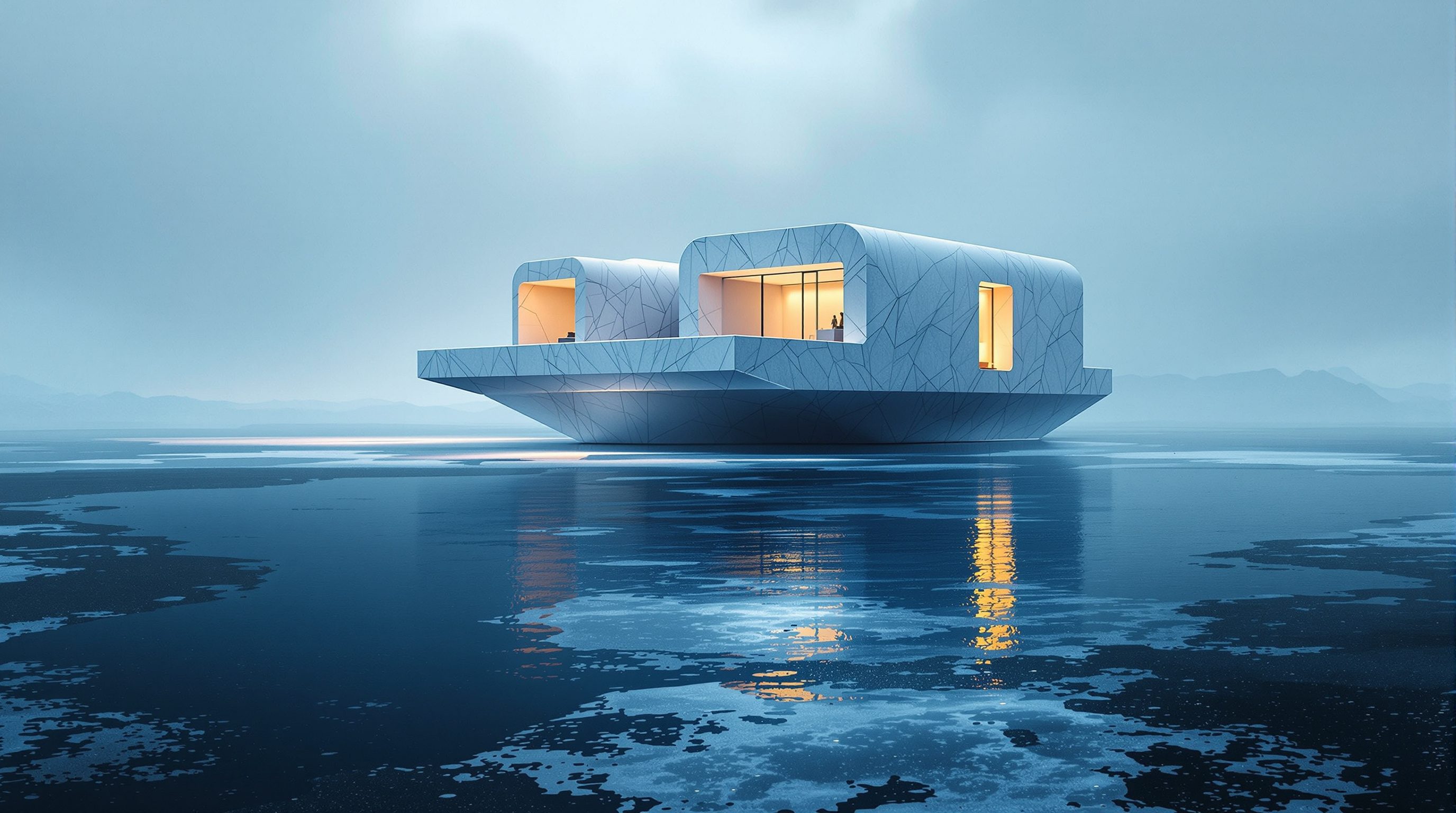
 Lesson 2.2
Lesson 2.2 · Floating Architecture
Floating Homes & Neighbourhoods
The real, built, humane scale of floating architecture today is not the ocean city but the ordinary home - houses and whole neighbourhoods that rise and fall with the water, from the floating streets of the Netherlands to the backwater and lake houseboats India has lived in for centuries
The honest future of floating architecture is not an ocean city - it is an ordinary home, with a kitchen and a garden on the deck, that simply rises when the river does.
The internet's picture of floating architecture is a glittering city on the open sea. The reality, built and lived in today, is far quieter and far more useful: a low, ordinary house on a concrete platform, moored along a canal, plumbed into the shore, with children's bicycles on the deck. When the water rises, the house rises with it, and nobody's living room floods.
This is the humane, near-term heart of the whole field. In the Netherlands, whole neighbourhoods of these homes now sit along floating jetties as a mainstream part of the country's answer to water. And India, far from being a newcomer, has lived on water for centuries - the kettuvallam gliding through the Kerala backwaters, the carved cedar houseboats of Dal Lake. This lesson looks at the real, built scale of floating architecture: what a floating home is, how it differs from a boat, why the Dutch floating neighbourhood works, and what India's own traditions have to teach - honest about the promise, and about the limits.
Floating homes + neighbourhoods = the REAL, near-term field. A building that floats (moored, level, serviced) - NOT a boat. Netherlands = whole neighbourhoods on jetties, rise + fall together. India already lives on water: Kerala kettuvallam + Dal Lake houseboats. Promise: rises with the flood. Limits: sheltered water only, more costly, one tool among several. Engineering stays with the experts.
The floating home: a house that happens to float
Forget the floating cities for a moment. The real, built, near-term scale of floating architecture today is domestic and modest: the floating home. These are ordinary houses - kitchens, bedrooms, gardens on the deck, a car parked on the shore - that happen to sit on a buoyant platform rather than on solid ground. They exist now, in the hundreds and thousands, in places long used to living close to water: the Netherlands, the canals of Amsterdam, the lakes and rivers of North America, and, in their own venerable forms, the backwaters of Kerala and the lakes of Kashmir. This is the part of the field that is not a render. It is people going to work, raising children and growing tomatoes, on water.
It matters to separate the floating home from its cousin, the houseboat, though the words blur in ordinary use. A houseboat is essentially a boat you live on - often self-propelled or at least boat-derived, tied up at a mooring but capable of movement. A floating home is closer to a building: it usually cannot move under its own power, is not shaped to travel, and is designed to be a permanent, still, level dwelling, plumbed and wired into the shore like any other house. The distinction is not pedantry; it changes how the thing is designed, regulated, financed and lived in. A floating home is treated, more and more, as real estate rather than a vessel - a house with an unusual foundation.
What makes floating homes genuinely valuable is not novelty but response to water. On a flood-prone waterfront, a home fixed to the ground is a hostage to the water level; a floating home simply rises with it. That is a humane and near-term promise: not to defeat the water, but to live with it, so that a flood becomes an inconvenience rather than a catastrophe, and a family does not lose everything each time the river comes up. For India - with its long coastline, its swelling delta populations, and cities that flood almost annually - this is not a lifestyle curiosity but a serious, if still emerging, response to a present emergency. The floating home is where the grand rhetoric of the field cashes out into something buildable, ordinary and kind: a dry, level, dignified home that rides the water instead of drowning under it, resting on the same buoyancy physics as any ship and, as always, on engineering that belongs to qualified specialists and the codes.
Floating neighbourhoods and the Dutch model
Scale a floating home up to a street, and you have a floating neighbourhood - and here the clear world leader is the Netherlands, a country that has spent centuries negotiating with water and now treats floating housing as a mainstream part of its flood-resilience toolkit rather than an experiment. In developments around Amsterdam and other Dutch cities, dozens of homes sit on individual concrete platforms, arranged along floating jetties that carry the footpaths, the water pipes, the power and the drainage. The whole assembly - homes, jetties, services - rises and falls together with the water level, so a change in the river or the tide moves the neighbourhood up and down as one, and nobody's living room floods.
The design lessons of these places are instructive, and transferable. First, floating works best as a community system, not a one-off object: the jetties, moorings and shared services are as much a part of the architecture as the houses, and getting them right is what turns a set of floating boxes into a walkable, connected place. Second, the platforms are usually prefabricated - built in a yard, floated to site and moored - which suits the constraints of building on water and gives a repeatable, affordable module. Third, the good examples are unglamorous and legible: low, wide, sensible homes that read as a normal neighbourhood which happens to be on water, not a spectacle. This is the opposite of the floating-city render, and far more real.
The honest promise of the floating neighbourhood is a genuine near-term one: on lakes, in old harbours, on canals, on reservoirs and along sheltered, flood-prone urban waterfronts, it is possible to make real homes for real people that are safe from a rising water level because they rise with it. It is not a universal answer - it needs sheltered water, careful mooring and services, and sound engineering, and it will never rehouse a whole coastal city on the open sea. But as one tool among several for living with water, the Dutch floating neighbourhood is proof that the idea works at the scale of a community, humanely and durably. The task for a designer elsewhere - very much including India, with its flood-exposed cities and its lakes and backwaters - is to learn from that proof honestly: to borrow the community-system thinking and the modest, buildable ambition, while leaving the moorings, the platforms and the services to the engineers who make them safe.
India already lives on water: Kerala and Dal Lake
India does not need to import the idea of living on water; it has been doing so, beautifully, for centuries, and any honest account of floating architecture in India should begin there. Two traditions stand out. On the backwaters of Kerala, the *kettuvallam* - originally a cargo barge, now most visible as the tourist houseboat gliding through the lagoons and canals of Alappuzha and Kumarakom - is a genuine piece of water-borne dwelling: a long, low, timber-and-thatch craft, historically built without nails by tying together planks and palm, carrying living quarters over the water. On Dal Lake and Nagin Lake in Srinagar, the Kashmiri houseboat is something else again: a large, richly carved cedar-wood house on a static hull, moored to the lakeshore, with drawing rooms, bedrooms and verandahs, developed over generations into a distinctive and elaborate architecture of living on water.
These are not quaint survivals to be admired from a distance; they are a living design intelligence about water that the modern field can learn from. They show that living on water can be dignified, culturally rich and deeply place-specific rather than a technological stunt; that timber, thatch and craft can make a water-dwelling of real beauty; and that a houseboat and a floating home occupy a genuine spectrum - the *kettuvallam* nearer the boat end, the Dal Lake houseboat nearer the moored-dwelling end, the modern platform home a further step toward being simply a building on water. They also carry hard-won knowledge about the unglamorous realities - mooring, waste, damp, maintenance, the daily discipline of living where the floor meets the water - that the next lesson takes up in earnest.
The honest position is one of respect without romanticism. These traditions are precious and worth reviving and protecting - the Dal Lake houseboats in particular face real pressures of pollution, regulation and decline - and they prove that India has both the appetite and the wisdom for living on water. But they are not, by themselves, an answer to the flood emergency facing Mumbai, Chennai, Kolkata and the great deltas; that will take modern floating and amphibious architecture, engineered to modern standards, layered onto this cultural foundation. The opportunity for an Indian designer is unusually rich: to marry a magnificent inherited literacy about water with contemporary floating-platform technique - and, as ever, to leave the buoyancy, structure, mooring and safety to qualified engineers, tested systems and the codes.
The promise and the limits, held together
It is worth being clear-eyed about both the promise and the limits of the floating home, because this is exactly the kind of idea that gets over-sold. The promise is real and humane, and it is near-term: on the right water, a floating home lets people live safely where a fixed house could not, rising with a flood instead of drowning under it, and doing so as an ordinary, dignified dwelling rather than a survival pod. It turns the water from an enemy to be walled out into a neighbour to be lived beside - which, for millions of people on flood plains and vulnerable coasts, is a profoundly better relationship than the one they have now.
The limits are equally real, and a good designer names them without being asked. Floating homes need sheltered water - lakes, canals, harbours, reservoirs, calm flood-prone waterfronts - not the open, storm-driven sea, which is a different and far harder problem (the subject of a later module, and mostly still a render). They need careful and continuing attention to mooring, flexible services and maintenance, the unglamorous engineering the next lesson is devoted to. They cost more than a comparable house on stable dry land, and they are not a mass solution that can simply rehouse an entire coastal megacity. And they are not a substitute for the whole toolkit of living with water - amphibious buildings, raised and stilted houses, wet- and dry-proofing, and, where nothing else will serve, managed retreat - but one tool among several, appropriate in some places and not others.
Held honestly, that makes the floating home one of the most encouraging things in this entire course: a piece of extreme-environment architecture that is not speculative, not a render, and not a stunt, but a buildable, humane response to one of the defining problems of our time - built and lived in today, extending a tradition India knows intimately. The designer's task is to deploy it where it genuinely fits, with real enthusiasm and without credulity, and always in partnership with the engineers. Get water where it belongs in the design imagination - as a condition to live with rather than only to fight - and the floating home stops being a curiosity and becomes what it should be: a normal, sensible way to make a home in a wetter world, for those places and communities it truly suits.
A building that floats, not a boat
What a floating home is
A floating home is a permanent, level dwelling on a buoyant platform, moored and plumbed into the shore, increasingly treated as real estate - not a self-propelled vessel. A houseboat is closer to a boat you live on. The distinction changes design, regulation and finance.
Floating works as a community system
The Netherlands model
The leading floating neighbourhoods (the Netherlands) work because the floating jetties, moorings and shared services are designed as much as the homes, and the platforms are prefabricated and modular. Floating best serves a connected community, not a one-off object.
Sheltered water only; one tool among several
Where floating homes fit
Floating homes suit lakes, canals, harbours, reservoirs and calm flood-prone waterfronts - not the open, storm-driven sea. They cost more than a house on dry land and sit alongside amphibious, raised and resilient building, not in place of them.
Learn from India's traditions; engineer to modern standards
The Indian opportunity
The Kerala kettuvallam and Dal Lake houseboats are a precious living tradition of dwelling on water to learn from and revive - but the flood emergency needs modern floating technique layered onto that wisdom, with buoyancy, structure, mooring and safety left to qualified engineers, tested systems and the codes.
Workshop - design a small floating home for a real Indian waterfront
You will make an outline design for a modest floating home on a specific sheltered Indian water body - a backwater, a lake, a reservoir, a calm flood-prone urban waterfront - reasoning about the home, its place in a small community, and its honest limits, without engineering any of it.
Sketch paper, a notebook, and a real water body you know. No engineering - the workshop is about design judgement and honesty about where floating fits, with every binding buoyancy, structural, mooring and safety matter left to qualified engineers, tested systems and the codes.
Goal: an honest outline design for a real floating home in an Indian context
Inputs: a chosen sheltered water body you know + notebook + sketch paper
Time: ~60 minutes
- 1Choose a specific, sheltered Indian water body and describe it honestly: how calm is it, how does its level change through the year, and why is floating (rather than a fixed house) a sensible response there?
- 2Sketch a single-storey floating home in plan and section: the platform, the living deck above it, the relationship of floor to water, and how you arrive from the shore.
- 3Design it as a building that floats, not a boat: mark how it is moored, how water, power and drainage reach it from shore, and how it stays a calm, permanent, level home.
- 4Sketch how three or four such homes could form a small community along a floating jetty, Dutch-style, with shared services - showing that floating works best as a system.
- 5Write an honest half-page: what this floating home genuinely offers over a fixed house here, what its limits and costs are, what it borrows from India's houseboat traditions, and which decisions (platform, mooring, services, safety) must go to qualified engineers and the codes.
You’ll walk away with
A short illustrated proposal: a sketched floating home in plan and section for a named Indian water body, a small community arrangement along a jetty, and an honest one-page note on its promise, its limits, its debt to Indian tradition, and the boundary with the engineering.
Three altitudes on the same idea
Read the band that fits you — or all three.
The built, near-term scale of floating architecture is the home and the neighbourhood, not the ocean city - and its value is a plain one: a house that rises and falls with the water instead of being flooded by it. Design it as a building that happens to float, not as a boat: low, wide, permanent, moored, plumbed and wired into the shore. Learn the Dutch lesson that floating works best as a community system - the floating jetties, moorings and shared services are as much the architecture as the houses, and prefabricated concrete platforms give a repeatable, affordable module. Be precise about where it fits: sheltered water (lakes, canals, harbours, reservoirs, calm flood-prone waterfronts), not the open sea; one tool among several (with amphibious, raised and resilient building) rather than a universal answer; more costly than a house on dry land. For India, layer modern floating technique onto a deep inherited literacy about water, and always leave the platform, mooring, services and safety to qualified marine and structural engineers, tested systems and the codes.
A floating home should feel like a calm, dignified, permanent dwelling - not a boat cabin and not a survival pod - so the interior's job is to make living on water feel ordinary, steady and lovely, while respecting that everything you place is weight on a balanced platform. The gifts are real: the water is right there, the floor sits close to the surface, and light bounces up off it, so you can open the living space generously to the view and let the shifting water become part of the room. The discipline is real too: keep heavy elements low and evenly distributed, treat tanks, stone and masonry as load rather than finish, and design for damp, condensation and the particular wear of a place that lives half on water. Study the Kerala and Kashmir houseboats for how richly and humanely people have furnished life on water for generations. But every question of weight, balance, buoyancy and safety is the engineers' and the codes' - your domain is the liveable, human, steady interior within the margins they guarantee.
This is the lesson that shows floating architecture is real, not a render: ordinary homes and whole neighbourhoods, built and lived in today, that rise and fall with the water - from the floating streets of the Netherlands to the houseboats India has lived in for centuries. Learn the key distinction: a floating home is a building that happens to float (permanent, level, moored, plumbed into the shore, treated as real estate), while a houseboat is closer to a boat you live on - and traditional Indian craft like the Kerala kettuvallam and the Dal Lake houseboat sit along that spectrum. Learn why the Dutch model works: floating as a community system of platforms, jetties and shared services, prefabricated and modest, not a spectacle. And practise the field's honesty: the promise is humane and near-term (a home safe from a rising flood because it rises too), but the limits are real (sheltered water only, careful mooring and maintenance, higher cost, one tool among several) - and the buoyancy, structure, mooring and safety always belong to qualified engineers and the codes.
“Floating homes are a novelty for the rich - eco-lifestyle toys on Dutch canals and holiday houseboats in Kerala - not a serious response to flooding, and certainly not relevant to ordinary people in a country like India.”
Do it yourself
No tools needed - reason it through.
- 1Explain the difference between a floating home and a houseboat, and why it matters for design, regulation and finance.
- 2Why does floating architecture work best as a community system, and what parts of a floating neighbourhood are as important as the houses themselves?
- 3Why is the Netherlands the leading example of floating neighbourhoods, and what is transferable from it to India?
- 4Describe the Kerala kettuvallam and the Dal Lake houseboat, and place each on the spectrum from boat to moored building.
- 5State the honest limits of the floating home: what water does it need, what does it cost, and what is it one tool among?
The one line to carry out
Peer-reviewed journals & authoritative standards
- 01Floating architecture — Wikipedia - Floating architecture, 2026.
- 02Houseboat — Wikipedia - Houseboat, 2026.
- 03Backwaters (Kerala) — Wikipedia - Backwaters (Kerala), 2026.
- 04Climate change adaptation — Wikipedia - Climate change adaptation, 2026.
The renders never show what actually decides whether a floating home works: how it is held in place while still rising with the water, how water and power and sewage reach it, and how it survives decades half-submerged. Next we turn to mooring, services and the hard problems.
The author
Amogh N P
Architect, interior designer, and creative polymath. Studio Matrx began in his notebooks — his vision of design made honest, useful, and open to everyone. Its Academy is written and taught in his memory, and free, forever.
More about Amogh →