Urban Design Strategies & Interventions
The menu of interventions — and the art of place-making.
Every urban site asks for a different kind of intervention. Learn the menu — transit-oriented development, heritage conservation and adaptive reuse, the urban waterfront, brownfield and greenfield, urban renewal, and the market square — each with an Indian example, from Ahmedabad's UNESCO walled city and the Sabarmati Riverfront to the National TOD Policy. Then the art that runs through them all: place-making — Gehl, Whyte, the Project for Public Spaces — and the street as the city's largest public space. Try the intervention explorer.
Learning objectives
By the end of this lesson, you will be able to — mapped to the course outcomes for Architectural Design IX:
Match an urban intervention type to a site and a brief.
Explain TOD, heritage conservation, waterfront and renewal with Indian examples.
Apply place-making principles — Gehl, Whyte, the Project for Public Spaces.
Treat the street as the city's largest public space.
The menu of interventions
From a transit node to a heritage precinct, a waterfront to a new community, each intervention has its own focus and Indian precedent — and each is designed as a piece of city, not a layout of plots.[1, 5]
Around the station, into the fragment
TRANSIT-ORIENTED DEVELOPMENT concentrates dense, mixed-use, walkable development within a walk or cycle of a transit station — integrating land use and movement so the station is both a node and a place (Calthorpe, 1993; India's National TOD Policy, 2017, on the Delhi and Ahmedabad metros). URBAN RENEWAL stitches a decayed or severed fragment back into the city through infill and repaired connectivity (area-based development under AMRUT and the Smart Cities Mission, both 2015). MISCONCEPTION→correct: 'wider roads fix congestion' — induced demand refills new capacity; mode shift, transit and complete streets do more.[1, 5]
Place-making
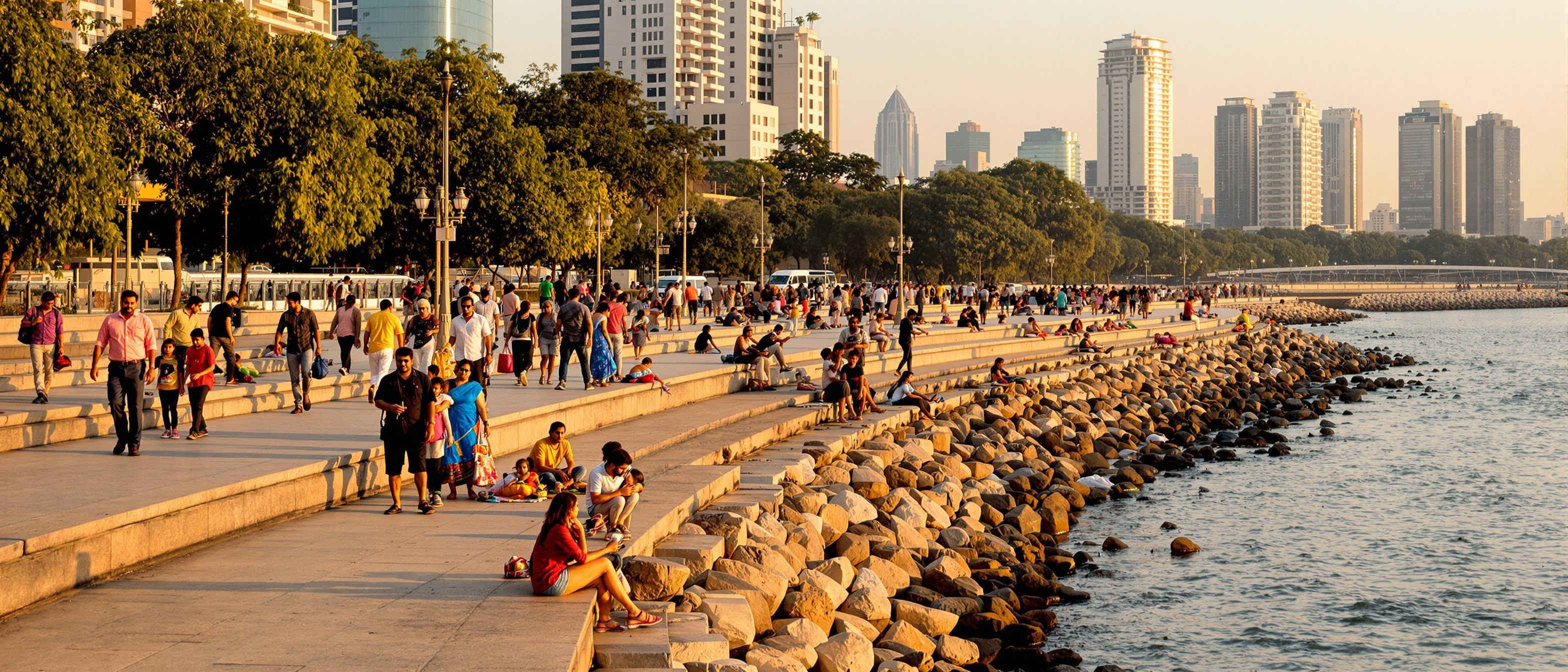
A good public realm multiplies optional and social life through sittable, sunny, lively space — and the street, designed complete for all users, is the city's largest public space.[2, 3, 4]
Gehl's lesson
Jan Gehl's Life Between Buildings (Danish 1971; English 1987) shifts attention from buildings to the LIFE between them. He distinguishes NECESSARY activities (you do them regardless — commuting), OPTIONAL activities (only if the place invites them — strolling, sitting) and SOCIAL activities (which grow from the other two). A good public realm multiplies the optional and social; a hostile one leaves only the necessary. Design for people at 5 km/h and eye level, not for cars at 60.[2]
Explore the interventions
Pick an intervention type and read its focus, its design tools and a real Indian example — then ask which one your own site and brief would call for.
Urban interventions · pick one
Transit-Oriented Development
Focus: Dense, mixed-use, walkable development within walk/cycle distance of a transit station — integrating land use and movement.
Design tools: Walkable catchment (≈800 m), mixed use, reduced parking, active frontages, the station as a node and place.
Indian example: India's National TOD Policy (2017) applied along Delhi and Ahmedabad metro corridors; concept codified by Peter Calthorpe (1993).
Match the intervention to the site and the brief — each is a piece of city, not a layout of plots.
At a glance
| Aspect | Detail | Note |
|---|---|---|
| Necessary activity | Happens regardless (commute) | Even in a hostile place |
| Optional activity | Only if invited (sit, stroll) | Needs a good public realm |
| Social activity | Grows from the other two | The mark of a living place |
| Good plaza needs | Sittable space, sun, food | Triangulation, life |
| Biggest public space | The street | Designed for all, not just cars |
Key terms
Dense, mixed-use, walkable development around a transit station.
Keeping a historic building alive with a compatible new use.
Reclaiming a river or sea edge as continuous public realm.
Designing public space for human activity and social life.
An external stimulus that prompts strangers in a space to interact (Whyte).
A street designed for all users, not only vehicle throughput.
Studio task
For your studio site, choose ONE intervention type from the explorer and justify it in three sentences against the analysis from Unit II. Then design one public space within it — a square or a street — and list the place-making moves (sittable space, sun, shade, food, active frontage, triangulation) you would use to bring it to life. Explain why “widening the road” would not have fixed the problem.
Self-assessment
1. Transit-Oriented Development concentrates development —
2. Adaptive reuse of heritage means —
3. Whyte found a good public plaza depends most on —
Recap
References & further reading
- [1]Carmona et al., Public Places — Urban Spaces — intervention types, the public realm, regeneration.
- [2]Jan Gehl, Life Between Buildings (1971 / English 1987) & Cities for People — necessary/optional/social activity.
- [3]William H. Whyte, The Social Life of Small Urban Spaces (1980) — sittable space, triangulation.
- [4]Project for Public Spaces — placemaking and the 'Power of 10'.
- [5]MoHUA (India) — National TOD Policy 2017, HRIDAY 2015, AMRUT & Smart Cities Mission 2015; Sabarmati Riverfront.
Further reading
- Jan Gehl — Life Between Buildings / Cities for People.
- William H. Whyte — The Social Life of Small Urban Spaces.
- Carmona et al. — Public Places Urban Spaces.
Sources gathered and fact-checked June 2026. Published values vary by source, sample and method — treat as indicative and confirm against the cited standard before structural use.
The author
Amogh N P
Architect, interior designer, and creative polymath. Studio Matrx began in his notebooks — his vision of design made honest, useful, and open to everyone. Its Academy is written and taught in his memory, and free, forever.
More about Amogh →