
Synthesis, Demonstration & Delivery
The masterplan, the charrette and the jury.
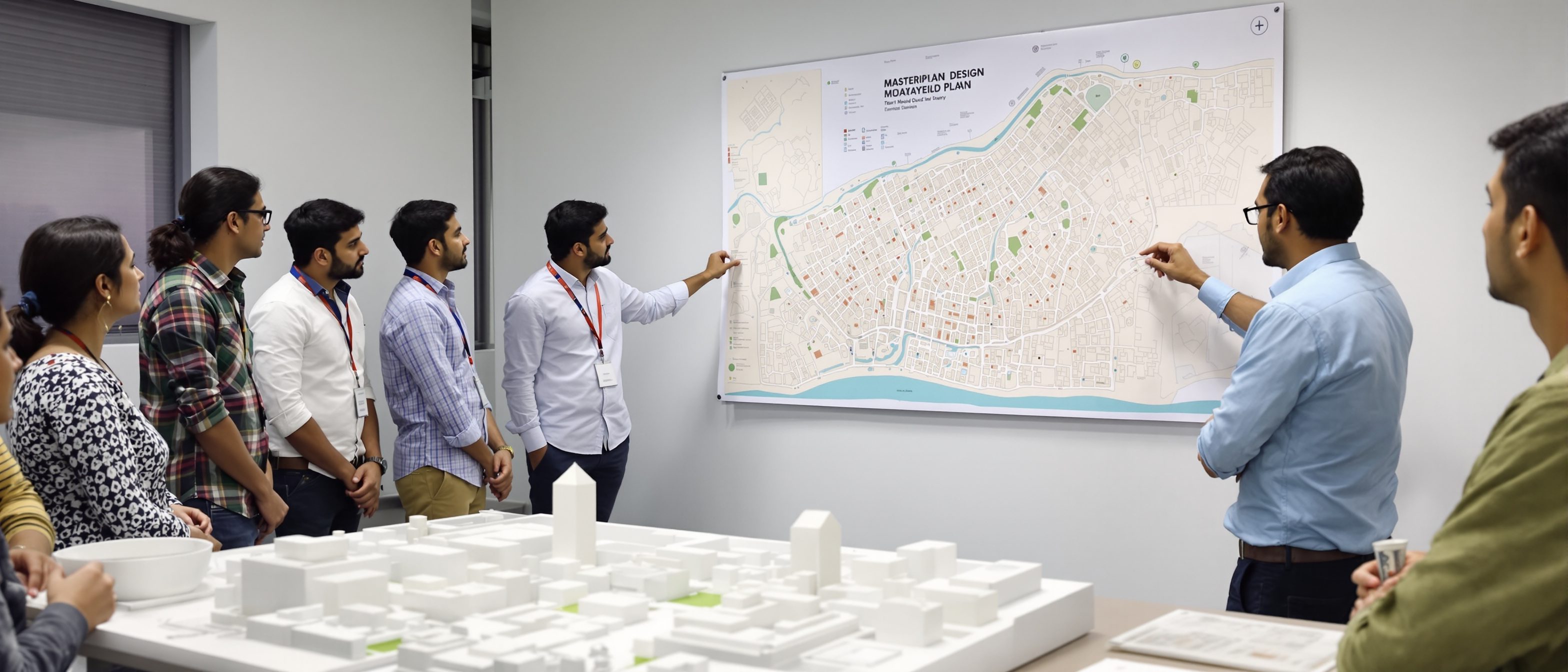
The studio ends by bringing everything together into a deliverable proposal. Learn the urban design framework and masterplan as a flexible, phased structure — not a frozen blueprint; stakeholders and genuine participation through the charrette; the demonstration drawings that communicate it — illustrative masterplan, sections, 3D and Cullen's serial vision; delivery through India's Development Authorities; and how to defend the proposal at jury against the Responsive Environments qualities and Carmona's dimensions.
Learning objectives
By the end of this lesson, you will be able to — mapped to the course outcomes for Architectural Design IX:
Synthesise a flexible, phased urban design framework and masterplan.
Run stakeholder and public participation through a charrette.
Produce demonstration drawings — masterplan, sections, 3D, serial vision.
Test the proposal against urban-design qualities and dimensions at jury.
Framework & delivery
The masterplan is a flexible, phased framework the city fills in over time, delivered with people through a real charrette and India's Development Authorities — not a frozen blueprint imposed from above.[1, 4, 5]
A flexible, phased structure
The masterplan is best understood as an urban design FRAMEWORK — a spatial structure of movement, blocks, public realm and character areas that coordinates MANY buildings, by many hands, OVER TIME. It is deliberately flexible and PHASED, with early moves that unlock later ones. MISCONCEPTION→correct: 'a masterplan is a fixed blueprint of the finished city' — a frozen end-state ages badly (Jane Jacobs's critique of rigid top-down planning); a good framework sets the rules and the public realm, then lets the city fill in.[1, 5]
Demonstration & jury
Demonstration drawings — including Cullen's serial vision — let a jury walk the proposal before it exists; testing it against the Responsive Environments qualities turns the jury into a design conversation.[2, 3]
Showing the place
A proposal is only as persuasive as its DEMONSTRATION. The studio set: the ILLUSTRATIVE MASTERPLAN (the place as it could be), URBAN SECTIONS through streets and spaces (showing enclosure and life), 3D massing and aerials, eye-level views, and SERIAL VISION — Gordon Cullen's sequence of framed views as you move through the space (Townscape, 1961). Together they let a jury — and a community — WALK the proposal before it exists.[2]
At a glance
| Aspect | One side | The other |
|---|---|---|
| Masterplan | Myth: a fixed blueprint | Reality: a flexible, phased framework |
| Participation | Myth: a formality | Reality: a charrette that changes the design |
| Permeability | Ease of movement through | A Responsive Environments quality |
| Robustness | Adapts to changing uses | Designed in, not added later |
| Serial vision | A sequence of framed views | Cullen's way of showing the walk |
Key terms
A flexible, phased spatial structure coordinating many buildings over time.
An intensive collaborative design workshop with stakeholders.
Cullen's sequence of framed views experienced while moving through space.
Seven qualities of good places (Bentley et al., 1985).
Ease of movement / capacity to adapt to changing uses over time.
The Indian body that implements plans and grants development permission.
Studio task
Assemble a one-page demonstration of your scheme: an illustrative masterplan, one urban section through a key street (showing enclosure and life), and a four-frame serial-vision sequence walking the main route. Then score your proposal against the seven Responsive Environments qualities (permeability, variety, legibility, robustness, visual appropriateness, richness, personalisation) and name the two you would most improve before the jury.
Self-assessment
1. A good urban design masterplan is best understood as —
2. A charrette is —
3. 'Serial vision', a key demonstration technique, comes from —
Recap
References & further reading
- [1]Carmona et al., Public Places — Urban Spaces — the dimensions of urban design, frameworks, delivery.
- [2]Gordon Cullen, The Concise Townscape (1961/1971) — serial vision and demonstration.
- [3]Bentley, Alcock, Murrain, McGlynn & Smith, Responsive Environments (1985) — the seven qualities.
- [4]URDPFI Guidelines 2014 (India) + Development Authority practice — delivery and development control.
- [5]Jane Jacobs, The Death and Life of Great American Cities (1961) — the critique of rigid top-down plans.
Further reading
- Carmona et al. — Public Places Urban Spaces.
- Gordon Cullen — The Concise Townscape.
- Bentley et al. — Responsive Environments.
Sources gathered and fact-checked June 2026. Published values vary by source, sample and method — treat as indicative and confirm against the cited standard before structural use.
The author
Amogh N P
Architect, interior designer, and creative polymath. Studio Matrx began in his notebooks — his vision of design made honest, useful, and open to everyone. Its Academy is written and taught in his memory, and free, forever.
More about Amogh →