
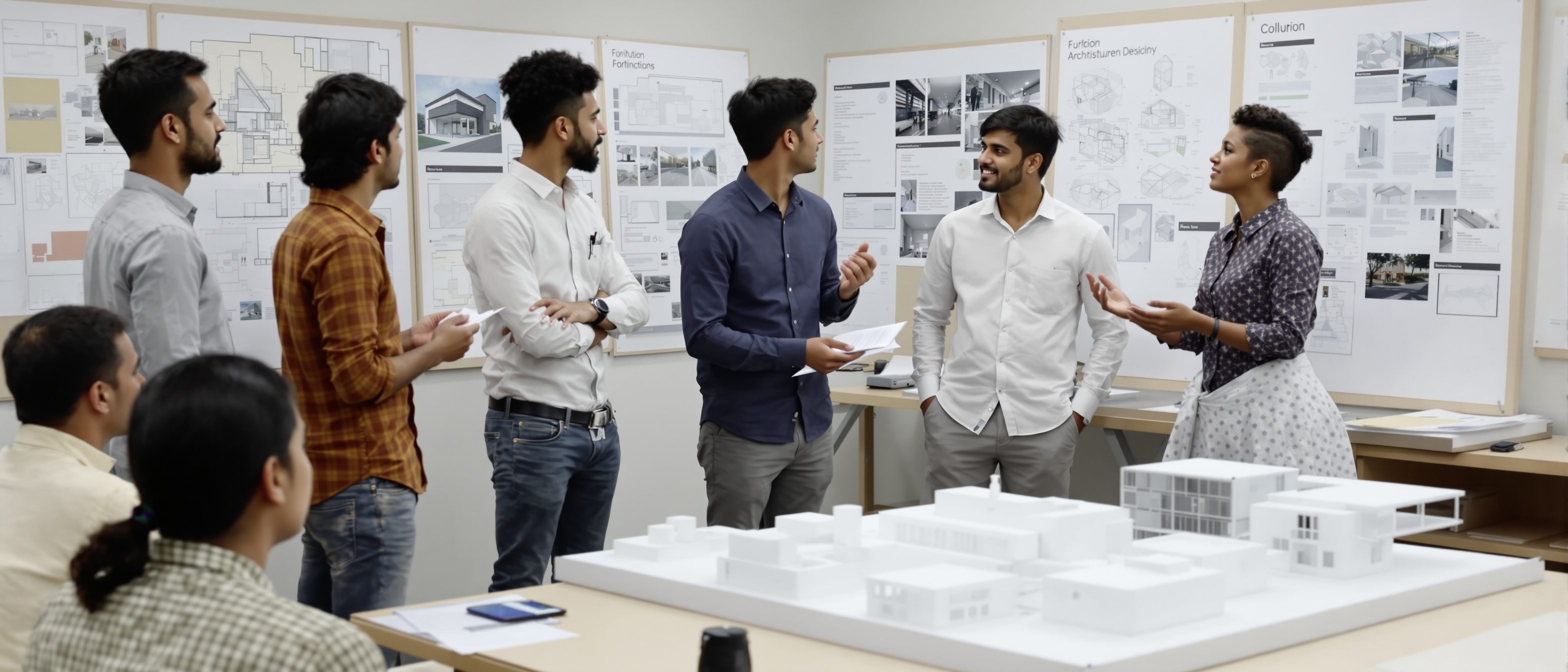
Design Development & Presentation
Resolving the scheme to buildable depth, and defending it at the jury.
Schematic design proves the idea works in principle; design development proves it works in resolution — dimensions firm up, the grid is real, the section is coordinated with structure and services, and details begin. The discipline is coherence: a change in plan must reflect in section and elevation the same day. Learn the comprehensive drawing set, how to use models as instruments of design, how to build and defend a design narrative, and how to self-critique before the jury. The real deliverable is a demonstrated process, not a pretty board.
Learning objectives
By the end of this lesson, you will be able to — mapped to the course outcomes for Architectural Design VI:
Develop the scheme to design-development depth with plan/section/elevation coherence.
Produce the comprehensive drawing set and the model that answers the hardest question.
Build and present a design narrative and compose boards as a left-to-right argument.
Anticipate hard questions, defend with reasoning, and self-critique before the jury.
Developing the design
Work plan and section together — the section is where integration is resolved — and produce the comprehensive set and the model that answers your hardest question.[1, 4]
From idea to buildable
Design development proves the scheme works in RESOLUTION — dimensions firm up, the grid is real, wall thicknesses and finishes are decided, the section is coordinated with structure and services, stairs and lifts are dimensionally correct, details begin. You stop drawing single-line diagrams and start drawing buildings that could be built. The discipline is coherence: a change in plan must reflect in section and elevation the same day.[1]
The narrative & the jury
Lead with the concept, name trade-offs honestly, have the hard answers drawn — and run your own crit before the panel does.[2, 3, 5]
Lead with why
The jury must understand WHY, not just what. Build a clear narrative: the problem statement (Unit I) → the site/urban response (Unit II) → the parti and how program generated it (Unit III) → how structure/services/code were integrated (Unit IV) → how the experience resolves. Lead with the concept, then show how every major decision serves it. Honestly naming a trade-off reads as mature judgement; pretending there were none reads as naïve.[2, 5]
Self-assess before the jury
Rate your scheme on the six things Design VI is graded on — concept, site, program, integration, accessibility and resolution — and see where it stands.
Self-assess your scheme
60/100
A clear organising idea generated by program + site (not an imposed shape).
Reads the context (figure-ground, edges, approach) and responds with a reasoned massing.
Public/private/service zoning, circulation for crowds, served/servant discipline.
Structure, services and NBC fire/egress woven in — not bolted on after.
A continuous accessible route; ramp 1:12, 1500 mm turns, accessible lifts/WCs.
Plan/section/elevation cohere; comprehensive set; a defended design narrative.
Nearly there — tighten the weak criteria below.
The deliverable is a demonstrated process — judgement under constraint, not a lucky final image.
At a glance
| Aspect | Schematic | Design development |
|---|---|---|
| Drawing style | Schematic: single-line diagrams | DD: dimensioned, real wall thickness |
| Structure | Schematic: grid implied | DD: grid sized, members real, section coordinated |
| Services | Schematic: cores located | DD: shafts, plant, plenum drawn and reconciled |
| Section | Schematic: conceptual | DD: resolved with structure + services + daylight |
| Test of success | Schematic: idea works in principle | DD: coherent and could be built |
Key terms
The stage that resolves the scheme to buildable, dimensioned, coordinated depth.
The full coordinated suite of site plan, plans, sections, elevations, details and 3D.
The structured 'why' account presented and defended at the jury.
Internal consistency so plan, section and elevation describe one building.
The panel review where the scheme is presented, questioned and defended.
The organising diagram the whole comprehensive set must still legibly express.
Studio task
Take your scheme to design-development depth and assemble the comprehensive set (site plan, all floor plans, ≥2 sections with one through the main public volume, elevations, key details, 3D). Write a one-page design narrative leading with the concept and naming one honest trade-off, and list the four hard questions a jury will ask — with the drawn answer to each. Then self-assess with the rubric above.
Self-assessment
1. The most reliable place to RESOLVE structure, services and daylight together is the —
2. A strong design narrative at the jury —
3. The real deliverable of Design VI is —
Recap
References & further reading
- [1]Francis D.K. Ching, Architectural Graphics; Design Drawing (conventions, section, composition).
- [2]Edward T. White, Presentation Strategies in Architecture (board composition and narrative).
- [3]Bryan Lawson, How Designers Think (design process, iteration and judgement).
- [4]Time-Saver Standards / NBC presentation norms (set completeness and drawing conventions).
- [5]William Peña & Steven Parshall, Problem Seeking (closing the loop: problem statement → defended solution).
Further reading
- Ching — Architectural Graphics; Design Drawing.
- Bryan Lawson — How Designers Think.
- Edward T. White — Presentation Strategies in Architecture.
Sources gathered and fact-checked June 2026. Published values vary by source, sample and method — treat as indicative and confirm against the cited standard before structural use.
The author
Amogh N P
Architect, interior designer, and creative polymath. Studio Matrx began in his notebooks — his vision of design made honest, useful, and open to everyone. Its Academy is written and taught in his memory, and free, forever.
More about Amogh →