
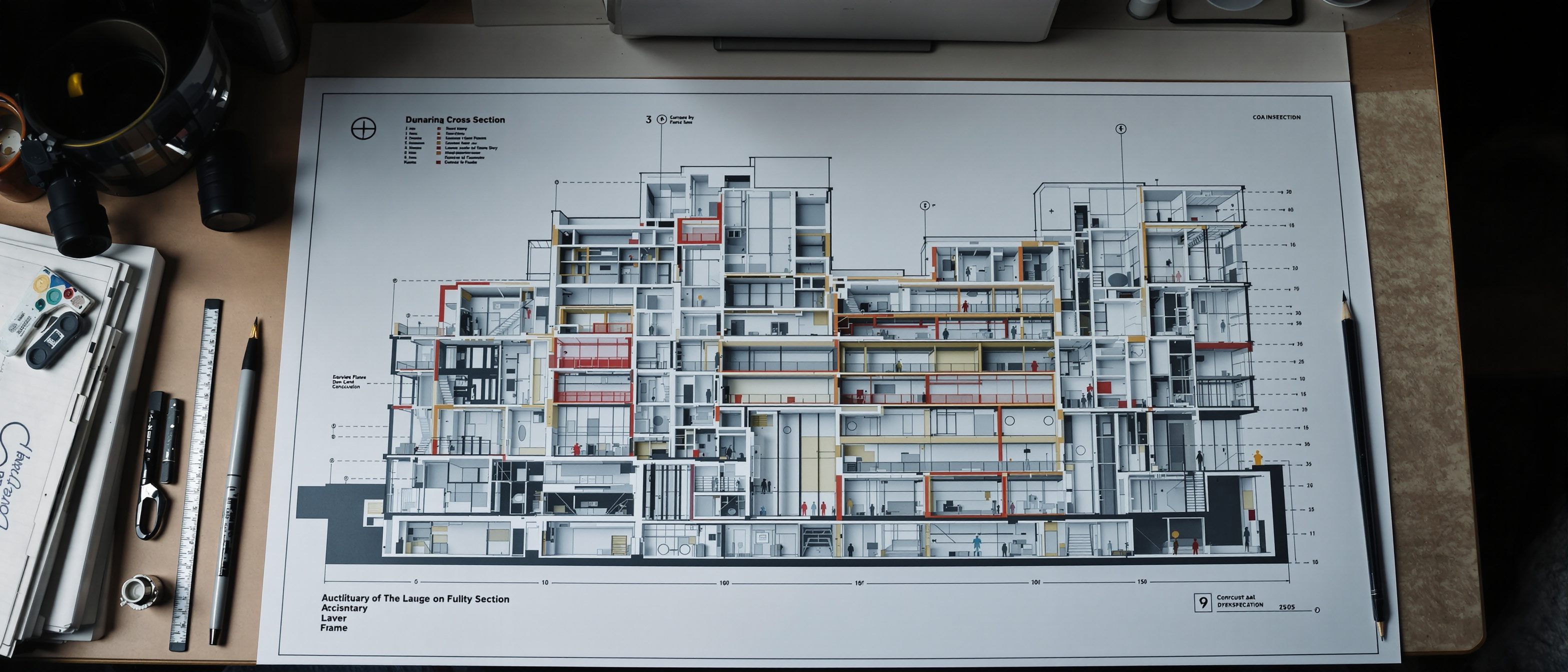
Technical & Regulatory Integration
Structure, services and the NBC — woven in, not bolted on.
The big idea of this unit is integration, not coordination-after-the-fact. Structure, services and code are not consultants you call after the design is frozen — they are design parameters you carry from the parti. A scheme that has to be “fixed” to fit a beam, a duct or an exit was never resolved. Learn to choose a structural system and commit to a grid, to give services their real spatial demands (cores, shafts, plant, the ceiling plenum), and to weave NBC Part 4 fire and life safety — the 500 mm exit unit, two remote exits, travel distance, refuge above 24 m — into the design from the start.
Learning objectives
By the end of this lesson, you will be able to — mapped to the course outcomes for Architectural Design VI:
Choose a structural system for the spans and commit to a coordinating grid early.
Give services their spatial demands — cores, shafts, plant rooms and the ceiling plenum.
Weave NBC Part 4 egress — 500 mm units, two remote exits, travel distance — into the plan.
Reconcile the structural grid, service core, egress and accessible route on one plan.
Structure & services in the design
Commit to a grid early — the cheapest coordination tool — and give services their real volume in cores, shafts, plant and the ceiling plenum.[2, 3, 5]
The cheapest coordination tool
Commit to a GRID early — it disciplines columns, bays, parking, facade module and services. A single well-chosen grid aligns the basement parking bays, the columns through the public floors, the facade mullions and the service zones. Set the grid from the parking and the long-span room FIRST, then plan rooms within it, to avoid columns landing in the middle of doorways.[3]
Code woven in
Occupant load sizes the exits; provide 500 mm units and two remote exits within the travel distance; add a refuge above 24 m — then overlay grid, core, egress and the accessible route and redesign the conflicts.[1]
People size the exits
Classify the occupancy (assembly, institutional, mercantile…) and compute the OCCUPANT LOAD (floor area ÷ the occupancy-specific area-per-person) — this sizes your egress. Get it wrong and the exits are undersized for the crowd.[1]
At a glance
| Situation | Structure | Consequence |
|---|---|---|
| Office/teaching floors | RCC/steel frame | ~7.5–9 m bays · shallow zone |
| Auditorium / hall | Trusses / portal frame | up to ~30 m · deep roof zone |
| Exhibition / concourse | Space frame | ~30–60 m+ · light two-way lattice |
| Grand civic volume | Shell / cable / arch | very large · form-active supports |
| Above 24 m | Refuge + fire lift + pressurised stair | fire-fighting shaft full height |
Key terms
The regular column rhythm that disciplines bays, parking, facade and services.
A gathered vertical cluster of lifts, stairs and shafts.
The horizontal void above the ceiling (~600–900 mm) carrying ducts, pipes and sprinklers.
The number of people a space is reckoned to hold — sizes its exits.
The 500 mm module by which NBC reckons egress capacity.
A protected floor above 24 m where occupants await assisted evacuation.
Studio task
On your scheme's plan and a key section, overlay four diagrams and force them to agree: the structural grid (sized for the longest span), the service core and shafts, the NBC egress diagram (two remote exits, 500 mm units, travel distance), and the accessible route. Mark every conflict — a duct fighting a column, an exit on a column-free corner — and redesign it. If the building crosses 24 m, add the refuge area and fire lift.
Self-assessment
1. The NBC 2016 unit of exit width is —
2. A refuge area is required, per NBC, principally for —
3. 'Integration, not coordination-after-the-fact' means —
Recap
References & further reading
- [1]Bureau of Indian Standards, NBC 2016 — Part 4 (Fire and Life Safety), Part 8 (Building Services), Part 6 (Structural).
- [2]Ernst Neufert, Architects' Data (cores, plenums, lift handling).
- [3]Edward Allen & Joseph Iano, The Architect's Studio Companion (span ranges, service zoning rules of thumb).
- [4]Angus Macdonald, Structure and Architecture (matching the structural system to architectural intent).
- [5]Joseph De Chiara & John Callender, Time-Saver Standards for Building Types (service zones and plant).
Further reading
- Edward Allen & Joseph Iano — The Architect's Studio Companion.
- Angus Macdonald — Structure and Architecture.
- BIS — NBC 2016, Part 4 (Fire and Life Safety).
Sources gathered and fact-checked June 2026. Published values vary by source, sample and method — treat as indicative and confirm against the cited standard before structural use.
The author
Amogh N P
Architect, interior designer, and creative polymath. Studio Matrx began in his notebooks — his vision of design made honest, useful, and open to everyone. Its Academy is written and taught in his memory, and free, forever.
More about Amogh →