
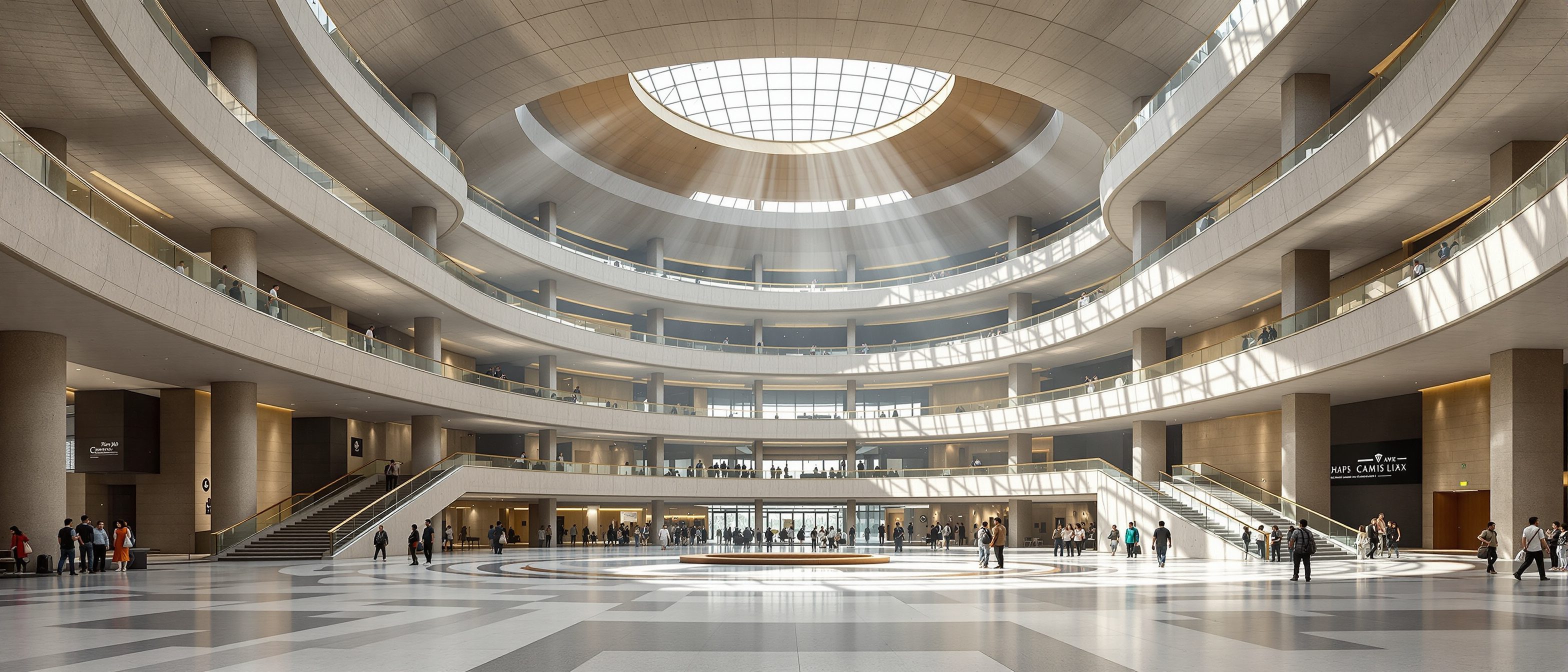
The Complex / Public Building
Naming the complexity, reading the brief, and arriving at a parti.
Complexity is not size — a warehouse is large and simple. A building becomes complex when it carries multiple, simultaneous, sometimes-conflicting demands: several user groups, several functions, a hard public/service split, large crowd-bearing spaces, and a civic role that answers to the city. Your first analytic move is to name the complexities before you draw anything — that list is your real program. Learn how typology sets the governing constraint, how to read and augment an incomplete brief, how to split objectives from constraints, and how a parti is generated, not imposed.
Learning objectives
By the end of this lesson, you will be able to — mapped to the course outcomes for Architectural Design VI:
Name what makes a building complex — user groups, functions, public/service split, civic role.
Identify a typology's governing constraint and let it order the design.
Read and augment a complex brief into a problem statement and area program.
Distinguish objectives (optimise) from constraints (satisfy) and derive a parti.
Complex building typologies
A library, museum, auditorium, terminal and hospital are all complex — but each has a governing constraint that orders everything else. Identify yours early.[3]
Civic & cultural centre
A multi-function public building hosting assembly, exhibition and civic functions. The hardest problem is the split between flexible public halls and heavy back-of-house (stage, stores, plant), with a strong civic frontage expected. Governing issue: serving generous public rooms while hiding a large servant zone.[3]
Reading the brief, finding the parti
A real brief is incomplete — read it as evidence, augment the back-of-house, write a one-sentence problem statement, and let the parti emerge from program and site.[1, 5]
Separate the fixed from the desired
Treat the brief as evidence, not instructions. Separate the GIVENS (site, budget envelope, statutory FSI, mandatory functions — which bound the problem) from the GOALS (civic presence, daylight, inclusion, flexibility — which you optimise within them). Confusing the two is a classic failure.[1]
At a glance
| Aspect | One | The other |
|---|---|---|
| User groups | Simple: one or two | Complex: many, with conflicting needs |
| Zones | Simple: front/back blur is fine | Complex: hard public / private / service split |
| Governing constraint | Simple: often comfort or cost | Complex: typology-specific (sightlines, egress…) |
| Civic accountability | Simple: minimal | Complex: answers to the street and city |
| The brief | Simple: usually adequate | Complex: under-specified; must be augmented |
Key terms
The irreducible diagram of how a building is organised — generated by program and site.
The public, finished, served zones visitors experience.
Servant, technical, restricted zones that make the front-of-house work.
The typology's non-negotiable (sightlines, throughput, climate) the whole design must serve.
Peña's one-sentence naming of the essential design problem, before design begins.
Ratio of gross built area to net usable area (~1.3–1.5), accounting for circulation and services.
Studio task
For your assigned typology, name its complexities (user groups, function families, served/servant pairs) and its governing constraint in one page. Augment the given brief with the back-of-house it omits, write a one-sentence problem statement, and sketch a parti diagram that already implies zoning and circulation — not a shape, an organisation.
Self-assessment
1. What primarily makes a building 'complex'?
2. In Peña's method, the deliverable that signals you are ready to design is —
3. A precedent study should primarily extract —
Recap
References & further reading
- [1]William Peña & Steven Parshall, Problem Seeking: An Architectural Programming Primer, 5th ed., Wiley.
- [2]Edward T. White, Introduction to Architectural Programming; Site Analysis.
- [3]Joseph De Chiara & John Callender, Time-Saver Standards for Building Types.
- [4]Ernst Neufert, Architects' Data (net-to-gross factors and spatial standards).
- [5]Francis D.K. Ching, Architecture: Form, Space and Order (parti and organisation diagrams).
Further reading
- Peña & Parshall — Problem Seeking (the programming primer).
- De Chiara & Callender — Time-Saver Standards for Building Types.
- Ching — Architecture: Form, Space and Order.
Sources gathered and fact-checked June 2026. Published values vary by source, sample and method — treat as indicative and confirm against the cited standard before structural use.
The author
Amogh N P
Architect, interior designer, and creative polymath. Studio Matrx began in his notebooks — his vision of design made honest, useful, and open to everyone. Its Academy is written and taught in his memory, and free, forever.
More about Amogh →