
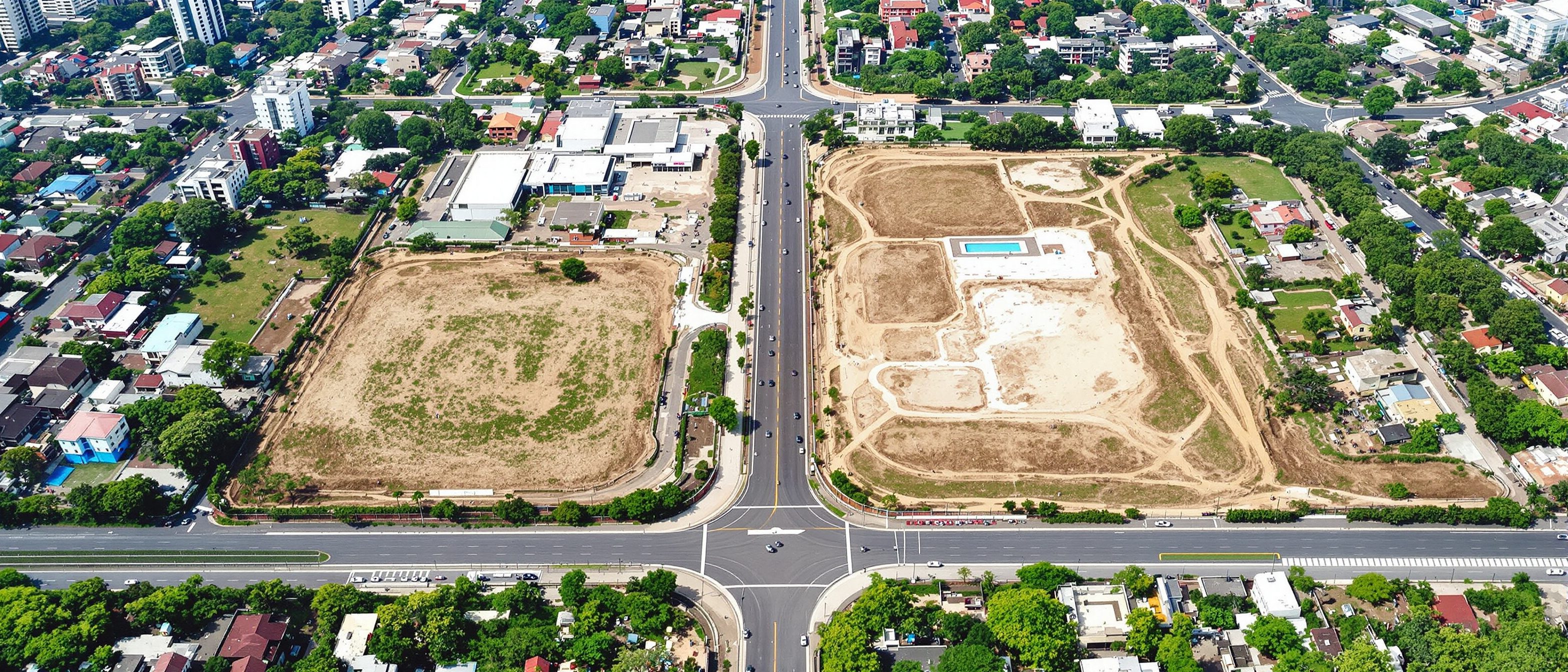
Site, Context & Urban Response
Negotiating a piece of city — figure-ground, arrival, presence and massing.
At the public-building scale, site analysis is no longer about sun and breeze on a plot — it is about how the building negotiates a piece of city. A public building's most important context line is often outside the plot boundary. Learn to read the urban grain by figure-ground, edges and street hierarchy; to design the approach, arrival and public realm; to give the building civic presence (legibility, not bigness); to compare massing strategies; and to compute the buildable envelope on day one. Try the massing-strategy explorer.
Learning objectives
By the end of this lesson, you will be able to — mapped to the course outcomes for Architectural Design VI:
Analyse a public-building site at urban scale (SWOT, access, services, statutory envelope).
Read the context by figure-ground, edges and street hierarchy and set the building's posture.
Design the approach, arrival and public realm and achieve civic presence through legibility.
Compare massing strategies and compute the buildable envelope from FSI/setbacks early.
Reading the context
The grain of the surrounding blocks tells you the building's posture; the street hierarchy locates the public face and the service edge; and the buildable envelope is computed on day one.[1, 4]
Read the urban grain
Draw a figure-ground (built solid, open void) of the surrounding two or three blocks. It instantly reveals the grain of the city — fine-grained street-wall fabric or coarse object-in-field — where public open space already exists, and what 'fits'. The building's correct posture (street-wall infill, freestanding civic object, courtyard block) is READ from this, not chosen arbitrarily.[1, 3]
Massing strategies
Massing is where program, site and presence meet. Test 3–4 options on the same criteria and choose by reasoned comparison — climate is a form-giver in India.[3]
Hold the street, stack above
Public functions in a generous podium, repetitive functions stacked above. Suits tight urban plots and libraries/institutions: the podium holds the street line, the tower gains daylight and FSI, and service hides behind the podium.[3]
Compare the strategies
Pick a massing strategy and read its best site, civic presence, daylight and service implications side by side.
Massing strategies · pick one
Podium-and-tower
- Best site
- Tight urban plot in continuous fabric
- Civic presence
- Podium holds the street line; tower reads from afar
- Daylight
- Facade + light-wells; tower gains daylight above
- Service
- Hidden behind the podium / on the blind side
Test 3–4 options on the SAME criteria and choose by reasoned comparison — not by which renders best.
At a glance
| Aspect | One | The other |
|---|---|---|
| Best site | Street-wall/podium: tight urban | Courtyard/mat: medium plot, hot climate |
| Civic presence | Podium: holds the street line | Object-in-landscape: maximum figure |
| Daylight | Podium: facade + light-wells | Courtyard: light brought deep via the court |
| Public realm | Podium: active street edge | Object: surrounding plaza/garden |
| Hiding service | Podium: behind the blind side | Object: often the hardest to hide |
Key terms
A plan showing built mass solid and open space void, to read the urban grain.
A public outdoor room that receives crowds before the entry.
The legibility and dignity that signals a building is public and welcoming — not bigness.
Designing so the building helps create a usable public place, not just floor area.
The maximum volume permitted by FSI, setbacks, ground coverage and height.
The mandated motorable approach and hard-standing for fire appliances (~6 m drive, per NBC).
Studio task
For your site, draw a figure-ground of the surrounding 2–3 blocks and annotate edges, street hierarchy and desire lines. Compute the buildable envelope from the local FSI, setbacks and height. Then develop 3–4 massing options, score them on daylight, frontage, public realm, service access and structure, and justify the one you carry forward.
Self-assessment
1. A figure-ground diagram is drawn primarily to —
2. 'Civic presence' is best achieved by —
3. The buildable envelope (FSI, setbacks, height) should be computed —
Recap
References & further reading
- [1]Roger Trancik, Finding Lost Space: Theories of Urban Design (figure-ground, linkage, place).
- [2]Kevin Lynch, The Image of the City; Site Planning (edges, paths, legibility).
- [3]Joseph De Chiara & John Callender, Time-Saver Standards for Building Types (massing & typology).
- [4]BIS, NBC 2016, Part 3 (Development Control) and the city DCR/bye-laws — FSI, setbacks, fire-tender access.
- [5]Matthew Carmona et al., Public Places, Urban Spaces (placemaking and the public realm).
Further reading
- Roger Trancik — Finding Lost Space.
- Kevin Lynch — The Image of the City; Site Planning.
- Carmona et al. — Public Places, Urban Spaces.
Sources gathered and fact-checked June 2026. Published values vary by source, sample and method — treat as indicative and confirm against the cited standard before structural use.
The author
Amogh N P
Architect, interior designer, and creative polymath. Studio Matrx began in his notebooks — his vision of design made honest, useful, and open to everyone. Its Academy is written and taught in his memory, and free, forever.
More about Amogh →