

Space Standards & Anthropometrics
Sizing space to the human body — including every human body.
Every dimension in a building traces back to the human body. This lesson is where method meets measurement: the anthropometrics that size each space, the habit of designing to a range rather than an average, and the barrier-free standards that make a building work for everyone.
Learning objectives
By the end of this lesson you will be able to — mapped to the course outcomes for Architectural Design II:
Explain anthropometry and ergonomics and how space standards derive from them.
Design to a percentile range (5th–95th), not to an ‘average’ person.
Apply space standards for common functions using the standard references.
Apply India's barrier-free / universal-design standards for wheelchair users and the elderly.
Sizing space to the body
Space standards are built from anthropometry — and you design to a percentile range, looking the figures up rather than guessing them. Select a topic.[1, 3]
Try it — the space-standards explorer
Pick a space and see the clearances that govern it, on a scaled plan. Figures follow India's Harmonised Guidelines and the standard references.[5]
Space-standards explorer
Pick a space to see the clearances that size it. Figures follow India's Harmonised Guidelines and the standard references — illustrative, not a substitute for the code.
0 mm
Turning circle Ø
0 mm
Clear door
0 mm
Cubicle depth
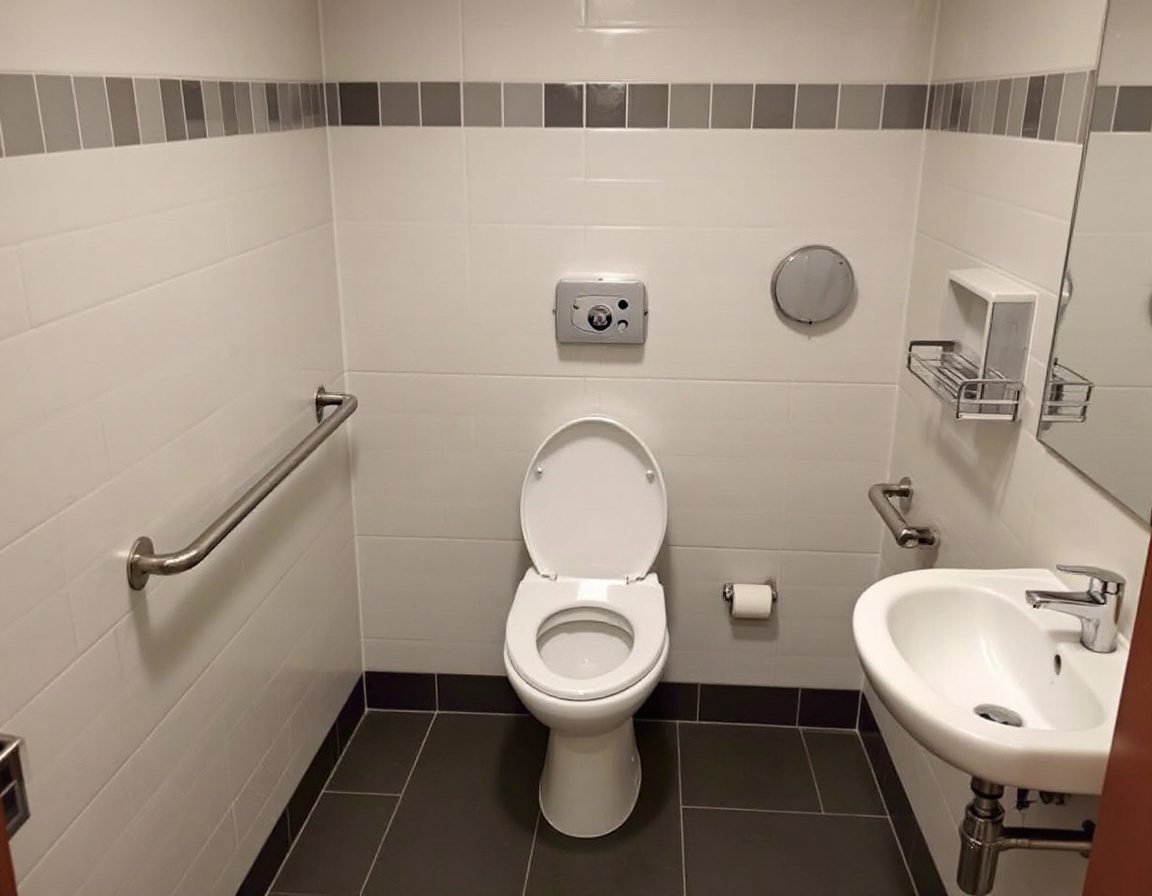
Sized around a 1500 mm wheelchair turning circle, with side transfer space and grab bars; the door swings out and is at least 900 mm clear.
Universal design
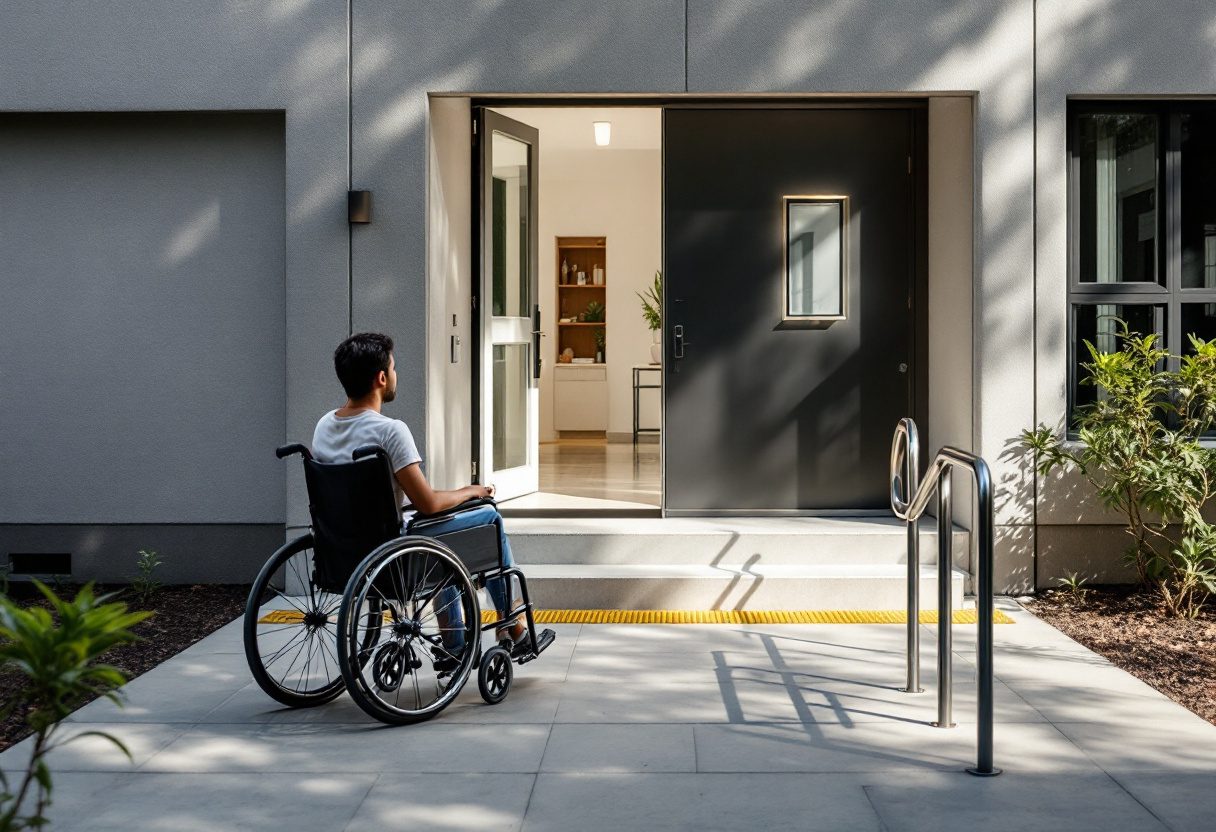
Good design works for everyone — wheelchair users, the elderly, children. India's Harmonised Guidelines set the figures, and the NBC and the RPwD Act make access a legal duty.[5, 6]
| Element | Standard | Why |
|---|---|---|
| Wheelchair turning circle | 1500 mm | A full 360° turn for a wheelchair user. |
| Clear door opening | ≥ 900 mm | So a wheelchair passes through (≈ 800 mm absolute min). |
| Ramp gradient (max) | 1:12 | With level landings top and bottom and handrails. |
| Accessible WC cubicle | ≈ 1500 × 1750 mm | Side transfer space + grab bars. |
| Two-way walkway | 1800 mm | For two wheelchairs to pass (≈ 900 mm min, single). |
Self-assessment
1. You should size a high shelf or a control for the:
2. India's Harmonised Guidelines give the wheelchair turning circle as:
3. The maximum gradient for an accessible ramp is:
Recap
References & further reading
- [1]Anthropometry & workspace design — static vs dynamic, percentiles (design for 5th–95th). Cornell Ergonomics. https://ergo.human.cornell.edu/studentdownloads/DEA3250pdfs/AnthroDesign.pdf
- [2]Anthropometry — body measurement as the basis of ergonomic / space design. EU-OSHA OSHwiki. https://oshwiki.osha.europa.eu/en/themes/anthropometry
- [3]Neufert, E. — Architects' Data (dimensioned space and building-type requirements). Reference scan. https://www.uceb.eu/DATA/CivBook/03.%20Architect_s%20Data.pdf
- [4]Panero, J. & Zelnik, M. (1979) — Human Dimension & Interior Space (anthropometric interior standards). https://en.wikipedia.org/wiki/Anthropometry
- [5]Harmonised Guidelines and Space Standards for Barrier-Free Built Environment (MoUD, 2016; revised 2021). Govt. of India. https://mohua.gov.in/upload/uploadfiles/files/Harmonized_%20Guidelines.pdf
- [6]Rights of Persons with Disabilities (RPwD) Act, 2016 — accessibility as a statutory duty; NBC 2016 Part 3. India Code. https://www.indiacode.nic.in/bitstream/123456789/15939/1/the_rights_of_persons_with_disabilities_act,_2016.pdf
Further reading
- Neufert, E. & Neufert, P. (2019). Architects' Data (5th ed.). Oxford: Wiley-Blackwell. ISBN 978-1-119-37987-0.
- Panero, J. & Zelnik, M. (1979). Human Dimension & Interior Space. New York: Whitney Library of Design.
- CPWD / MoHUA (2021). Harmonised Guidelines and Standards for Universal Accessibility in India.
Sources gathered and fact-checked June 2026. Published values vary by source, sample and method — treat as indicative and confirm against the cited standard before structural use.
The author
Amogh N P
Architect, interior designer, and creative polymath. Studio Matrx began in his notebooks — his vision of design made honest, useful, and open to everyone. Its Academy is written and taught in his memory, and free, forever.
More about Amogh →