

Design Strategies & Methods
Where ideas come from — and how to move from many to one.
How do designers actually arrive at form? Not by waiting for inspiration. This lesson — the heart of the studio — surveys the generators of form and the methods that organise them, so you can choose a strategy deliberately rather than by habit.
Learning objectives
By the end of this lesson you will be able to — mapped to the course outcomes for Architectural Design II:
Describe the main generators of architectural form and where ideas come from.
Explain Broadbent's four mechanisms — pragmatic, iconic, analogic, canonic.
Use the three-stage process — divergence, transformation, convergence.
Choose an appropriate design strategy for a given problem.
Where ideas come from
Design answers a context and a function, and a first idea usually starts from one of a few recognised generators — nature and geometry, music and mathematics, precedent, or the site. Select a topic.[4, 5, 6]
Designing in context
No design starts on a blank page. It answers a CONTEXT — the site, climate, culture, brief and budget — and a FUNCTION. ‘Constituents of design’ are the raw materials of the response: space, structure, materials, light, movement and meaning. Strategy is choosing how to put these together.[6]
Broadbent's four mechanisms
Geoffrey Broadbent (1973) named four ways to generate architectural form — most real schemes blend several.[3]
| Mechanism | The idea | Example |
|---|---|---|
| Pragmatic | Trial and error — do what works | Vernacular houses refined over generations |
| Iconic | Copy a proven type / image | A new courtyard house on the traditional model |
| Analogic | Borrow a form by analogy | A roof shaped from a leaf or a shell |
| Canonic | Design from a system or rule | A plan set out on a structural grid |
The three-stage process
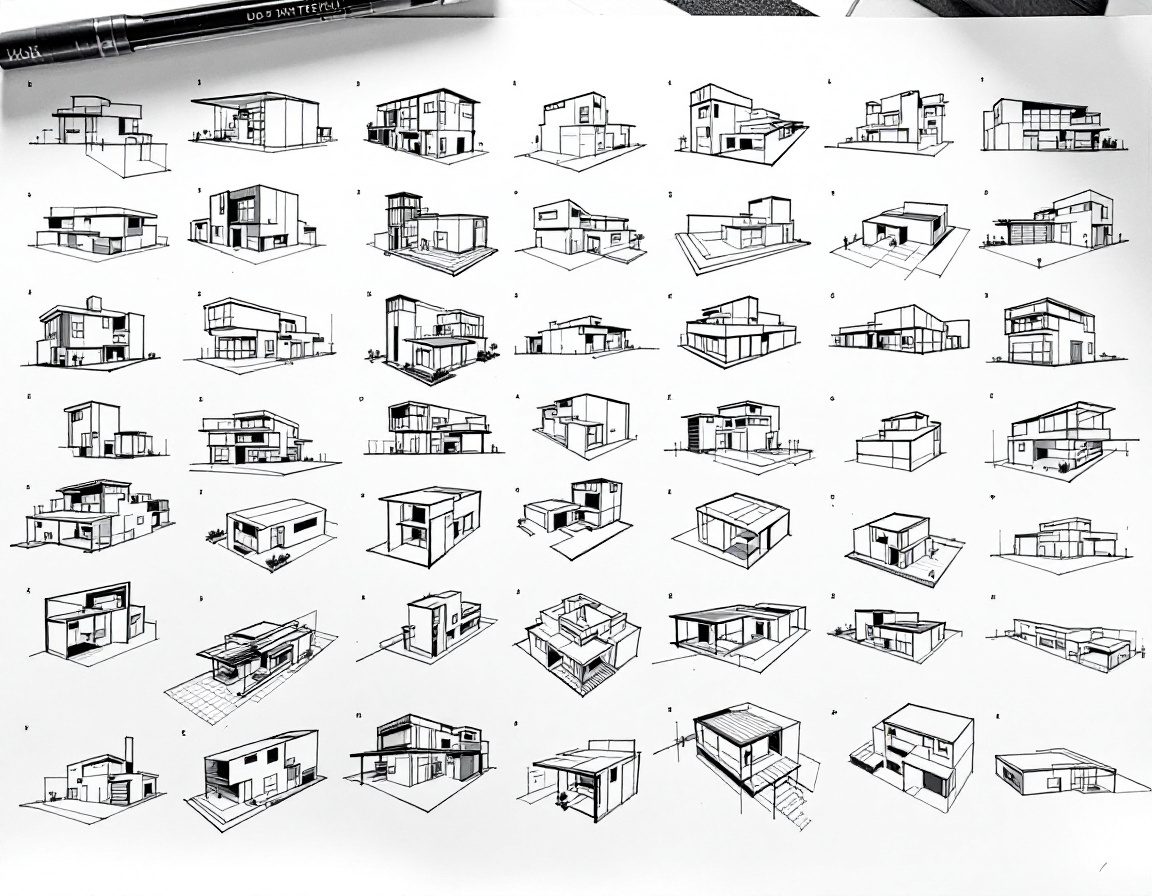
J. C. Jones's classic method moves through three stages — and the golden rule is to diverge before you converge. There is no single right method; choose by the problem in front of you.[7, 3]

Self-assessment
1. In J. C. Jones's three-stage process, the FIRST stage is:
2. Designing a building by borrowing a form from nature (e.g. a shell roof) is Broadbent's:
3. Le Corbusier's Modulor is a system of:
Recap
References & further reading
- [1]Le Corbusier — the Modulor (proportion from the human body + the golden section, 1945). ETH Library. https://library.ethz.ch/en/collections-and-archives/platforms/virtual-exhibitions/fibonacci-un-ponte-sul-mediterraneo/reception-of-fibonacci-numbers-and-the-golden-ratio/le-corbusier-the-modulor.html
- [2]Wittkower, R. (1949) — Architectural Principles in the Age of Humanism (Palladio's musical proportion; note: contested). Overview. https://en.wikipedia.org/wiki/Rudolf_Wittkower
- [3]Broadbent, G. (1973) — Design in Architecture: the pragmatic / iconic / analogic / canonic mechanisms. Overview. https://en.wikipedia.org/wiki/Geoffrey_Broadbent
- [4]Idea generation in architecture — generators of form (nature, geometry, precedent, site). StudySmarter. https://www.studysmarter.co.uk/explanations/architecture/interior-design-in-architecture/idea-generation/
- [5]Ching, F.D.K. — Architecture: Form, Space and Order (ordering principles: axis, symmetry, hierarchy, rhythm, datum). Wiley. https://www.wiley.com/en-us/Architecture%3A+Form%2C+Space%2C+and+Order%2C+5th+Edition-p-9781119853381
- [6]Lawson, B. — How Designers Think (constituents of design; choosing methods). Routledge. https://www.routledge.com/How-Designers-Think/Lawson/p/book/9780750660778
- [7]Jones, J.C. (1970) — Design Methods: divergence, transformation, convergence. Reference. https://en.wikipedia.org/wiki/John_Chris_Jones
Further reading
- Jones, J.C. (1992). Design Methods (2nd ed.). New York: Wiley — divergence, transformation, convergence.
- Broadbent, G. (1973). Design in Architecture: Architecture and the Human Sciences. London: Wiley.
- Ching, F.D.K. (2023). Architecture: Form, Space and Order (5th ed.). Hoboken, NJ: Wiley.
Sources gathered and fact-checked June 2026. Published values vary by source, sample and method — treat as indicative and confirm against the cited standard before structural use.
The author
Amogh N P
Architect, interior designer, and creative polymath. Studio Matrx began in his notebooks — his vision of design made honest, useful, and open to everyone. Its Academy is written and taught in his memory, and free, forever.
More about Amogh →