
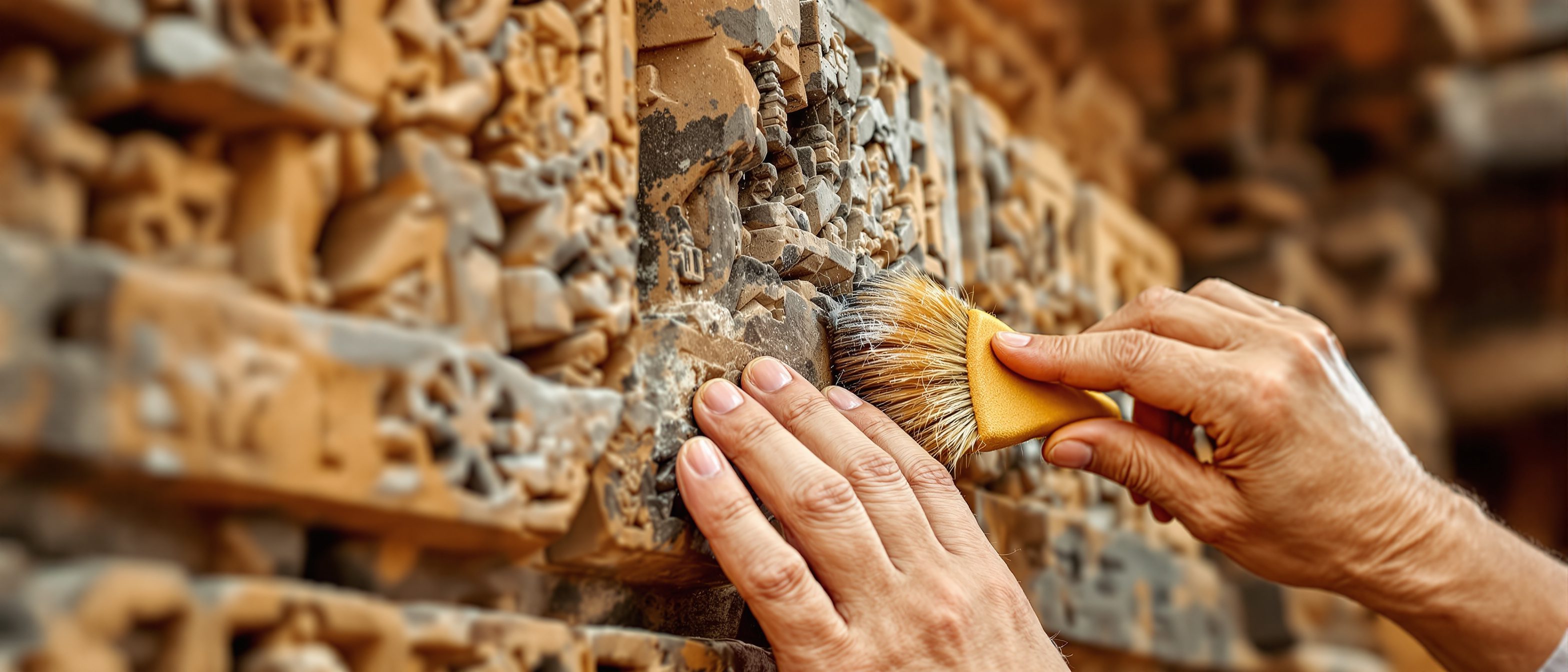
Introduction to Conservation
Why we conserve, the spectrum of approaches, and who governs it.
Old buildings carry a society's memory, identity and craft — and once demolished they are gone forever. Conservation is the discipline of caring for that heritage so it survives. This unit sets out WHY we conserve; defines the spectrum from preservation through restoration to adaptive reuse; distinguishes the conservation of a single building from a whole historic AREA; and maps the agencies and charters — UNESCO, ICOMOS, ICCROM, and India's ASI and INTACH — that govern it. Explore the spectrum below.
Learning objectives
By the end of this unit, you will be able to — mapped to the course outcomes for Architectural Conservation:
Explain why heritage is conserved and the debate around it.
Define and distinguish preservation, restoration, adaptive reuse and the spectrum of intervention.
Identify the international and Indian conservation agencies — UNESCO, ICOMOS, ICCROM, ASI, INTACH.
Describe the key conservation charters and Indian policy and legislation.
Why we conserve
Heritage is non-renewable memory; conservation manages change along a spectrum from preservation to reuse — as much as necessary, as little as possible — at the scale of a building or a whole area.[1, 4, 5]
Memory you cannot remake
We conserve heritage because old buildings carry a society's MEMORY, IDENTITY and craft knowledge; because they are non-renewable — demolish a 12th-century temple and it is gone forever; because they anchor a sense of place and continuity; because they embody embodied energy and are often the sustainable choice; and because they can have living economic value (tourism, use). Conservation is not nostalgia or stopping progress — it is the careful management of CHANGE so that what is valuable survives it.[1]
Explore the approaches
Pick a conservation approach and see where it sits on the intervention spectrum, what it means, and when it is the right choice.
Conservation approach · pick one
Arrest decay and maintain the fabric in its existing state — keep it AS IT IS, do not add or return it to an earlier form.
When used: When the existing state, including its age and patina, is itself valued; the default starting point.
The golden rule: do as much as necessary, but as little as possible.
Who governs conservation
UNESCO, ICOMOS and ICCROM set the global framework and the charters; in India the ASI protects national monuments and INTACH the vast unprotected heritage, within central and state law.[3, 2, 6]
UNESCO, ICOMOS, ICCROM
Three bodies anchor world conservation: UNESCO runs the World Heritage Convention (1972) and the World Heritage List of outstanding sites; ICOMOS (the International Council on Monuments and Sites, 1965) is the professional advisory body that wrote the charters and advises UNESCO; and ICCROM (the International Centre for the Study of the Preservation and Restoration of Cultural Property, Rome, 1959) leads research, training and standards. Together they set the global framework conservators work within.[3]
At a glance
| Aspect | One | The other |
|---|---|---|
| Preservation vs restoration | Preservation: keep as is | Restoration: return to a known earlier state |
| The golden rule | Restore to a perfect ideal | As much as necessary, as little as possible |
| Building vs area | Architectural: one building | Urban: a whole historic area & community |
| ASI vs INTACH | ASI: statutory, national monuments | INTACH: NGO, unprotected heritage |
| Ruskin vs Viollet-le-Duc | Ruskin: never restore | Viollet: restore to an ideal — both rejected |
Key terms
The umbrella discipline of caring for heritage so it survives — managing change to keep what is valuable.
Arresting decay and keeping the fabric in its existing state — the least intervention.
Returning fabric to a known earlier state on firm evidence — never conjectural.
Giving a heritage building a compatible new use while keeping its significance — the sustainable option.
Do as much as necessary but as little as possible (Burra Charter).
Genuineness of fabric, design, materials and traditions (Nara Document, 1994).
World Heritage; the advisory body and charter-writer; the research/training centre.
India's statutory protector of national monuments; the NGO for unprotected heritage.
Studio task
Pick a historic building near you and decide, with reasons, where on the conservation spectrum it should sit (preservation? adaptive reuse?) — use the approach explorer. Then find out its protection status: is it an ASI monument, a state-listed one, or unprotected (INTACH's territory)? Note one international charter principle (Venice or Burra) that would guide its care.
Self-assessment
1. The Burra Charter's guiding rule for how much to intervene in heritage is —
2. In India, the vast UNPROTECTED built heritage (not covered by the ASI) is mainly documented and advocated for by —
3. 'Adaptive reuse' in conservation means —
Recap
References & further reading
- [1]Feilden, Bernard — Conservation of Historic Buildings (Architectural Press, 2003).
- [2]ICOMOS — The Venice Charter (1964); Australia ICOMOS — The Burra Charter (1979, rev.); Nara Document on Authenticity (1994).
- [3]UNESCO World Heritage Convention (1972); ICOMOS (1965); ICCROM (1959).
- [5]Appleyard, Donald — The Conservation of European Cities (MIT Press, 1979).
- [6]INTACH — publications and the INTACH Charter for the Conservation of Unprotected Heritage (2004); ASI / AMASR Act 1958.
Further reading
- Bernard Feilden — Conservation of Historic Buildings (2003).
- Feilden — Guidelines for Conservation: A Technical Manual (INTACH, 1989).
- ICOMOS charters (Venice 1964; Burra 1979).
Sources gathered and fact-checked June 2026. Published values vary by source, sample and method — treat as indicative and confirm against the cited standard before structural use.
The author
Amogh N P
Architect, interior designer, and creative polymath. Studio Matrx began in his notebooks — his vision of design made honest, useful, and open to everyone. Its Academy is written and taught in his memory, and free, forever.
More about Amogh →