
Conservation in India
Hampi to Mahabalipuram, and the living temple cities of the south.
India has one of the richest, oldest and most LIVING heritages on Earth — and conserving it raises questions the West rarely faces. This unit studies conservation in India through its great sites: the vast ruined Vijayanagara capital of Hampi, the Pallava shore-temples of Mahabalipuram, the fort of Golconda. It looks at the CRAFT issues — the living traditions of stone, lime and timber. And it confronts the hardest case — the LIVING heritage town, where the monument is a working temple and the precinct a crowded living city.
Learning objectives
By the end of this unit, you will be able to — mapped to the course outcomes for Architectural Conservation:
Discuss conservation in India through case studies of major monumental sites.
Explain the craft issues of conserving Indian stone, lime and timber heritage.
Analyse the character and issues of historic towns and heritage precincts.
Explain the special challenge of conserving living heritage in India.
The great sites
Hampi teaches conservation at the scale of a landscape, Mahabalipuram the conservation of sculpture against the sea; and all of it depends on the living crafts and lime, not harmful cement.[1, 6]
The ruined capital
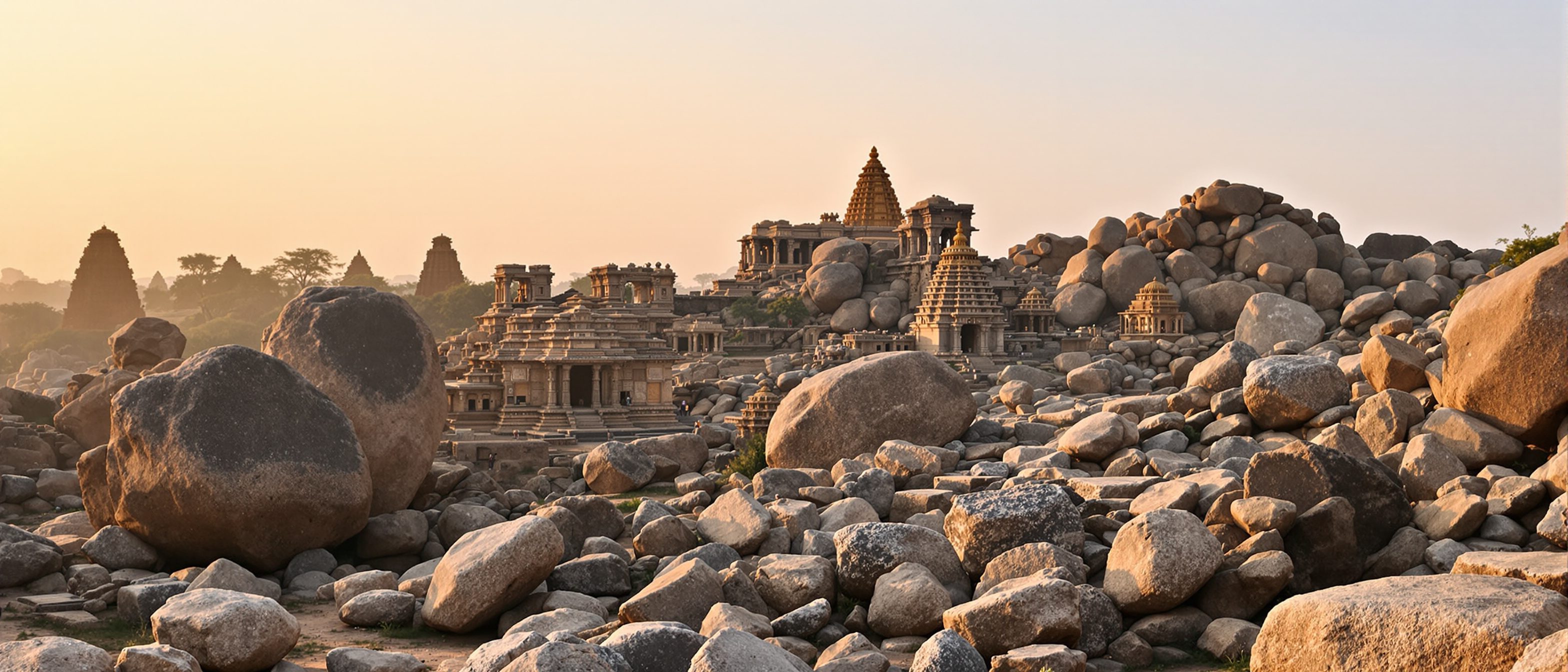
HAMPI, the capital of the Vijayanagara Empire (14th–16th c.), is a vast landscape of ruined temples, bazaars, palaces and waterworks scattered across a dramatic boulder-strewn terrain — a UNESCO World Heritage site (inscribed 1986). Its conservation issues are huge SCALE, an archaeological landscape rather than a single building, the pressure of tourism and a living village amid the ruins, and the balance between excavation, stabilisation and leaving the romantic ruin as it is. Hampi teaches conservation at the scale of a whole historic LANDSCAPE.[1]
Living heritage
The living temple city must be managed as a living system, with its precinct and setting; and India broadened world conservation's idea of authenticity to include living craft and tradition.[5, 2, 6]
Heritage that breathes
The hardest, most Indian case is the LIVING heritage town — the great temple cities of the south like SRIRANGAM (the vast Ranganathaswamy temple-town within concentric prakara walls), KUMBAKONAM and KANCHIPURAM. Here the monument is a WORKING temple, in daily worship for a thousand years, and the precinct is a dense LIVING city of homes, shops and streets. You cannot freeze it in a glass case — it must keep functioning, changing and being used, while its heritage survives. This is conservation as managing a LIVING system.[5]
At a glance
| Aspect | One | The other |
|---|---|---|
| Hampi vs Mahabalipuram | Hampi: a ruined landscape, scale | Mahabalipuram: sculpture vs the sea |
| Mortar for heritage | Hard cement: incompatible, harmful | Lime: breathable, compatible |
| Living temple city | Freeze it as a museum | Manage it as a living, changing system |
| What is heritage | Just the famous monument | + its precinct, setting and community |
| Authenticity (India) | Only the original stone | Also living craft & tradition (Nara/INTACH) |
Key terms
The ruined Vijayanagara capital — a vast heritage landscape (UNESCO 1986).
The Pallava rock-cut and shore temples (UNESCO 1984) — conserving sculpture against the sea.
A historic town where the monument is a working temple and the precinct a living city (Srirangam, Kanchipuram).
The historic streets, tank, houses and skyline around a monument — part of its significance.
The traditional, breathable, compatible mortar/plaster — preferred over harmful hard cement in conservation.
Mending heritage with the living trades (stone, lime, timber) that built it.
The Indian tradition of sacred renewal/rebuilding of temples using the same craft and tradition.
The Nara/INTACH idea that continuing tradition and craft can be authentic, not only original fabric.
Studio task
Choose an Indian heritage site you can visit or research — a temple town, a fort, a stepwell. Identify its main conservation issues (scale? material decay? encroachment? a living use?). Note one place where hard cement repair has harmed it, and what lime-based repair would do instead. Then describe one way its precinct/setting is threatened and how you would manage the change without freezing the place.
Self-assessment
1. Hampi and Mahabalipuram are both —
2. In conserving historic Indian masonry, lime mortar is preferred over hard cement because lime is —
3. The special challenge of a living heritage temple city like Srirangam is that —
Recap
References & further reading
- [1]Feilden, Bernard — Conservation of Historic Buildings; UNESCO World Heritage nominations for Hampi (1986) and Mahabalipuram (1984).
- [2]Nara Document on Authenticity (1994); INTACH Charter for the Conservation of Unprotected Heritage (2004).
- [5]Appleyard, Donald — The Conservation of European Cities (1979) — on the living historic town.
- [6]INTACH publications; studies of the living temple towns of Tamil Nadu (Srirangam, Kumbakonam, Kanchipuram).
Further reading
- Bernard Feilden — Conservation of Historic Buildings.
- INTACH — Guidelines and publications on Indian heritage.
- James M. Fitch — Historic Preservation: Curatorial Management of the Built World (1990).
Sources gathered and fact-checked June 2026. Published values vary by source, sample and method — treat as indicative and confirm against the cited standard before structural use.
The author
Amogh N P
Architect, interior designer, and creative polymath. Studio Matrx began in his notebooks — his vision of design made honest, useful, and open to everyone. Its Academy is written and taught in his memory, and free, forever.
More about Amogh →