
Inpainting, recolour & virtual staging
The surgical edit: change only the wall, only the floor, only the empty room - and leave everything else exactly as it was.
Lesson byAmogh N P· Architect & interior designer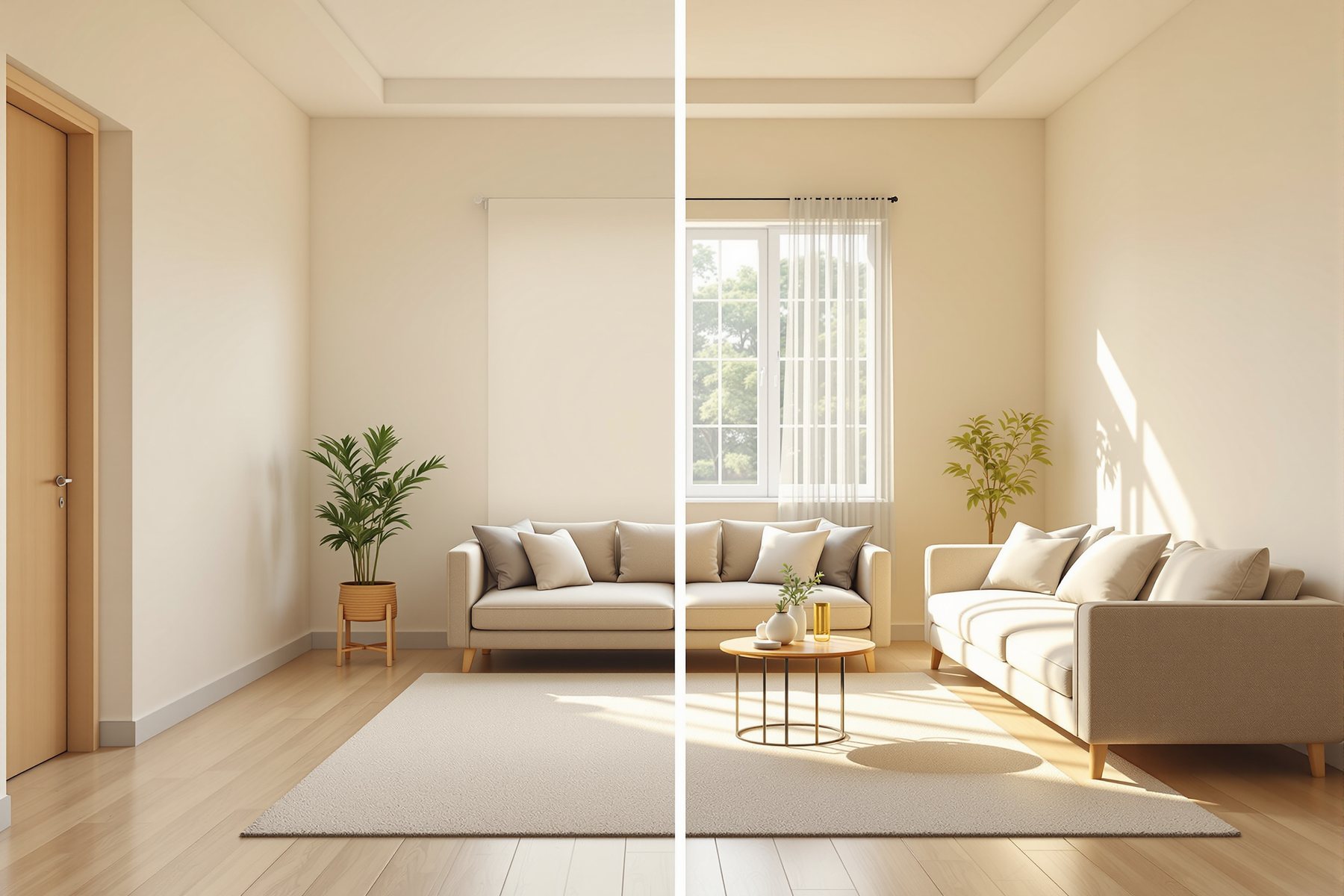
The client loved the room. They just hated the floor. Don't re-render the room.
A builder sends you a photo of a finished 3BHK living room to use in a brochure - but the empty floor reads cold and the feature wall is a flat builder-white. The old reflex was to rebuild the whole scene in 3D or send the photographer back. The new move is surgical: mask the floor, change only the floor; mask the wall, recolour only the wall; drop in furniture only where there is none. Everything you didn't touch stays photographically real because it's still the original photo. This is the most directly billable AI move in interiors, and Indian real-estate developers are the fastest-growing buyers of it.
Editing, not generating - change the part, keep the whole
Paint a region, change only that region
Inpainting is generation confined to a mask. You paint over the part of the image you want changed - a wall, a sofa, a patch of clutter - and the model regenerates only inside that mask, blending the new content to the untouched pixels around it. Everything outside the mask is the original photo, untouched and fully real.
This flips the control problem. Instead of fighting the model to keep what you like, you fence off what you want changed and the rest is automatically safe. The mask is the most precise instruction in image AI - far tighter than any prompt.
Three everyday jobs come straight out of this: recolour / swap a finish (mask a wall, prompt 'deep terracotta lime plaster'); remove clutter (mask the mess, let it fill with plausible background); restage (mask an empty floor, add furniture). Same technique, three deliverables.
Furnish the empty, empty the cluttered
Virtual staging is inpainting aimed at empty space: take a bare room and add furniture, rugs, art and plants so a buyer can feel the life of it. For India's real-estate developers - the fastest-growing AI-in-interiors segment in a market moving from roughly USD 1.39B in 2025 toward USD 1.76B in 2026 - it replaces expensive physical staging and reshoots.
Decluttering is the mirror image: mask the tenant's belongings, the cables, the bin, and let the model reconstruct clean background. Listing-ready in minutes.
The honest limits: staged furniture is plausible, not buyable - it's a feeling, not a catalogue. Reflections, shadows and floor perspective can go subtly wrong, so check that the new sofa actually sits on the floor and casts a sane shadow. And for a listing, disclose that staging is virtual - misrepresenting a property invites trouble.
Stage to sell the feeling of the space. Never let the buyer think the sofa comes with the flat.
From hand-masking to 'just tell it'
The frontier removes the brush. Context-aware tools - FLUX Kontext and Google's Nano Banana - let you skip masking and simply instruct: recolour the back wall to terracotta, remove the cables, add a rug. The model figures out the region itself and holds the rest steady. Faster, but slightly less precise than a hand-drawn mask when boundaries are tricky.
This is exactly what Studio Matrx Design Ideas does in production: a wall-only recolour built on FLUX Kontext that changes a wall's colour while furniture, flooring and layout stay locked - a context edit, tuned for Indian rooms, one tap. It's the cleanest live demo in this whole module of 'editing, not generating'.
The spine holds even here: a context edit can bleed colour onto a skirting or invent a junction. You diverge fast with the tool, then converge - confirm the change is the only change, and that the staged or recoloured result is honest about what's real.
Inpainting is your fastest way to test a finish on a real photo of a real building. Got an as-built facade shot? Mask one bay and trial three cladding options without remodelling. For competition and DPR boards, decluttering site photos and restaging interiors saves a reshoot. Keep the rule from Module 0: an edited photo persuades, it doesn't certify. A recoloured facade is a finish study, not a material approval; verify the actual product, cost and code before it reaches a spec.
This is the lesson you'll bill against most. Recolour a client's existing wall before suggesting they repaint; restage their empty new flat to sell a scheme; declutter a lived-in room to photograph your own completed project. ReimagineHome, Remodel AI and InteriorAI all do this; Studio Matrx's Design Ideas wall-only recolour does the single most common request - 'what would this wall look like in...' - in one tap. Then close the loop your way: turn the loved direction into a real, sourced, costed FF&E and finishes schedule.
Virtual staging is a service you can sell from day one with almost no overhead - real-estate agents and small builders need listing-ready photos constantly, and physical staging is expensive. Remodel AI runs around USD 29 a month for unlimited staging; one paid job covers months. Start there. The discipline: always disclose virtual staging on a listing, and never let your portfolio imply a staged render is a built result. Honesty is the moat - the solos who get burned are the ones who blurred it.
ReimagineHome
Redesign + virtual staging from a photo
Redesigns rooms and stages from a single photo. Quick and accessible for restyle and staging; like all staging, the furniture is plausible mood, not a buyable, costed product list - source the real items separately.
Remodel AI
Listing-ready virtual staging
Top-tested 2026 staging for furniture realism; around USD 29 per month for unlimited staging, aimed at listing-ready output. Strong for real-estate volume; check floor perspective and shadows on each result.
FLUX Kontext / Nano Banana
Context edits, no masking
Instruction-based 'change only this' editing without a hand-drawn mask. FLUX Kontext powers Studio Matrx's recolour; Nano Banana excels at keeping an object consistent across edits. Slightly less precise than manual masking on fiddly boundaries.
Studio Matrx Design Ideas
Wall-only recolour (live, India-tuned)
A FLUX-Kontext context edit in production: recolours a wall one tap while furniture, flooring and layout stay locked. The cleanest worked example of surgical editing for Indian interiors - and a direct funnel for clients.
“Editing one part of the image means I have to regenerate the whole thing and hope the good parts come back.”
No - that's the old, frustrating way. Inpainting (and context edits like FLUX Kontext and Nano Banana) regenerate ONLY the masked or instructed region and leave every other pixel as the original photo. You're not gambling the whole image to fix one wall. The skill is precise masking or precise instruction, not rerolling and praying the sofa you liked survives.
Workshop - restage and recolour one real room
Take one ordinary room photo and run the three surgical edits - recolour, declutter, stage - then audit them for the tells that give an edit away. This is the exact deliverable a builder or agent will pay you for.
Free/cheap: any inpainting tool, or a context-edit tool (FLUX Kontext / Nano Banana / ReimagineHome). Studio Matrx Design Ideas for the recolour. Bring one room photo (yours or a sample).
ONE room photo. Three surgical edits:

  EDIT 1  RECOLOUR  -> mask the feature wall
          prompt: "deep terracotta lime plaster, matte"
  EDIT 2  DECLUTTER -> mask cables / clutter / bin
          prompt: "clean wall, plain floor, empty"
  EDIT 3  STAGE     -> mask the empty floor area
          prompt: "low sofa, jute rug, floor lamp,
          two indoor plants, warm Indian living room"

AUDIT each result: shadows / reflections / floor line / spill- 1Recolour: mask only the feature wall (or use Design Ideas' wall-only recolour) and apply a new finish. Check the colour didn't spill onto the skirting, ceiling or sofa.
- 2Declutter: mask the clutter and let the model reconstruct clean background. Check the fill matches the surrounding floor and wall texture.
- 3Stage: mask the empty floor and add furniture with the prompt above. Check the sofa sits on the floor and casts a believable shadow.
- 4Audit all three against the tells: wrong shadows, impossible reflections, a floating object, a warped floor line. Mark any edit that fails the look.
- 5Re-run the weakest edit with a tighter mask or a more specific instruction - precision in, quality out.
- 6Caption the staged image honestly ('virtually staged') and write your own one-line disclosure rule for client and listing work.
You’ll walk away with
Three surgical edits of one real room - a recoloured wall, a decluttered shot and a staged room - each audited for tells, plus a personal disclosure rule for virtual staging.
A two-minute test, if you have a wall handy.
- 01Run a wall-only recolour on a photo of your own room in Studio Matrx Design Ideas, then zoom into the wall edges and confirm the furniture and floor stayed exactly as they were.
Inpainting and context editing change only a chosen region and keep the rest of the photo real - recolour a wall, remove clutter, stage an empty room. The mask (or the instruction) is the most precise control in image AI. Edit, don't regenerate; stage to sell a feeling, not a catalogue; and always be honest that the staging is virtual.
Inpainting regenerates only inside a mask; the rest stays the original photo. It powers recolour, decluttering and virtual staging. ReimagineHome, Remodel AI and InteriorAI do it; FLUX Kontext, Nano Banana and Studio Matrx Design Ideas do it without a brush. Check shadows and floor lines, source the real products, and disclose virtual staging.
What is virtual staging and is it legal to use on property listings in India?
Virtual staging digitally adds furniture and decor to a photo of an empty room so buyers can feel the space. It's widely used and accelerating in India, especially by developers. The key rule is disclosure: clearly label images as 'virtually staged' so you don't misrepresent the property's actual condition. Used honestly it's a legitimate, cost-saving marketing tool; used to deceive, it's a risk.
How do I change just one wall colour in a photo without affecting the rest?
Use inpainting - mask only that wall and recolour inside the mask - or a context-edit tool like FLUX Kontext that you simply instruct ('recolour the back wall to terracotta'). Studio Matrx Design Ideas does exactly this as a one-tap wall-only recolour, holding furniture, flooring and layout fixed. Afterwards, zoom into the edges to check the colour didn't spill onto skirting or ceiling.
Will the furniture in an AI-staged room be real products I can buy?
Generally no. Staged furniture is plausible mood art, not a buyable catalogue - it's there to sell the feeling of the space, not to be ordered. Treat it the way you'd treat any AI image: align the client on direction, then specify real, available, costed products. Some pipeline tools place actual buyable items, but standard staging does not.
The author
Amogh N P
Architect, interior designer, and creative polymath. Studio Matrx began in his notebooks — his vision of design made honest, useful, and open to everyone. Its Academy is written and taught in his memory, and free, forever.
More about Amogh →Your edits are clean - but a phone-screen render isn't a print board. Next: getting print-resolution output, keeping a whole set consistent, and the light post that turns raw gen into a polished image.