
Textile Design & the Motif
The repeat is a designed unit — not a motif copied in a grid
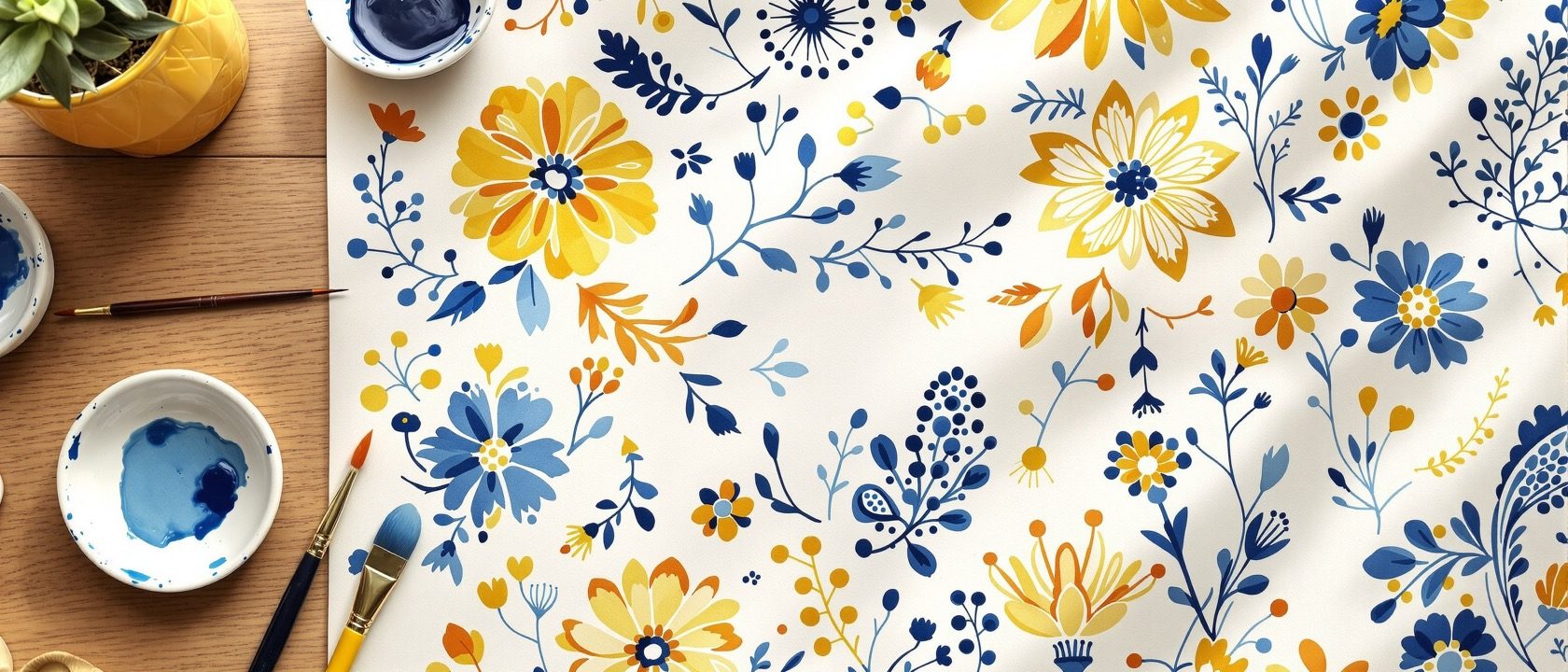
A textile pattern is built from a motif — a design unit with structure, symmetry and a source — arranged into a repeat. And here is the heart of textile design: a good repeat is engineered so its join is invisible, not a motif merely copied in a grid. The layout — full-drop, half-drop, brick, toss — sets the rhythm and hides the join. Textile design draws on a long conversation across cultures, using the elements and principles of design applied to cloth.
Learning objectives
By the end of this lesson, you will be able to — mapped to the course outcomes for Advanced Workshop:
Trace the development of textile design across cultures and read a motif.
Apply the elements and principles of design to a textile.
Build a seamless repeat, choosing the layout that hides the join.
Textile design across cultures
Textile design developed across every culture — primitive marks, great traditional vocabularies (India’s paisley/buta, florals, geometry), and contemporary work. It uses the elements (line, shape, colour, texture) and principles (balance, rhythm, repetition, scale) of design, applied to the surface of cloth.[1, 2]
From primitive to contemporary
Textile design is one of humanity's oldest and richest arts. It DEVELOPED across every culture, from PRIMITIVE and tribal marks — simple, symbolic, hand-made — through the great TRADITIONAL vocabularies (India's paisley/buta, florals, and geometry; the patterns of every region), to CONTEMPORARY design, which draws on all of it with new tools. Studying this development teaches a designer the deep well of MOTIFS and meanings to draw from, and how pattern carries culture. India especially holds one of the world's greatest textile heritages. To design textiles well is to join a long conversation — not to invent in a vacuum, but to understand what has come before and add to it with respect and originality.[1, 2]
Analysing a motif
The motif is the single design unit from which a pattern is built — a flower, a paisley, a geometric figure. It is not just a pretty picture: it has structure, symmetry and a source, and it is designed for its future life in repeat.[1]
The design unit, understood
The MOTIF is the single design element from which a pattern is built — a flower, a paisley (buta), a leaf, a geometric figure, an abstract mark. A motif is not just a pretty picture: it has STRUCTURE (how it is drawn and balanced), SYMMETRY (or a deliberate lack of it), and a SOURCE (nature, geometry, culture, imagination). ANALYSING a motif — taking it apart to see how it is built and why it works — is the start of designing one. A strong motif is simple enough to repeat without tiring the eye, distinctive enough to carry a design, and considered in how it will sit beside copies of itself. The motif is designed for its future life in repeat.[1]
The repeat and its layouts
The repeat is the tile that tiles across the cloth — and a good one is engineered so the join is invisible, not a motif copied in a grid. The layout (full-drop, half-drop, brick, toss) sets the rhythm and hides the join; a good toss looks random but is engineered to tile seamlessly. Try each in the explorer.[1]
Repeat explorer · one motif, four layouts
The repeat is a designed unit — the layout changes the rhythm and hides the join. Pick one:
Half drop
- How:
- Alternate columns are dropped by half a repeat, so no two neighbours line up straight.
- Character ·
- The classic textile layout: it breaks the grid, hides the join and flows — the workhorse of good repeats.
Watch the join: full-drop shows the grid; half-drop, brick and toss break it — a good repeat hides the seam.
Engineered, not copied
The REPEAT is the basic unit of a printed textile — the tile that tiles across the whole cloth. And here is the honest heart of textile design: a good repeat is NOT a motif merely copied in a grid. It is ENGINEERED so that when the unit repeats, the JOIN is invisible — no seam, no awkward line, no gap or collision where one tile meets the next, and no unintended 'tramlines' or holes across the cloth. Designing the repeat unit — getting the motifs to flow across the join — is the hardest and most skilled part of textile design. A beginner draws a nice motif; a designer builds a repeat that reads as one seamless, living surface. Try the repeat explorer below to feel it.[1]
At a glance
| Aspect | The fact | The folklore |
|---|---|---|
| Textile design is | A long conversation across cultures — primitive to contemporary | Invented in a vacuum |
| It uses | The elements and principles of design, applied to cloth | Only pretty pictures |
| A motif is | A design unit with structure, symmetry and a source | Just a nice drawing |
| A repeat is | An ENGINEERED unit whose join is invisible | A motif copied in a grid |
| The layout (half-drop, toss...) | Sets the rhythm and hides the join | Doesn't matter |
| A good toss looks random but | Is carefully engineered to tile seamlessly | Is truly random |
Key terms
The single design unit of a textile — a flower, paisley (buta), leaf or geometric figure — with structure, symmetry and a source, designed to work when repeated.
The basic tile of a printed textile that tiles across the cloth — engineered so the join is invisible, not a motif merely copied in a grid.
Repeat layouts: full-drop aligns motifs on a straight grid (formal, hard to hide the join); half-drop drops alternate columns by half a repeat (breaks the grid, hides the join, flows).
Brick shifts alternate rows sideways like brickwork; toss turns motifs to varied angles for a scattered look — a good toss is engineered to look random yet tile seamlessly.
One textile design in a particular colour combination — the same motif and repeat printed in different palettes, each suiting a different room and needing its own separated colours.
Line, shape, colour and texture (elements) arranged by balance, rhythm, repetition and scale (principles) — design brought consciously to the surface of cloth.
Study task
Design one motif — a flower, a leaf, a paisley, a geometric mark — and analyse it: what is its structure, its symmetry, its source? Now build it into a repeat. Draw a square tile and place your motif so that when the tile repeats, the design flows across the join with no visible seam or gap (this is the hard part). Open the repeat explorer and try your motif idea in each layout — full-drop, half-drop, brick, toss — and notice how the layout changes the rhythm and how well it hides the join. Which layout suits your motif, and why? The goal is to feel that a repeat is a designed, engineered unit — not a motif copied in a grid.
Self-assessment
1. What is the honest truth about a repeat?
2. Why does the repeat layout matter?
3. What is a motif?
4. How is a good 'toss' (scattered) layout made?
Recap
References & further reading
- [1]June Fish, Designing and Printing Textiles, The Crowood Press — textile design, the motif, the elements and principles, and building a repeat. https://www.crowood.com/
- [2]Textile design across cultures — motifs, traditions and their development from primitive to contemporary (textile-history and surface-pattern references). https://www.vam.ac.uk/
Further reading
- June Fish, Designing and Printing Textiles, The Crowood Press.
- Marypaul Yates, Fabrics: A Guide for Architects and Interior Designers.
- Surface-pattern and textile-design references on motif and repeat.
Sources gathered and fact-checked June 2026. Published values vary by source, sample and method — treat as indicative and confirm against the cited standard before structural use.
The author
Amogh N P
Architect, interior designer, and creative polymath. Studio Matrx began in his notebooks — his vision of design made honest, useful, and open to everyone. Its Academy is written and taught in his memory, and free, forever.
More about Amogh →