
Introduction to Fabric
A working material, not a finishing touch
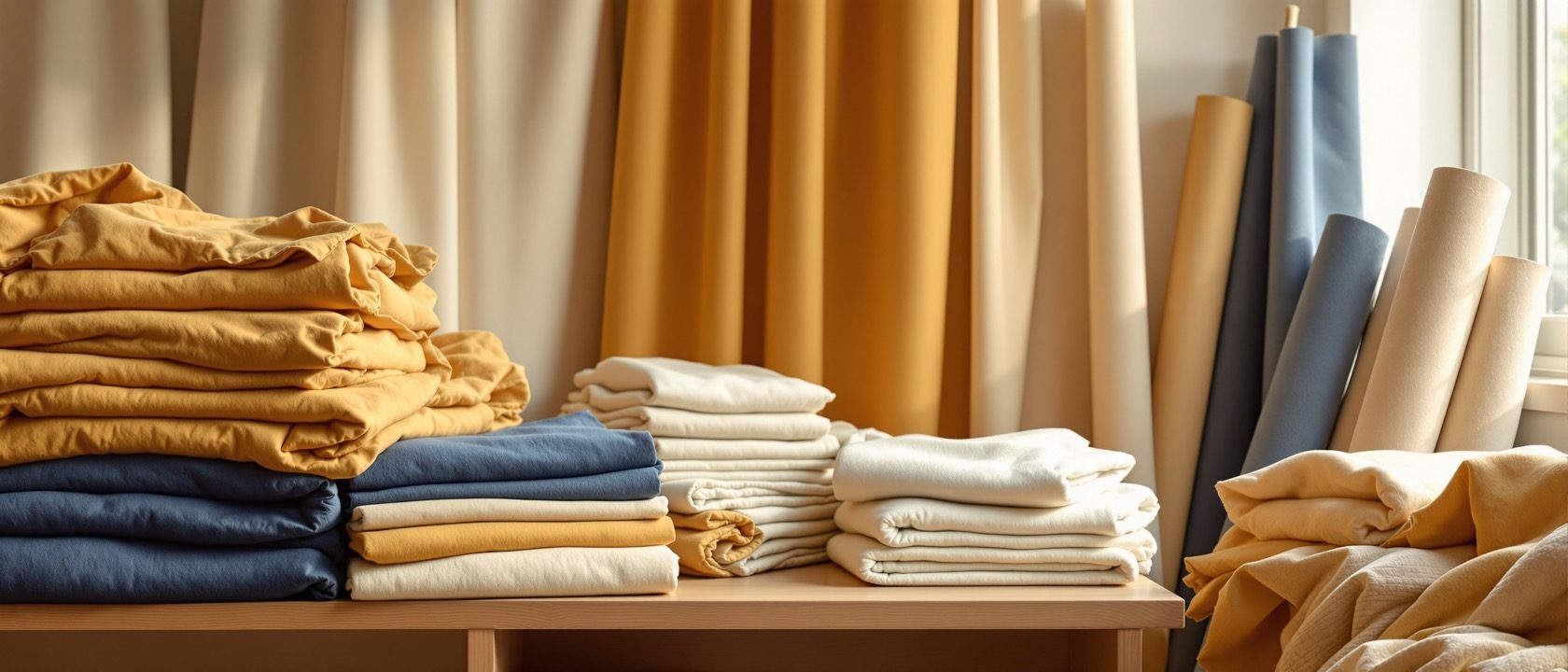
Fabric is a working material, not the finishing touch — it controls light and privacy, absorbs sound, gives comfort, colour and warmth, and defines space. A cloth is defined by its fibre (natural, synthetic, regenerated) and its weave (warp and weft), and read by its properties — weight, drape, hand, colourfastness, durability — against the use. And two honest duties enter early: fabric in public interiors must be safe (flammability) and durable (the rub test) for its job.
Learning objectives
By the end of this lesson, you will be able to — mapped to the course outcomes for Advanced Workshop:
Explain the real functional work fabric does in an interior, beyond decoration.
Distinguish fibre families and weaves, and read a fabric by its properties.
Describe the chain from fibre to finished fabric, and match a fabric to a use.
Fabric does real work
‘Fabric is just the finishing touch’ is a myth. Textiles do real work: curtains control light and privacy, upholstery gives comfort, panels absorb sound, rugs warm and define. A fabric is defined first by its fibre and then by its weave (warp and weft — plain, twill, satin).[1, 4]
Not the finishing touch
'Fabric is just the finishing touch' is a MYTH. Textiles do real, functional WORK in a room. Curtains and blinds control LIGHT and give PRIVACY; upholstery and cushions give COMFORT; rugs warm a floor and define a zone; wall hangings and panels absorb SOUND and soften a space; and everywhere, fabric brings COLOUR, TEXTURE and warmth that hard materials cannot. Fabric is one of the most powerful tools an interior designer has, and it is a WORKING material — chosen for what it does, not only for how it looks. This workshop begins by learning to understand fabric itself, so it can be used with knowledge rather than as an afterthought.[1, 4]
Reading a fabric
A fabric is read by measurable properties — weight (GSM), drape, hand, colourfastness, durability — judged against the use, not the price or looks (‘high thread count = better’ is a myth). And the right fabric for a public interior must be safe and durable: a real professional duty.[1, 4]
The properties that decide
Beyond fibre and weave, a fabric is described by measurable PROPERTIES a designer learns to read. WEIGHT (GSM, grams per square metre) — heavy or light. DRAPE — how it hangs and folds. HAND or HANDLE — how it feels: crisp, soft, coarse. COLOURFASTNESS — how well the colour resists light and washing. DURABILITY — how well it resists rubbing and wear. These decide SUITABILITY: a heavy, durable, colourfast weave for a busy sofa; a light, well-draping cloth for a curtain. Explore this vocabulary in the textile decoder below. The professional habit is to judge a fabric by its properties against the USE — not by its price or its looks alone.[1, 4]
Textile decoder · the vocabulary of fabric & printing
Fibre & fabric, motif & repeat, print methods, and traditions — graded VERIFIED, NUANCED or MYTH.
Fabric in interiors
It does real work
Means: Textiles used in a room — curtains and blinds, upholstery, cushions, rugs, wall hangings and acoustic panels — doing real functional work, not only decoration.
Honestly · Fabric softens light, gives privacy, absorbs sound, adds warmth, comfort, colour and texture, and defines zones. 'Fabric is just the finishing touch' is a myth: it is a working material with function, chosen for the job, not only the look.
Fibre
Natural, synthetic, regenerated
Means: The raw material a yarn is spun from — NATURAL (cotton, silk, wool, linen, jute), SYNTHETIC (polyester, nylon, acrylic) or REGENERATED (viscose/rayon, from natural cellulose).
Honestly · Fibre decides much of a fabric's behaviour — feel, strength, absorbency, care, cost. Knowing the fibre is the first step in judging whether a fabric suits a use; there is no single 'best' fibre, only the right one for the job.
Weave (warp & weft)
How threads interlace
Means: Cloth made by interlacing lengthwise WARP threads with crosswise WEFT threads — in structures such as plain, twill and satin weave, each giving a different surface and strength.
Honestly · The weave, as much as the fibre, gives a fabric its character: plain is simple and strong, twill (like denim) durable with a diagonal, satin smooth and lustrous. Reading the weave is reading how a cloth will behave and look.
Fabric properties
Reading a cloth
Means: The measurable qualities that describe a fabric — weight (GSM), drape (how it hangs), hand or handle (how it feels), colourfastness, and durability (rub resistance).
Honestly · These decide suitability: a heavy, durable, colourfast weave for a busy sofa; a light, well-draping cloth for a curtain. Judge a fabric by its properties against the use, not by its price or its looks alone.
'High thread count = better'
Often marketing
Means: The belief that a higher thread count always means a better, higher-quality fabric.
Honestly · A MYTH, and often marketing: past a point, thread count is inflated by counting plies or using thin, weak yarns, and fibre quality, weave and finish matter more. Judge a fabric by hand, weight, weave and performance — not a single number.
Motif
The design unit
Means: The single design element of a textile — a flower, a paisley (buta), a geometric figure, an abstract mark — from which a pattern is built.
Honestly · A motif is not just a pretty picture: it has structure, symmetry and a source (nature, geometry, culture), and it is designed to work when repeated. Analysing a motif — how it is built and why it works — is the start of textile design.
The repeat
Engineered, not copied
Means: The basic unit of a textile pattern — one tile that tiles seamlessly across the cloth, in layouts such as full-drop, half-drop, brick and toss.
Honestly · NUANCED: a repeat is not a motif merely copied in a grid. A good repeat is ENGINEERED so the join is invisible and the eye finds no seam or awkward line. Designing the repeat unit — the hardest part of textile design — is a real craft.
Repeat layouts
Full-drop, half-drop, brick, toss
Means: The ways a repeat unit is arranged: FULL-DROP (aligned in a grid), HALF-DROP (alternate columns dropped), BRICK (alternate rows shifted), and TOSS (motifs at varied angles).
Honestly · Each layout gives a different rhythm and hides the join differently: half-drop and toss break the grid and feel more natural; full-drop is orderly and formal. Choosing the layout is choosing the character and the flow of the pattern.
Colourway
One design, many palettes
Means: A particular colour combination of a single textile design — the same motif and repeat printed in different palettes (indigo on white, ochre on cream, and so on).
Honestly · One design lives in many colourways, each suiting a different room and mood, and each needing its own separated colours to print. Thinking in colourways — not one fixed colouring — is how a textile design becomes a usable, flexible product.
Block printing
Hand craft, alive
Means: Printing cloth by hand with carved WOODEN blocks — an outline (rekh) block and fill (datta/gad) blocks — dipped in dye and stamped in repeat, registered by hand.
Honestly · A living hand craft, not a relic: precise carving, careful registration and real skill. Its slight irregularities are the signature of the hand, its authenticity and value — the mark of a person, not a flaw to be 'fixed'.
'Block printing is primitive'
It is a living GI craft
Means: The belief that hand block printing is old-fashioned, unskilled, dying or obsolete beside machine printing.
Honestly · A MYTH. It is a highly skilled, living craft, GI-protected (Sanganeri 2009, Bagru 2011) and globally valued precisely for being handmade. Its irregularity is its worth. Machine printing is different work, not 'better' work; the craft is alive and prized.
Screen printing
Flat, even, scalable
Means: Printing by pushing ink with a SQUEEGEE through the open (design) areas of a fine mesh SCREEN onto the cloth below — one screen per colour, aligned by registration.
Honestly · Excellent for flat, even coverage, large solid areas, fine and photographic detail, and larger runs. The screen is prepared by stencil or photo-emulsion to block the non-design mesh. A different tool from the block — suited to different work.
'Screen is better than block'
Different, not better
Means: The belief that screen printing simply replaces or improves on block printing.
Honestly · A MYTH. They are DIFFERENT techniques with different aesthetics: block gives hand-mark character, small repeating units and craft value; screen gives flat even coverage, large flats and fine detail. Each suits different work — neither is simply 'better'.
'Natural dye is always greener'
The honest whole-life view
Means: The belief that natural (vegetable/mineral) dyes are always better and more sustainable than synthetic ones.
Honestly · NUANCED. Natural dyes are biodegradable and culturally rich, but vary in colourfastness, need mordants (some, like chrome, are toxic) and can be land- and water-hungry; modern low-impact synthetics can be more consistent. Judge whole-life, not the label.
'Digital killed block & screen'
They coexist
Means: The belief that digital textile printing has made block and screen printing pointless.
Honestly · A MYTH. Digital printing is fast, photographic and low-setup, superb for short runs and complex imagery — but block and screen keep their craft value, hand, texture and tradition. They coexist; a designer chooses the method for the work and the meaning.
Ajrakh
Resist-dye, indigo & madder
Means: A complex, many-step RESIST block-print tradition of Kutch (Gujarat), Barmer (Rajasthan) and Sindh — geometric, double-sided, in natural indigo and madder on both faces of the cloth.
Honestly · One of the world's most sophisticated hand-print crafts — up to sixteen or more stages of printing, resisting and dyeing. Its precision and depth are the opposite of 'primitive'; it is a living, protected tradition of extraordinary skill.
Bagru & Sanganeri
Rajasthan's block towns
Means: Two famed Rajasthani hand-block traditions: SANGANERI (fine, delicate motifs on a WHITE ground; GI 2009) and BAGRU (bolder, natural-dyed, dabu mud-resist on an OFF-WHITE/fawn ground; GI 2011).
Honestly · GI-protected living crafts, distinguished by ground and dye: Sanganeri white and fine, Bagru fawn and earthy with mud-resist. Knowing India's block towns — and respecting their protected names — is part of an Indian designer's literacy.
The textile industry
Fibre to finished cloth
Means: The chain that turns fibre into designed cloth — FIBRE, then YARN (spinning), then FABRIC (weaving/knitting), then FINISHING and DYEING/PRINTING and DESIGN — from hand craft to mill scale.
Honestly · Understanding the whole chain lets a designer specify honestly: where a fabric comes from, how it was made and finished, its cost and its impact. India's textile industry spans village block-print units to large mills; the designer works across both.
Flammability & durability
The right fabric for the use
Means: The real performance duties of interior fabric: FLAMMABILITY standards for drapery and upholstery in public spaces (tests such as NFPA 701 and BS 5852) and DURABILITY (the Martindale rub test) for high-traffic use.
Honestly · Not just any fabric suits any interior. Curtains and upholstery in public and commercial spaces must resist ignition, and busy seating needs a high rub count. Specifying a fabric that is safe and durable for its use is a professional responsibility, not an afterthought.
Craft deserves respect, not nostalgia — choose the right fabric, dye and method for the work.
Fibre to fabric
Cloth is the end of a chain — fibre → yarn (spinning) → fabric (weaving) → finishing → design. India’s textile industry spans village hand-block units to large mills, and a designer works across both — knowing the chain is knowing what you are really specifying.[1, 3]
The chain, and the industry
Cloth is the end of a CHAIN: FIBRE (grown or made) is spun into YARN, yarn is woven or knitted into FABRIC, the fabric is FINISHED (bleached, dyed, treated), and then DESIGNED and printed. Understanding the whole chain lets a designer specify HONESTLY — where a fabric comes from, how it was made and finished, its cost and its impact. India's TEXTILE INDUSTRY spans the whole range, from village hand-block units and handlooms to large power-loom mills, and a designer works across both — a mill-woven base cloth, hand block-printed by a craftsperson, for one project. Knowing the chain and the industry is knowing what you are really specifying, and being able to source and judge it well.[1, 3]
At a glance
| Aspect | The fact | The folklore |
|---|---|---|
| Fabric in a room is | A working material — light, privacy, sound, comfort, colour | Just decoration, the finishing touch |
| A fabric is defined by | Its FIBRE and its WEAVE (warp and weft) | Only its colour |
| The best fibre is | The right one for the job — no single 'best' | Always natural / always synthetic |
| You judge a fabric by | Its properties (weight, drape, hand, fastness, durability) against the use | Its price or its looks alone |
| 'High thread count = better' | A myth — often marketing; weave and fibre matter more | Always true |
| Safety and durability are | Real DUTIES — flammability and rub tests for the use | Optional extras |
Key terms
The raw material a yarn is spun from — natural (cotton, silk, wool, linen, jute), synthetic (polyester, nylon, acrylic) or regenerated (viscose/rayon); it decides much of a fabric's behaviour.
Cloth made by interlacing lengthwise warp and crosswise weft threads — in plain, twill, satin and other structures, each with its own surface and strength.
Drape is how a fabric hangs and folds; hand (or handle) is how it feels — crisp, soft, coarse — two key properties in judging a cloth for a use.
GSM is a fabric's weight (grams per square metre); colourfastness is how well its colour resists light and washing — both read to judge suitability.
How well a fabric resists rubbing and wear — measured by the Martindale rub test, counting the rubs it survives; high-traffic upholstery needs a high count.
The responsibility to specify fabric that resists ignition in public and commercial interiors — assessed by tests such as NFPA 701 (drapery) and BS 5852 (upholstery).
Study task
Gather four fabric swatches from around you — a curtain, an upholstery cloth, a shirt, a bedsheet. For each, identify the likely fibre and weave, and describe its properties: is it heavy or light, how does it drape, how does it feel (hand), does it seem colourfast and durable? Then name the use each would suit in an interior, and one it would fail. Pick the one you would choose for a busy public sofa, and say why — considering flammability and durability, not just looks. Using the decoder, grade three things you have heard about fabric as VERIFIED, NUANCED or MYTH. The goal is to read a cloth as a working material, chosen for the job.
Self-assessment
1. What is the honest view of fabric in an interior?
2. What defines a fabric first?
3. How should a designer judge a fabric?
4. Why are flammability and durability real duties?
Recap
References & further reading
- [1]Marypaul Yates, Fabrics: A Guide for Architects and Interior Designers, W. W. Norton — fibre, weave, fabric properties and specifying textiles for interiors. https://wwnorton.com/
- [3]The textile chain and industry — fibre to yarn to fabric to finishing and design, from hand craft to mill (textile-manufacturing references). https://textilelearner.net/
- [4]Corky Binggeli, Materials for Interior Environments, John Wiley & Sons — textiles among interior materials, their properties, performance and use. https://www.wiley.com/
Further reading
- Marypaul Yates, Fabrics: A Guide for Architects and Interior Designers.
- Corky Binggeli, Materials for Interior Environments.
- June Fish, Designing and Printing Textiles, The Crowood Press.
Sources gathered and fact-checked June 2026. Published values vary by source, sample and method — treat as indicative and confirm against the cited standard before structural use.
The author
Amogh N P
Architect, interior designer, and creative polymath. Studio Matrx began in his notebooks — his vision of design made honest, useful, and open to everyone. Its Academy is written and taught in his memory, and free, forever.
More about Amogh →