Block Printing
A living craft — its irregularity is its worth
Block printing stamps colour from a hand-carved wooden block. A multi-colour print needs an outline (rekh) block plus fill (datta) blocks, one per colour, registered perfectly by hand — precise, disciplined work. ‘Natural dye is always greener’ is nuanced, and ‘block printing is primitive’ is a myth: it is a highly skilled, GI-protected living craft — Sanganeri, Bagru, Ajrakh, Kalamkari — whose slight irregularity is its authenticity and worth.
Learning objectives
By the end of this lesson, you will be able to — mapped to the course outcomes for Advanced Workshop:
Explain how a printing block is carved and how outline and fill blocks register.
Weigh natural against pigment dyes honestly, over their whole life.
Recognise India's living block-print traditions and why the craft is valued.
The block, and registration
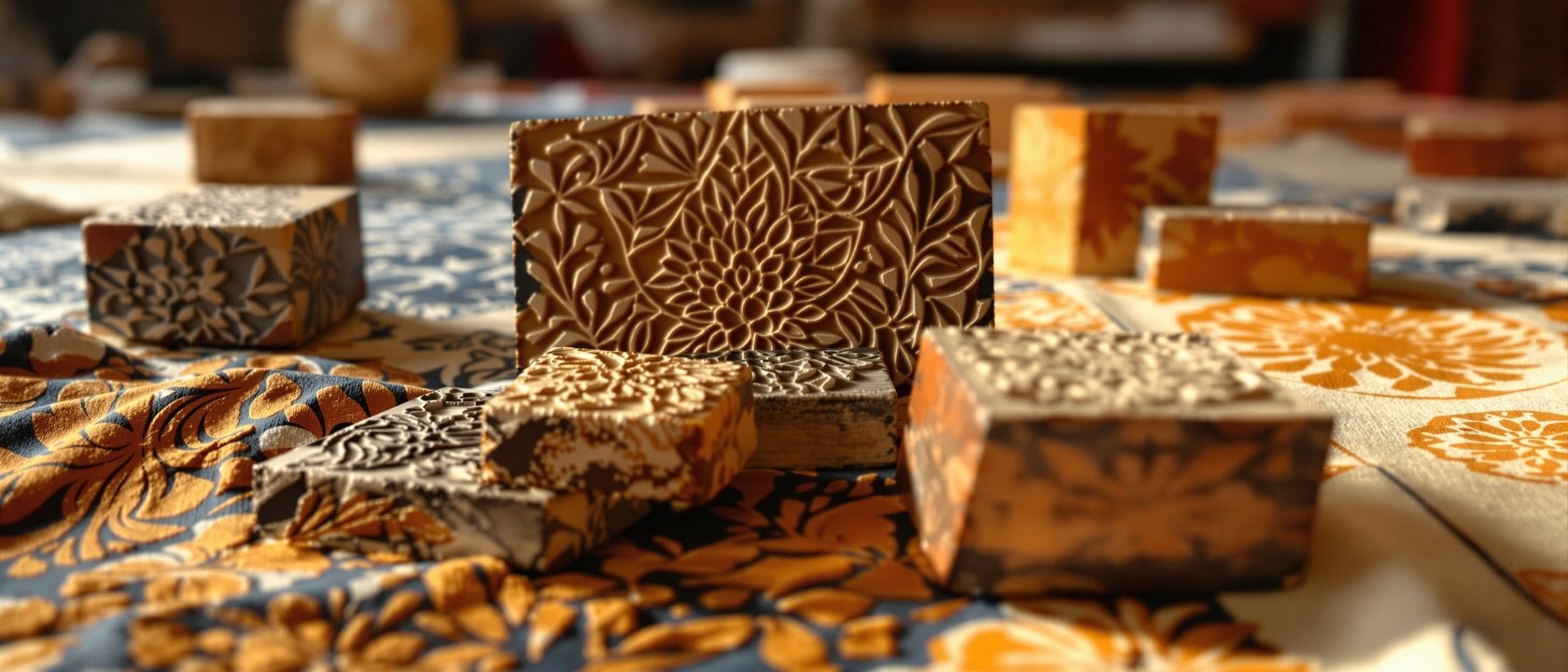
Block printing starts with a hard wooden block (sheesham/teak), carved so the design stands in relief. A multi-colour print uses several — a rekh (outline) block and datta (fill) blocks, one per colour — that must register perfectly by hand. This precision is the real skill, the opposite of crude.[1, 2]
Carved by hand, from wood
Block printing starts with the BLOCK — a piece of hard WOOD (traditionally sheesham or teak), on the face of which a design is carved by hand so the design STANDS UP in relief. The carver's skill is exacting: fine lines, clean edges, and small holes for the dye to breathe and for registration. A good block can print thousands of impressions and last for years. Making the block is itself a craft (the block-makers of Pethapur in Gujarat are famous), separate from and as skilled as the printing. To print, the block is dipped in dye and pressed firmly on the cloth, then lifted and moved along — by hand, by eye, in repeat. This is where a designer meets the material directly.[1, 2]
Dyes, honestly
‘Natural dye is always better and greener’ is a nuanced half-truth. Natural dyes (indigo, madder, turmeric) are biodegradable and beautiful, but vary in colourfastness, need mordants (some toxic, like chrome), and can be land- and water-hungry; modern low-impact synthetics can be more consistent. Judge whole-life, not the label.[1, 3]
Natural is not simply greener
Block printing uses DYES, and 'natural dye is always better and greener than synthetic' is a NUANCED half-truth. NATURAL dyes (indigo blue, madder red, turmeric yellow, pomegranate) are biodegradable, culturally rich and beautiful — but they vary in COLOURFASTNESS, need MORDANTS to fix them (some mordants, like chrome, are toxic), and can be land- and water-hungry to grow and process. Modern low-impact SYNTHETIC or pigment dyes can be more consistent and colourfast. The honest view is WHOLE-LIFE: neither is automatically better; each has real trade-offs of colour range, fastness, consistency and impact. A designer chooses the dye for the cloth, the use and the values — with open eyes, not by the label.[1, 2]
India's living traditions
India holds the world’s greatest hand-block traditions, and they are alive and geographically protected: Sanganeri (fine, white ground; GI 2009), Bagru (dabu mud-resist, fawn; GI 2011), Ajrakh (resist, indigo & madder, both sides), Kalamkari (pen & block). ‘Block printing is primitive’ is a myth — its slight irregularity is the signature and value of the hand.[2]
Sanganeri, Bagru, Ajrakh, Kalamkari
India holds the world's greatest hand-block traditions, and they are ALIVE and geographically PROTECTED. SANGANERI (Rajasthan; GI 2009) is fine and delicate, with small floral motifs on a WHITE ground. BAGRU (Rajasthan; GI 2011) is bolder and earthier, natural-dyed with DABU mud-resist on an off-white/fawn ground. AJRAKH (Kutch in Gujarat, Barmer in Rajasthan, and Sindh) is a complex, many-stage RESIST print in natural indigo and madder, geometric and printed on BOTH sides — one of the most sophisticated textile crafts on earth. KALAMKARI (Andhra Pradesh) exists in two forms: Srikalahasti (drawn with a pen, the kalam) and Machilipatnam (block-printed). Knowing and respecting these named, protected traditions is part of an Indian designer's literacy.[2, 3]
At a glance
| Aspect | The fact | The folklore |
|---|---|---|
| A printing block is | Hard wood, hand-carved so the design stands in relief | A crude stamp |
| A multi-colour print needs | An outline (rekh) block + fill (datta) blocks, registered by hand | One block for everything |
| 'Natural dye is always greener' | Nuanced — fastness, toxic mordants, land/water; judge whole-life | Always true |
| Block printing is | A highly skilled LIVING craft, GI-protected | Primitive, dying, obsolete |
| Its slight irregularity is | The signature and value of the hand | A defect to fix |
| Ajrakh, Sanganeri, Bagru, Kalamkari are | Named, protected living traditions to respect | Generic old patterns |
Key terms
A hard wooden block (sheesham/teak) with a design carved in relief on its face, dipped in dye and pressed on cloth by hand — a craft in itself to carve.
The outline (rekh) block and the fill-colour (datta/gad) blocks — one per colour — that must register perfectly by hand to build a multi-colour motif.
A substance that fixes a natural dye to the fibre; essential to colourfastness, but some (like chrome) are toxic — one reason natural dye is not automatically greener.
A resist paste of mud, lime and gum applied by hand or block so dye cannot reach that area — the technique behind Bagru's characteristic prints.
A complex, many-stage resist block-print of Kutch, Barmer and Sindh, in natural indigo and madder, geometric and printed on both sides — one of the most sophisticated textile crafts.
Two GI-protected Rajasthani block-print traditions — Sanganeri (fine, white ground; GI 2009) and Bagru (bold, natural-dyed, dabu mud-resist, fawn ground; GI 2011).
Study task
Take one of your motifs and plan it as a two-colour block print. Describe the blocks you would need — the rekh (outline) block and one datta (fill) block — and how they would register to build the motif. Choose a dye approach (natural or pigment) and argue it honestly over its whole life: colour, fastness, mordants, impact — not by the label. Then research ONE of India’s living traditions — Sanganeri, Bagru, Ajrakh or Kalamkari — and write three lines on what makes it distinctive and why it is protected. Finish by explaining, in your own words, why the slight irregularity of a hand block print is its worth, not a defect. The goal is to respect the craft and understand it as skilled, living work.
Self-assessment
1. What does a multi-colour block print require?
2. Is natural dye always greener than synthetic?
3. Is hand block printing primitive or obsolete?
4. What is Ajrakh?
Recap
References & further reading
- [1]June Fish, Designing and Printing Textiles, The Crowood Press — block printing: carving the block, outline and fill blocks, dyes and printing. https://www.crowood.com/
- [2]India's hand-block traditions — Sanganeri (GI 2009), Bagru (GI 2011, dabu mud-resist), Ajrakh (Kutch/Barmer/Sindh resist-dye), Kalamkari (Srikalahasti & Machilipatnam); their techniques and protected status. https://search.ipindia.gov.in/GIRPublicSearch/
- [3]R. W. Lee, Printing on Textiles by Direct and Transfer Techniques, and references on natural dyes, mordants and their honest trade-offs. https://www.sciencedirect.com/
Further reading
- June Fish, Designing and Printing Textiles, The Crowood Press.
- R. W. Lee, Printing on Textiles by Direct and Transfer Techniques, Noyes Data Corporation.
- References on Indian hand-block traditions (Ajrakh, Bagru, Sanganeri, Kalamkari) and natural dyeing.
Sources gathered and fact-checked June 2026. Published values vary by source, sample and method — treat as indicative and confirm against the cited standard before structural use.
The author
Amogh N P
Architect, interior designer, and creative polymath. Studio Matrx began in his notebooks — his vision of design made honest, useful, and open to everyone. Its Academy is written and taught in his memory, and free, forever.
More about Amogh →