
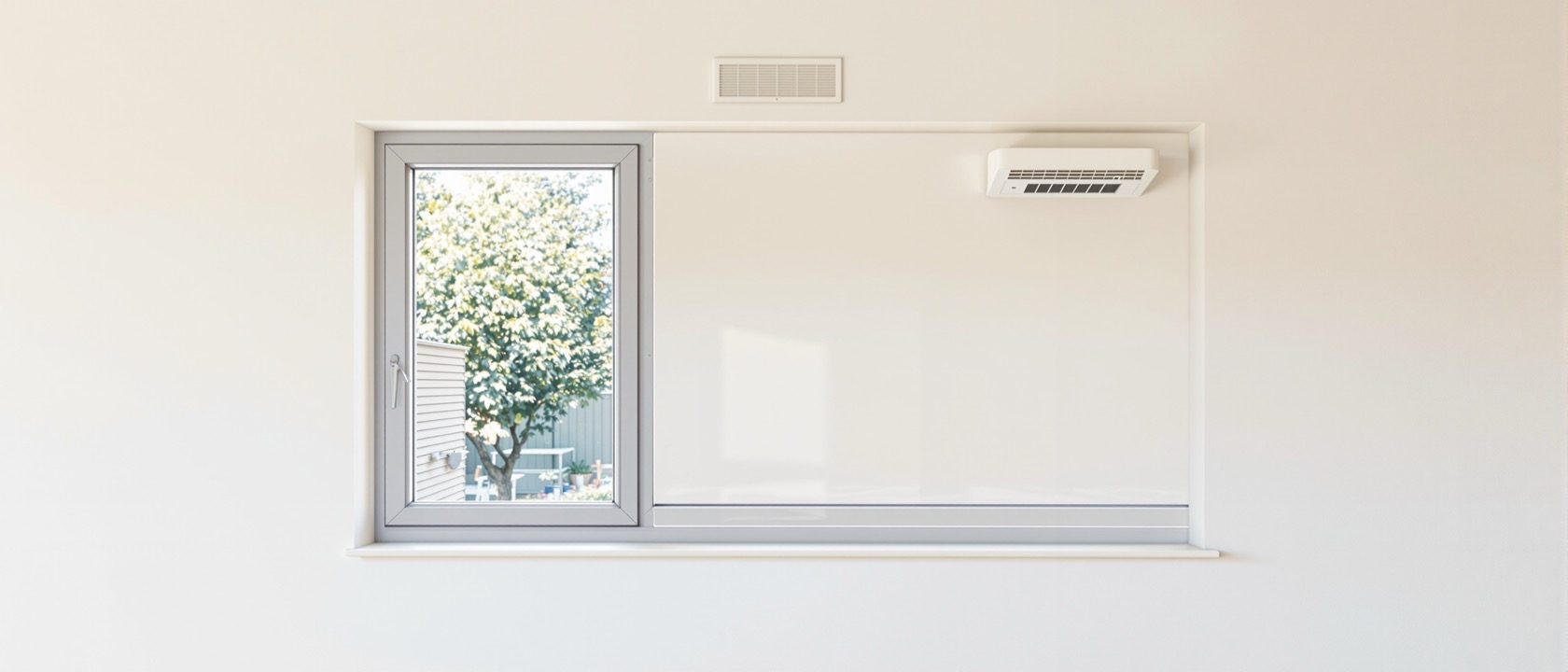
Doors, Windows & Ventilators
Classified by material, operation and nature — and the honest truth about 'advanced' materials
An opening is classified three ways — by material, by operation (how the leaf moves), and by nature (French, corner, bay) — and each choice carries honest trade-offs. The course objective’s claim that ‘advanced technologies have overtaken the old’ is only half true: aluminium thermally bridges unless it has a thermal break, uPVC has its own trade-offs, and timber’s thermal performance was always good. The real advance is the double-glazed unit — and ‘double glazing is only for cold countries’ is a myth.
Learning objectives
By the end of this lesson, you will be able to — mapped to the course outcomes for Advanced Materials & Applications:
Classify an opening by material, operation and nature, and name where each belongs.
Explain how each operation (swing, slide, fold, pivot, revolve, hang, louvre) sets clearance and seal.
Judge aluminium vs uPVC vs timber honestly, including aluminium's thermal bridging.
Grade the 'double glazing is only for cold countries' claim for the Indian climate.
Choose an operation and material for a given opening and justify both.
The material question
Classify the opening three ways, and grade the ‘advanced beats old’ claim honestly — because aluminium is a superb conductor that bridges heat unless it carries a thermal break.[1, 2]
'Advanced' overtook 'old' — only half true
An opening can be timber, engineered/flush and industrial timber, mild steel, aluminium, uPVC, glass or concrete, and the course objective's line that advanced materials have overtaken the old ones needs grading. Aluminium is strong, slim, precise and low-maintenance — but bare aluminium is a superb conductor (it conducts heat on the order of a THOUSAND times faster than wood and hundreds of times faster than uPVC), so it THERMALLY BRIDGES, carrying heat straight through the frame unless it is built with a thermal break; a broken frame roughly halves the heat loss of an unbroken one. uPVC insulates well through its hollow chambers and never needs painting — but under strong sun it weathers and can yellow over years, is less stiff (needs steel reinforcement for big spans), and its fire behaviour is nuanced not simply 'safe' (it self-extinguishes and resists ignition, but burning releases toxic smoke and hydrogen chloride and unreinforced profiles soften). Steel is strong and slim but rusts without protection. And timber, the 'old' material, always had good thermal performance and real repairability; its only real cost is maintenance and, in India, termite risk. So the honest verdict: the materials each have a place, and 'newer is better' is a sales line, not a law. (Real Indian systems to know: Fenesta and Schüco for aluminium/uPVC windows.)[1, 2]
How the leaf moves
Operation is a design decision as important as the material: swing, slide, fold, pivot, revolve, hang or louvre — each sets the clearance the opening needs and the seal it can make.[3]
Casement, pivoted, revolving
The swinging openings turn a leaf about an axis. A CASEMENT (side-hung) is the default openable window and door — a full opening and a good seal, at the cost of the swing space. A PIVOTED leaf turns on a central or offset pivot, which lets it carry a large, heavy leaf that edge hinges could not, and makes an architectural statement — but because part of the leaf swings the 'wrong' way it cannot seal or lock like a hinged door, so it is rarely the security or weather choice. A REVOLVING door rotates continuously in a drum; its real purpose is to act as an AIR-LOCK at a busy entrance, stopping the constant draught and heat loss of an open door, and it always needs a swing door beside it for accessibility and escape.[3]
Explore the operations
Pick an operation and see how the leaf moves — the casement’s swing, the slider that opens only half, the bi-fold that opens the whole width, the top-hung that sheds rain. The diagram shows the clearance each needs and the seal it can make.
Operation explorer · how the leaf moves sets the seal
Openable / casement
Motion: Side-hinged leaf swings out (or in) on hinges
Suits: General rooms; the default openable window and door
Clearance: The full arc of the swing must be clear
Seals well against a rebate and throws a full opening for ventilation. The swing eats floor or facade space, and an out-swing catches wind and rain.
Operation is a design decision as important as the material: it sets the clearance the opening needs and the seal it can make. A fixed light seals best because it never opens.
At a glance
| Aspect | The fact | The folklore |
|---|---|---|
| 'Advanced beats old' | NUANCED: each material has a place — aluminium/uPVC/timber trade off | MYTH: newer is always better (aluminium thermally bridges) |
| Aluminium frame | Slim, strong, low-maintenance — but needs a THERMAL BREAK | MYTH: aluminium alone insulates. Bare aluminium bridges heat |
| Fixed vs openable | A FIXED light seals best — it never opens (no gaps/hardware) | Assuming every opening must open — pair fixed + a vent |
| Sliding door | Saves swing space — but opens only HALF, seals less well | MYTH: a slider opens the full width like a bi-fold |
| Double glazing | Cuts heat AND noise — useful in hot India, not just cold climates | MYTH: double glazing is only for cold countries |
| Revolving door | An AIR-LOCK cutting draught/heat loss — needs a swing door beside it | MYTH: it's just for grandeur; it can serve escape/accessibility |
Key terms
A side-hinged openable leaf. The default window/door — full opening, good seal, needs swing space.
A leaf turning on a central/offset pivot. Carries a heavy leaf and makes a statement, but can't seal or lock like a hinge.
Folding leaves hung from a top track that also slide — the wide-span movable-partition workhorse (no floor track).
Hinged at top (sheds rain outward — ventilators) or bottom (tilts in, vents securely). The two ventilator hangs.
Tilting angled slats — ventilation with privacy and rain-shedding, but seals and insulates poorly.
An insulating barrier inside a metal frame that stops heat conducting straight through. Without it, aluminium THERMALLY BRIDGES.
Two panes with a sealed gas gap — the real 'advanced' glazing. Cuts heat and noise; not just for cold climates.
U-value = heat passing through the glazing (lower better); SHGC = solar heat admitted (lower = cooler room). The two glass numbers to spec.
The small high-level opening for air (often top-hung or louvred), distinct from the window it sits above.
Study task
Take one real opening you can see — a window or a door — and classify it honestly by material, operation and nature. Then propose an alternative: if you would change the material, say what you gain and what you give up (and, for aluminium, whether it needs a thermal break); if you would change the operation, say how the clearance and seal change. Finally, decide whether double glazing would earn its cost here, naming the heat and noise it would cut. Classifying an opening and weighing the material trade-offs honestly — not just picking the ‘advanced’ one — is the judgement this unit builds.
Self-assessment
1. A rep says 'switch to aluminium windows — they're more advanced than timber.' What's the honest response?
2. Which opening OPERATION seals best, and why?
3. Is double glazing worth it in a hot Indian city?
4. Why is a ventilator usually TOP-HUNG?
Recap
References & further reading
- [1]Ching, Francis D. K. (2014). Building Construction Illustrated (5th ed.). Wiley. Doors, windows, frames and the material/operation fundamentals.
- [2]Riggs, J. Rosemary (2013). Materials and Components of Interior Architecture (8th ed.). Pearson/Prentice Hall. Windows, doors and their materials for interiors. (On aluminium thermal bridging and thermal breaks — verify the specific thermal-conductivity figures against a glazing manufacturer's data.)
- [3]Plunkett, Drew (2014). Construction and Detailing for Interior Design. Laurence King. Opening operation types and interior detailing.
- [4]On insulated glass units, U-value and SHGC for the Indian climate: see the Energy Conservation Building Code (ECBC) glazing guidance and glazing-manufacturer technical data. 'Double glazing only for cold climates' is a common misconception; Low-E DGUs reduce solar heat gain and noise in hot climates. (Confirm specific U-value/SHGC figures per product.)
- [5]Indian opening standards (commonly misquoted): IS 1003 Part 1 (timber door shutters, 2003) & Part 2 (window/ventilator shutters, 1994); IS 4021 (timber frames); flush/engineered doors IS 2202 & IS 2191. STEEL: IS 1038 (steel doors, windows and ventilators) — NOTE IS 4351 is steel door FRAMES, not windows; IS 1361 (industrial steel windows). Bureau of Indian Standards. https://www.bis.gov.in/
- [6]Aluminium & uPVC: IS 733 is the wrought aluminium ALLOY bar/rod/SECTION (the extrusion), while IS 1948 is the finished aluminium door/window/ventilator — two different levels. uPVC has IS 17953:2023 (profiles for windows and doors) and IS 15931:2012 (uPVC door shutters). NBC: SP 7:2016 is WITHDRAWN, superseded by SP 7:2026 (though most state byelaws still reference NBC 2016). Verify opening/ventilation provisions. https://www.bis.gov.in/
Further reading
- Ching, Francis D. K. — Building Construction Illustrated. Wiley. The illustrated reference for openings and detailing.
- Plunkett, Drew — Construction and Detailing for Interior Design. Laurence King.
- Riggs, J. Rosemary — Materials and Components of Interior Architecture. Pearson.
- Punmia, B. C. — Building Construction / Building Materials. Laxmi / New Age International.
- Indian Standards: IS 1003 (timber shutters), IS 1038 (steel doors/windows/ventilators; IS 4351 = steel door frame), IS 1948 (aluminium windows) / IS 733 (aluminium section), IS 17953:2023 (uPVC profiles). Bureau of Indian Standards.
Sources gathered and fact-checked June 2026. Published values vary by source, sample and method — treat as indicative and confirm against the cited standard before structural use.
The author
Amogh N P
Architect, interior designer, and creative polymath. Studio Matrx began in his notebooks — his vision of design made honest, useful, and open to everyone. Its Academy is written and taught in his memory, and free, forever.
More about Amogh →