Twenty-two hours in The Orchard, Doha
A long layover at Hamad International Airport becomes a lesson in architecture, landscape, engineering, technology and human psychology — and a reminder that great design can turn waiting into wonder.
There is a particular despair that arrives when you check a boarding pass and find a twelve-hour gap before your next flight. Mine, last December, was twenty-two. I was flying home from Sulaimaniyah, in northern Iraq, tired in the way that only a string of connecting flights can manage, and Doha's Hamad International was where I would spend the better part of a day and a night. I had already rehearsed the survival routine — find a lounge, find a coffee, walk the same loop of duty-free until my feet complained. What I had not budgeted for was wonder.
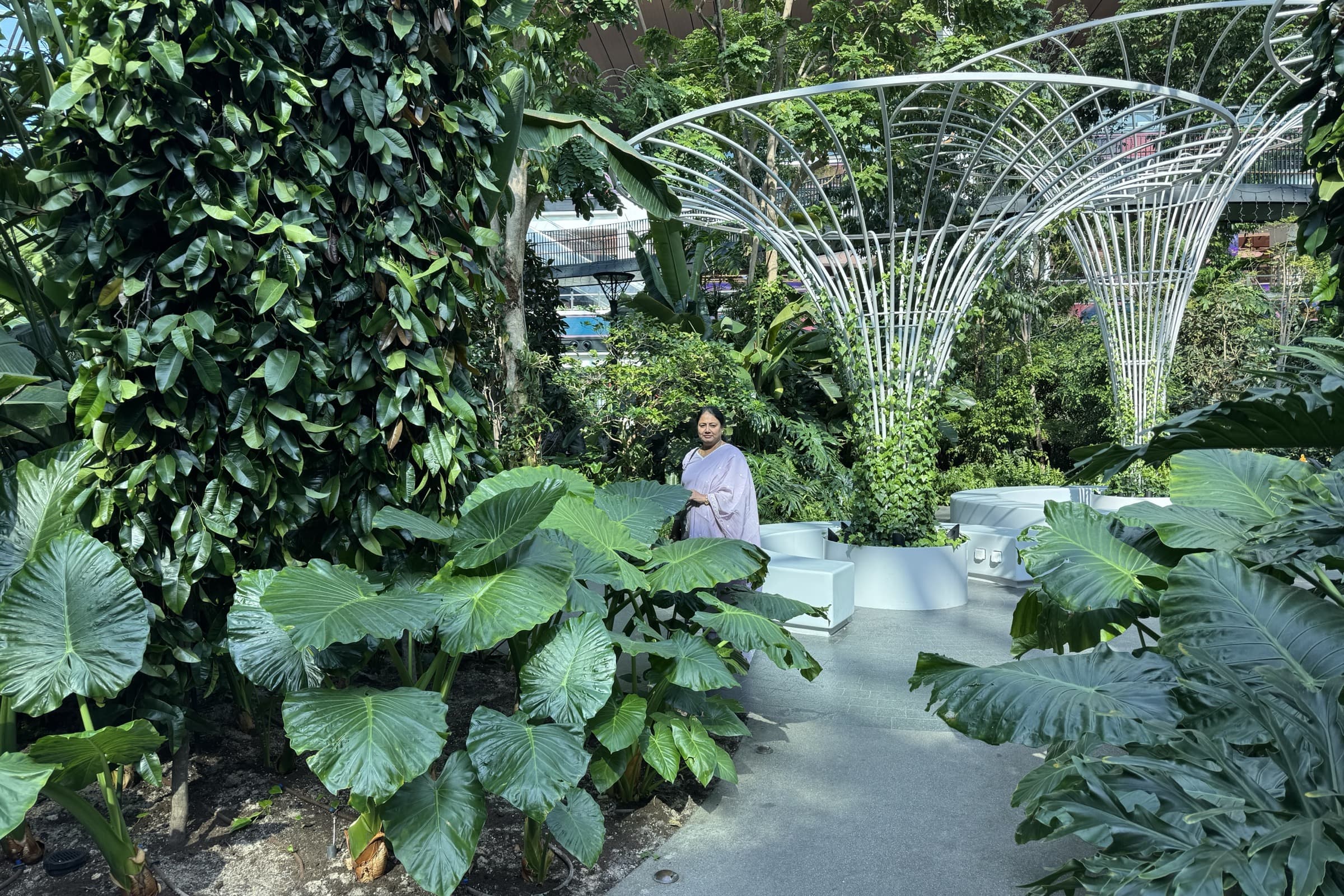
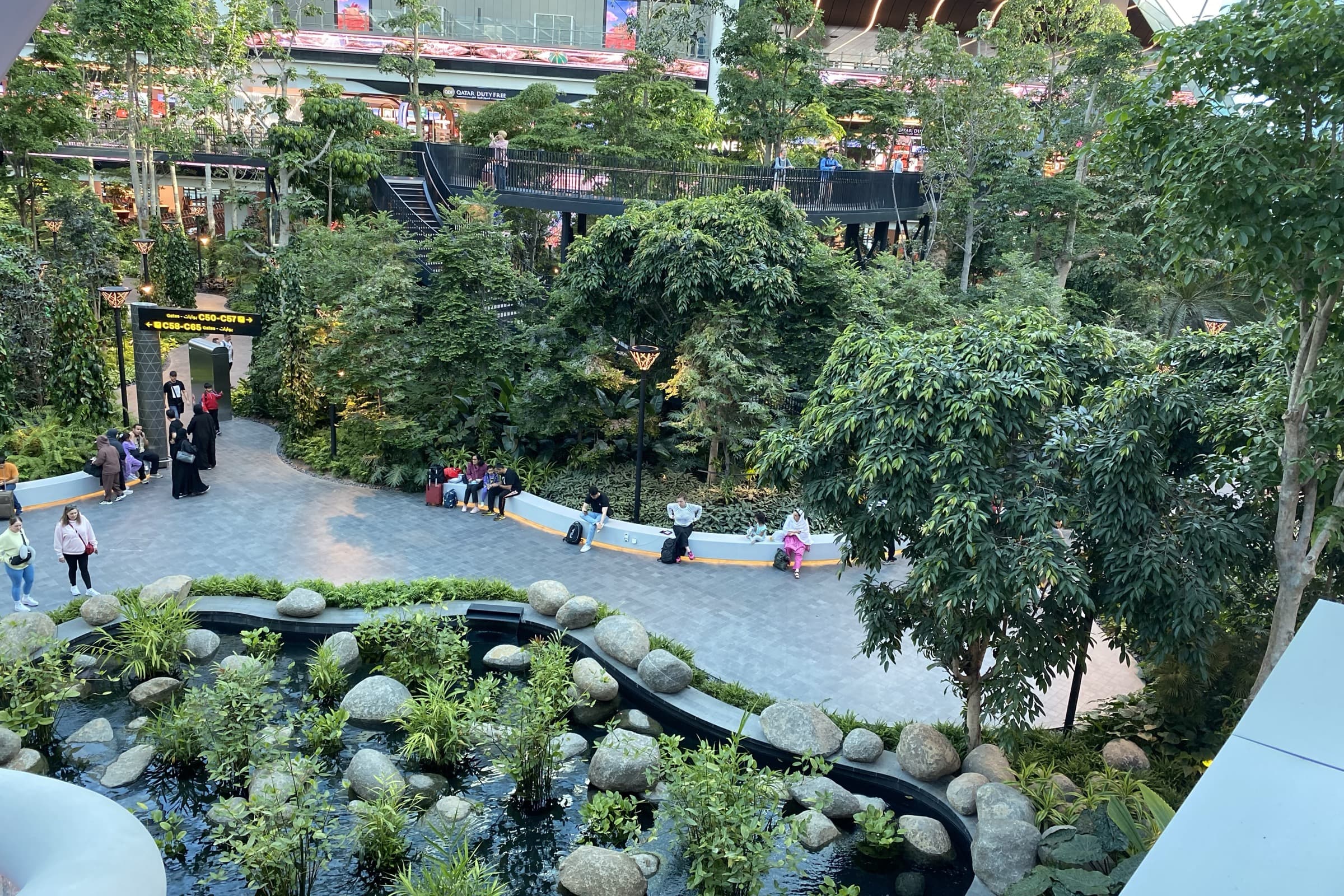
You come upon The Orchard almost by accident. One moment you are inside the cool, glassy efficiency of one of the busiest airports on earth; the next, the corridor opens and there is a forest. Not a planter, not a polite row of palms in pots, but a genuine tropical garden — some ten thousand square metres of it, breathing under a great vaulted roof of glass. Trees reach for the light. Ferns and philodendrons bank up in layers along the paths. Near the centre, water moves quietly over stone in a pool that runs to nearly 268 square metres. I stood at the edge of it for a while, the way you pause at the lip of something you weren't expecting, and forgot, briefly, that aircraft were pushing back a few hundred feet away.
What struck me first was not the scale but the change in everyone's pace. Travellers who had been speed-walking through immigration a minute earlier slowed to a stroll. A family unpacked itself onto a bench and simply sat. Two men in suits put their phones away to look up at the canopy. Children, who always recognise a good thing, treated the winding paths as an adventure. The garden was quietly doing what most airports never even attempt — it was making people feel better. After days of airports, that small mercy was the thing I noticed before I noticed anything clever about the building.
The Orchard is the centrepiece of Hamad's expansion, and it is the work of Foster + Partners, a practice that evidently decided an airport need not feel like one. They shaped the architecture, the interiors and, most spectacularly, the roof: a column-free glass grid-shell that arcs over the whole garden without a single post interrupting the green. It is the sort of structure you stop noticing the instant it does its job — which is the highest compliment you can pay a piece of engineering. The glass lets daylight flood in while holding back the worst of the desert sun's heat, the exact climate a rainforest needs to survive indoors in Qatar. Beneath it grow more than three hundred trees and over twenty-five thousand plants and shrubs.
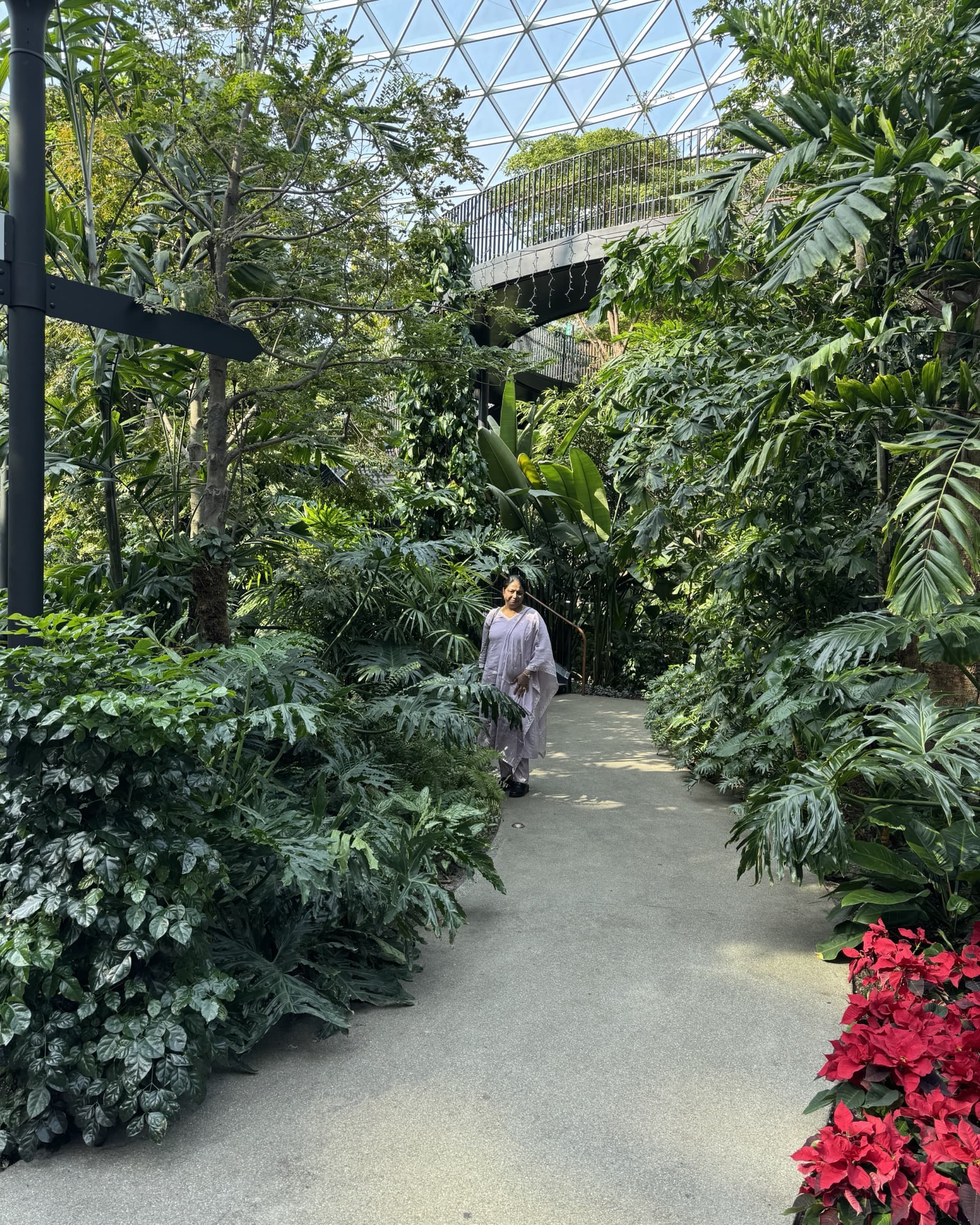
I kept circling back to how unbothered the place felt about a distinction architects have argued over for a century. For decades 'modern' meant steel and glass and right angles, with nature kept politely outside the wall. The Orchard simply declines the argument. The geometry is exact, the engineering is serious, the circulation is carefully plotted — and still you feel as though you have walked into something growing and alive. The architecture isn't competing with the garden; it is the frame that lets you see it. The trade has a word for this — biophilic design, the idea that people need contact with the living world even, perhaps especially, in the most engineered places we build. The Orchard is the most persuasive case for it I have ever walked through.
Less obvious, and rather cleverer, is how much of the garden is digital. The immersive media threaded through it is the work of Moment Factory, a studio known for blending light, sound and story into physical space. The restraint is the achievement. There are no walls of clamouring screens; the technology hangs back, surfacing as small moments of light and discovery that you half-catch and then go looking for. Nature and software, for once, in conversation rather than competition — a glimpse, maybe, of how the public spaces of the coming decades will be made.
The beauty announces itself; the engineering keeps its secrets. Growing a rainforest inside a terminal means governing temperature, humidity, irrigation and drainage with a care that never shows, and planning not for plants that merely survive but for trees meant to keep growing for as long as the airport stands. Holding those maturing trees steady is a hidden skeleton — stainless-steel 'Deadman' and eyebolt anchoring systems, supplied through WT Burdens and installed by Urban Landscapes in Doha, buried out of sight beneath the soil. I found that detail strangely moving. A passenger admires the shade; somewhere below, an anchor no one will ever see is holding a tree to the earth. The best engineering is usually the part nobody photographs.
And yet people photograph everything else. Airports have long fought for our loyalty with route maps, lounges and the sheer size of their duty-free halls. Doha chose to compete on feeling instead. Every passenger who lifts a phone to the canopy — and nearly everyone does — becomes, unasked, an advertisement for the airport and for Qatar. The Orchard is now among the most photographed airport interiors in the world, and not a rupee of media spend made it so. That is branding of a rare kind: not a campaign about an experience, but the experience itself, doing the talking. I took my own share of pictures. I am, plainly, part of the strategy.
I had braced for twenty-two hours of clock-watching. Instead I lost the thread of time entirely — wandering the paths, sitting under the trees, watching the whole travelling world pass through one borrowed garden. Somewhere in there I stopped thinking of it as a clever airport and started thinking about what design is actually for. Not decoration; not even, in the end, efficiency. It is the quiet shaping of how a place makes you feel — whether it leaves you frayed, or, against every expectation, a little restored. When my flight finally boarded, I carried away more than a camera roll of greenery. I carried the reminder that even in transit — tired, in-between, going nowhere in particular for the better part of a day — you can still be handed something beautiful, if someone upstream cared enough to design it.