
Reading your contractor's quote
Every line item tells you something. How to read a construction quotation — what it includes, where the hidden costs hide, and the questions to ask before you sign.

A contractor's quotation is the first real document of your project — and, too often, the one homeowners read the least carefully. It is more than a price. It is a description of exactly what will, and will not, be built. Read it well and it becomes the foundation of a calm project; skim it, and the gaps surface months later as bills you never budgeted for.
Before you sign anything, it helps to know how a quote is put together, where its silences usually hide, and what to ask. Here is how to read one, line by line.
Why homeowners get it wrong
The scope of work is the heart of any quotation, yet many homeowners look only at the total and skip straight past it. A lower quote often looks cheaper simply because it excludes essential items, and those exclusions come back later as “extra” charges. The cheapest number on the page is rarely the cheapest house in the end.
The anatomy of a quote
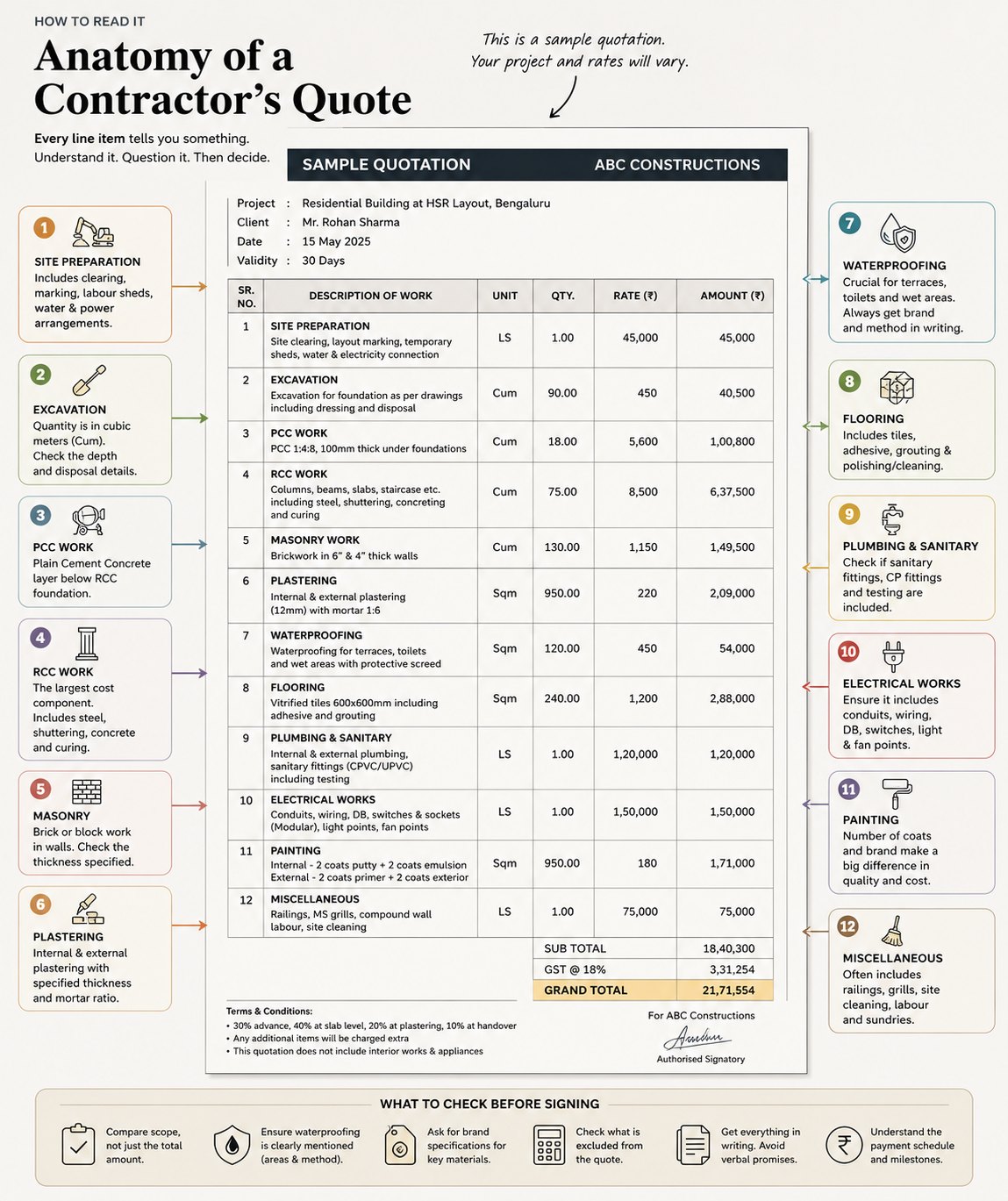
Most quotations run in the order the house is built. Read down the list and you are really reading the sequence of your own construction: site preparation and excavation first; then the plain-cement-concrete (PCC) bed and the RCC frame of columns, beams and slabs — almost always the single largest line; then masonry and plastering; flooring and waterproofing; plumbing and electrical; painting and finishing; and, at the foot of the page, labour, a “miscellaneous” catch-all, and taxes. The sample above shows all twelve, annotated.
Where hidden costs usually hide
The danger in a quote is rarely the numbers you can see. It is the work quietly left out, to be billed later as an extra. These are the items worth interrogating before you sign.
Waterproofing
If it is not spelled out, ask whether it is included, and for which areas. Waterproofing failures are among the costliest defects to repair once a house is finished — worth every question now.
Electrical
Does the quote cover only conduits and wiring, or also switches, fixtures, the distribution board and installation? The gap between the two is large.
Plumbing
Check whether sanitary fittings, CP fittings and testing are included, or only the rough-in pipework.
Painting
Confirm the number of coats, the brand and the finish. “Painting” can mean anything from a single distemper coat to two coats of putty under premium emulsion.
Flooring
Does the rate include skirting, adhesives and polishing, or only the tile, laid loose?
Site cleaning & debris removal
Often omitted, and later billed separately. Ask.
Transportation
Clarify who bears the cost of moving materials to site — it is not always the contractor.
GST & taxes
Always confirm whether taxes are already in the figure or added on top. On a large quote, that difference runs to lakhs.
If a quotation says “Lump Sum” without explaining what is included, ask for a detailed breakdown before you sign.
Before you sign
The best contractor is not always the cheapest, and the best quotation is not the lowest. It is the one that tells you plainly what you are paying for, what you are receiving, and who carries which responsibility. Compare scope, not just price. Read every exclusion. Ask for brand specifications. Verify the waterproofing. Ask for a Bill of Quantities wherever you can — and never rely on a verbal promise; get every commitment in writing.
A well-understood quotation is the foundation of a successful project — long before the first brick is laid.