
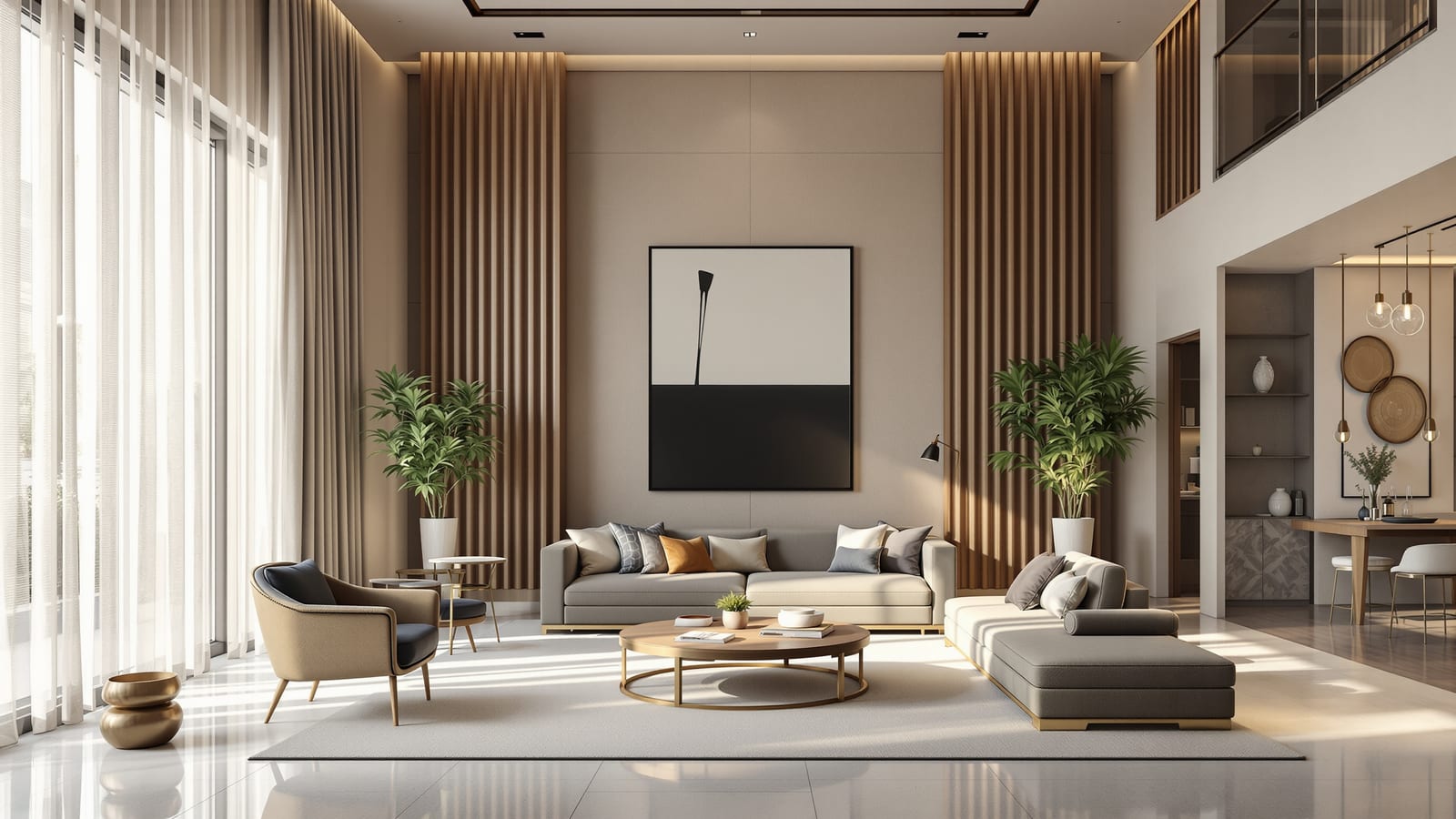
Villa Curtain Design Guide (India 2026)
Dressing a whole villa coherently — double-height windows, sliding and French doors, one palette across many rooms, whole-house motorisation and scenes, premium fabrics where they show, outdoor solutions and a phased budget.
Dressing a single room is a decision. Dressing a villa is a project. A villa throws problems an apartment never does — windows that climb two storeys, sliding doors three metres wide, French doors that swing into the curtain, a dozen rooms that must feel like one home, verandahs and balconies that face the weather, and a budget large enough that mistakes are expensive. Do it room by room with whoever the tailor recommends and you end up with a beautiful living room and a patchwork everywhere else. Plan it as one scheme and the whole house reads calm, deliberate and expensive.
This guide is the whole-villa version of curtain planning: the palette logic, the hard windows (double-height, sliding, French), what to motorise, where premium fabric is worth it, the outdoor problem, and how to phase the spend so you are never paying for everything at once. It is luxury thinking applied practically — for a Bengaluru or Hyderabad villa, a Goa second home, or a builder-floor that wants to live like a villa.
A villa does not need the most expensive curtains in every room. It needs one coherent palette, generous fullness everywhere it shows, and real money concentrated on the four or five windows everyone actually sees.
Start with one palette, not twelve fabrics
The single biggest difference between a villa that looks designed and one that looks accumulated is restraint. Resist the urge to pick a different fabric per room. Instead, build a house palette of two or three coordinated curtain families and repeat them:
- One sheer — a single warm off-white or oatmeal linen-look sheer used behind almost every window in the house. Repetition is what makes a villa feel like one home.
- One or two heavier "anchors" — a dim-out or blackout in a neutral that sits with your walls, plus optionally one accent fabric (a deeper tone, a subtle texture) reserved for the formal living and master.
- A consistent heading and drop — pinch or wave pleat, floor-length, hung high and wide throughout. Consistency of proportion reads as luxury even when fabrics vary.
Pick the palette against your flooring and wall tones first, fabrics second. The deeper logic of what makes drapery read expensive — fullness, length, finish — is worth reading in the luxury curtain design guide before you commit a whole house to a choice.
The hard windows: double-height, sliding and French
Villas are defined by their difficult openings. Get these right and the rest is easy.
Double-height and stairwell windows. A two-storey window is the villa's signature and its biggest trap. Treat it as a single tall curtain on a concealed ceiling track at the top, not two stacked panels. Floor-to-ceiling fabric at full height needs serious fullness and weight or it looks thin and lost. Almost always motorise it — nobody reaches a 5-metre track with a wand. The dedicated floor-to-ceiling curtains guide and the double-height curtains guide cover the tracking, weighting and access details these windows demand.
Wide sliding doors. The villa living and family rooms usually open onto a deck or garden through 2.5 to 4 metre sliders. The curtain has to stack clear of the glass when open (budget 15 to 20 cm of stack each side, so hang the track well past the frame), and it must not foul the door track below. A single wide motorised drape, or a centre-open pair, on a ceiling track is the clean answer.
French and casement doors that swing in. Here the curtain and the door fight for the same space. Either hang the curtain to stack entirely off the glass so the door clears it, or use a door-mounted treatment (a slim blind fixed to the leaf). Never specify a floor-puddle on a door you walk through daily.
The villa, room by room
A whole villa benefits from a written plan so the same logic repeats. Here is a typical two-storey villa as a worked example — adjust to your own rooms:
| Room | Window / opening | Treatment | Motorise? | Fabric tier |
|---|---|---|---|---|
| Formal living | Double-height + wide slider | Sheer + accent drape, ceiling track | Yes | Premium |
| Family / TV room | Standard + slider to deck | Sheer + blackout dim-out | Optional | Mid |
| Dining | Tall windows | Sheer + light dim-out | Optional | Mid–premium |
| Master bedroom | Picture window + balcony door | Sheer + full blackout, overlap centre | Yes | Premium |
| Other bedrooms | Standard | Sheer + dim-out | No | Mid |
| Stairwell | Double-height | Single tall sheer, ceiling track | Yes | Mid |
| Kitchen | Small / above counter | Easy-clean blind or short cafe | No | Value |
| Study / home office | Screen-wall window | Dim-out for glare, or blind | No | Mid |
| Verandah / balcony | Open frontage | Outdoor sheer or weatherproof drape | Optional | Outdoor |
Two rules make a plan like this work. First, concentrate premium fabric on the formal living and master only — the rooms guests and you see most. Everywhere else, a mid or value fabric at the same generous fullness looks just as considered for a fraction of the cost. Second, keep the same sheer everywhere so the house reads continuous from the outside and from room to room.
Whole-house motorisation and scenes
In a villa, motorisation stops being a gadget and becomes how the house is actually liveable — you are not closing twenty curtains by hand at dusk. Plan it as a system:
- Wire the windows you will keep forever — the double-height, the master, the formal living sliders — with mains motors during construction or renovation. Wired motors are powerful, silent and maintenance-free, but the cabling must be planned before the false ceiling closes.
- Use battery/rechargeable motors for retrofits and secondary rooms where running a cable is not worth it.
- Commit to one ecosystem — Alexa, Google Home, or a Matter/Zigbee hub — so every motor in the house obeys the same scenes and voice commands. Mixing brands across a villa is the usual regret.
- Build scenes, not switches — a Morning scene that opens the living and dining sheers at dawn, an Afternoon scene that closes the west-facing drapes against the sun, a Movie scene that blacks out the family room, an All-Night scene at bedtime. Scenes are the real luxury; per-curtain remotes are not.
The full integration and selection detail lives in the motorized curtains guide. Across a whole villa the motor and track spend is significant, which is exactly why a phased plan and a clear budget matter.
The outdoor problem: verandahs, balconies and decks
Villas live outdoors in a way apartments rarely do, and indoor curtains do not survive a verandah. Direct sun fades and rots regular fabric within a season; monsoon damp ruins linings; wind whips loose panels. For covered outdoor frontages use outdoor-grade fabrics (solution-dyed acrylic or PVC-coated mesh), weighted hems, and tracks rated for the conditions, or switch to outdoor roller blinds / bamboo chiks that roll away in storms. Treat these as a separate, weather-tolerant category — never an extension of the indoor palette. The pillar's broader survey of options is the complete curtain guide, and the apartment curtains guide is a useful contrast if you also own a flat.
Budgeting a villa in phases
A whole villa dressed at once is a large cheque. The good news is curtains are the most phaseable interior spend there is — you can stage them by room without anything looking unfinished, because bare windows in a half-furnished villa read as "in progress," not "wrong."
A sensible three-phase order:
1. Phase 1 — the public and private must-haves. Formal living, master bedroom and any double-height. These are seen most and hardest to retrofit (the ceiling tracks and wiring), so do them first and well.
2. Phase 2 — the daily rooms. Family room, dining, other bedrooms. Mid-tier fabric, same palette and fullness.
3. Phase 3 — the edges. Kitchen, study, outdoor frontages, guest rooms. Value and outdoor-grade solutions.
Cost in a villa is driven by fullness, lining and motorisation far more than by the print — and by the sheer number and size of windows. Price the whole house before you start so the palette is affordable at scale, not just in the showroom for one window. The curtain cost calculator sizes the fabric metres and per-window price for each opening (track width times fullness, plus drop, lining and hardware), so you can total a phase before committing.
Working with a designer
A villa is the point where a designer earns their fee. The fabric and stitching cost the same whether you specify them or a professional does, but a designer prevents the expensive errors — the double-height track that should have been recessed, the slider curtain that does not stack clear, the twelve mismatched fabrics, the motors on three incompatible apps. Bring them a written room-by-room plan (the table above is a start), your palette, and a phased budget, and ask them to resolve the hard windows and the automation ecosystem first.
Two honest caveats. Motorisation across a whole villa is a real, recurring system — motors, hubs and apps need updates and the occasional battery or track service; budget for upkeep, not just install. And every cost, dimension and fabric here is indicative — measure your own windows, price your own fabrics locally, and account for the premium that very tall and very wide openings carry before you commit a phase.
Plan your villa with Studio Matrx. Map every opening, fullness and fabric tier with the Luxury Curtain Planner, price each window and phase with the Curtain Cost Calculator, then return to the complete curtain guide and the wider window treatments cluster for the type, fabric, motorisation and room-by-room deep dives.
Export this guide
Related Guides — Deep-dive reading
Sliding Door & Large-Opening Curtains (India 2026)
Dressing wide sliding doors, French doors and balcony openings — wide-span tracks, where the curtain stacks so it clears the door, one-way vs centre draw, floor clearance for the door track, fabric weight, vertical blinds and wave alternatives, plus motorisation and honest costs.
Window TreatmentsVertical Blinds: The Guide for Large Windows & Sliding Doors (India 2026)
Why vertical louvres still beat almost everything on wide glazing, sliding and French doors and balconies — fabric vs PVC vanes, real Indian costs, and the honest downsides nobody mentions in the showroom.
Window TreatmentsFloor-to-Ceiling Curtains: The Height Illusion Done Right (India 2026)
Why hanging high and dropping to the floor makes a room look taller and more expensive, where to mount, how to measure the drop, and the fabric, hardware and costs that make long curtains work in Indian homes.
Window TreatmentsRelated Tools — Try Free
Curtain Cost Calculator
Get the fabric metres you need plus the total curtain cost by window size, fabric, pleat, lining and hardware.
Curtain CalculatorMotorized Curtain Cost Calculator
Estimate the all-in cost to motorise curtains — motors, tracks, hub and installation.
Cost CalculatorFalse Ceiling Cost Estimator
Live ₹/sqft across 8 ceiling types — POP, gypsum, designer, metal, PVC, wooden — with cove and spot lighting for 20 Indian cities.
Cost Calculator