
Human Dimensions
Furniture only works if it fits the body — the ergonomics and anthropometrics behind every seat height, worktop and clearance you specify.
This is the discipline that separates a specified interior from a decorated one. A chair can be beautiful and still be wrong — too high, too deep, no support where the back needs it. Furniture has to fit the human body and leave room to use it, and "the body" is a range, not one person. Get the dimensions right and comfort is designed in before a single fabric is chosen; get them wrong and no finish will rescue the piece.
What you'll be able to do
By the end of this module you will be able to — mapped to the course outcomes for Furniture for Interior Design:
Explain how anthropometric data works — percentiles, reach and the difference between structural and functional dimensions.
Recall and apply the critical dimensions of seating — seat height, depth, width and back angle.
Set correct heights for tables, desks, worktops and bars, and size beds and storage to the user.
Provide the clearances and circulation zones that let furniture actually be used.
How human-dimension data works
Four ideas run through everything: bodies vary, so you design to a percentile range; dimensions are either structural (at rest) or functional (in use); seating is where comfort is won or lost; and every surface height and clearance follows the body that uses it.[3, 4]
Design for a range, not a person
Human bodies vary, so anthropometric data is given as PERCENTILES: the 5th percentile is small, the 95th is large. The rule of thumb: size REACH and access to the SMALL user (so the short person can still reach the shelf), and size CLEARANCE and headroom to the LARGE user (so the tall person still fits). Where one dimension must suit everyone — a fixed seat height — you design to the middle and, ideally, make it adjustable. Getting the percentile logic right is the whole game.[3, 4]
Piece by piece
Now the specifics — the dimensions that matter for the pieces you specify most: the chair, the workstation, the kitchen worktop and the bed, each sized to the body that uses it.[1, 3]
The hardest thing to get right
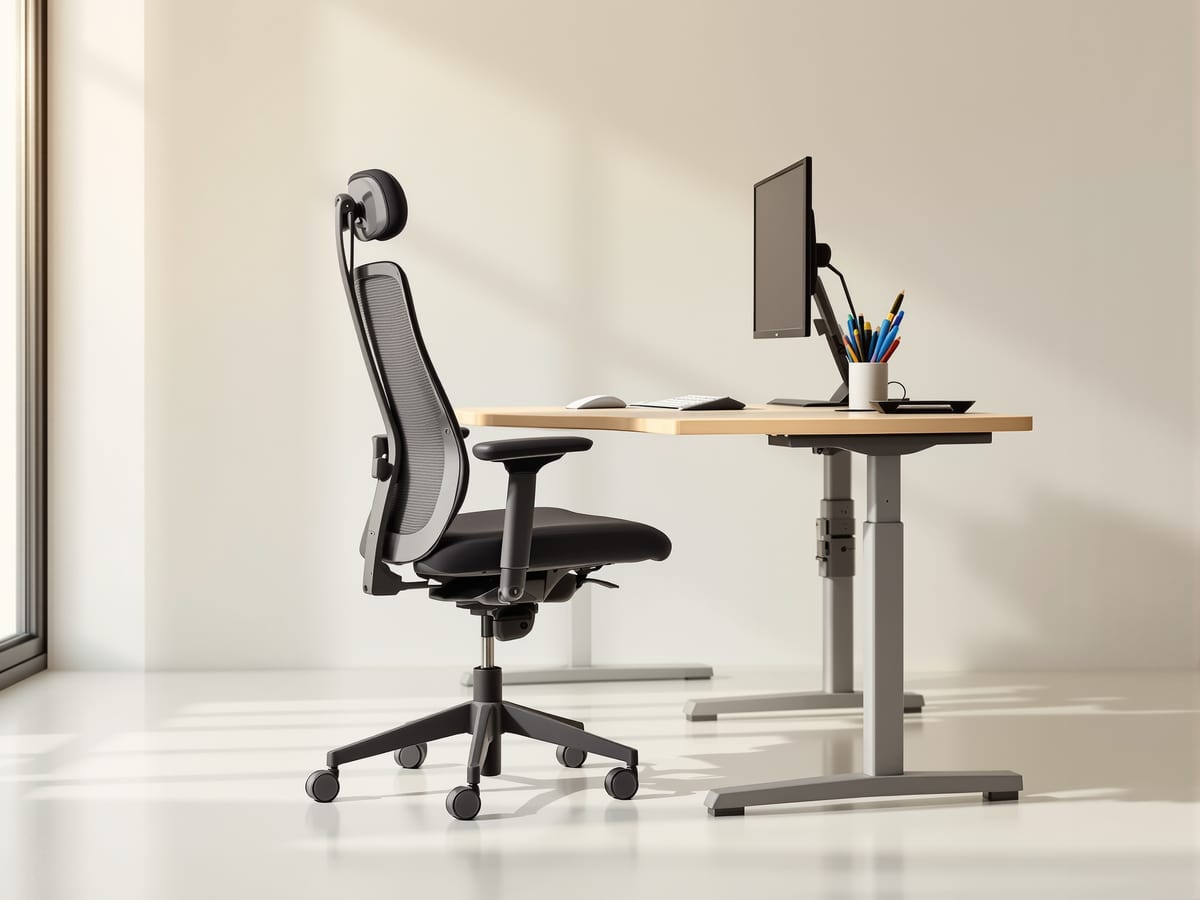
A chair is deceptively hard: it must fit a range of bodies, support a changing posture, and be safe and light enough to move. Design the seat height to the smaller user's lower-leg length so feet reach the floor; the depth so the back is usable without cutting the knee; the back to give lumbar support at the angle the task needs (upright to eat and work, reclined to relax). Test in the flesh — a chair that measures right can still feel wrong.[1, 3]
The dimensional decisions
| Aspect | One | The other |
|---|---|---|
| Which user to size to | Reach & access → the 5th-percentile (small) user | Clearance & headroom → the 95th-percentile (large) user |
| Kinds of dimension | Structural — the body at rest | Functional — the body in use (reach, rising, door swing) |
| Seat height error | Too high — front edge cuts the thigh, feet dangle | Too low — hard to rise, knees above hips |
| Fixed vs adjustable | Fixed height — design to the middle, compromise | Adjustable — fit each user (task chairs, sit-stand desks) |
| Surface heights | Seated work / dining ~720–750 mm | Standing work (kitchen) ~850–920 mm |
Key terms
The measurement of the human body — the data furniture and interiors are sized from.
Designing furniture and spaces to fit the body and its use, for comfort, safety and efficiency.
A way of expressing body-size range: 5th = small user, 95th = large user; design reach to the small, clearance to the large.
The body measured at rest — sitting height, hip breadth, shoulder width.
The body in motion — reach, the space to rise from a seat, a door's swing.
Floor to the top of the seat; ~400–450 mm for a general chair so feet rest flat and thighs stay near level.
The comfortable arc the arm can reach; sets where the most-used storage and controls go.
The functional space left around furniture so it can actually be used — to pull a chair, open a door, pass behind a diner.
Practice task
Measure a chair you own. Record its seat height, seat depth and back angle, then sit in it and note where it fails your body — feet dangling, edge under the knee, no lumbar support. Redraw it corrected to the dimensions in this module, and write one line on which user (5th or 95th percentile) each corrected dimension now suits.
Self-check
1. You are setting the height of a fixed shelf everyone must reach. Which user do you size it to?
2. A general chair seat is too HIGH. What goes wrong?
3. Why must you draw the clearance around furniture, not just the furniture?
Recap
References & further reading
- [1]Drew Plunkett & Sam Booth, Furniture for Interior Design. London: Laurence King Publishing, 2015.
- [2]Francis D.K. Ching & Corky Binggeli, Interior Design Illustrated (3rd ed.). Hoboken: John Wiley & Sons, 2012.
- [3]Julius Panero & Martin Zelnik, Human Dimension & Interior Space. New York: Whitney Library of Design, 1979.
- [4]Ernst Neufert, Architects' Data (4th ed.). Oxford: Wiley-Blackwell, 2012.
- [5]Studio Matrx — Ergonomics & Anthropometry Guide (practitioner reference). https://www.studiomatrx.org/for-designers/ergonomics-guide
Further reading
- Julius Panero & Martin Zelnik, Human Dimension & Interior Space. Whitney Library of Design.
- Ernst Neufert, Architects' Data. Wiley-Blackwell.
- Stephen Pheasant & Christine M. Haslegrave, Bodyspace: Anthropometry, Ergonomics and the Design of Work. CRC Press.
Sources gathered and fact-checked June 2026. Published values vary by source, sample and method — treat as indicative and confirm against the cited standard before structural use.
Where this course goes next
You can now size furniture to the body. Next we look at the pieces that got it famously right — Module III, Iconic Pieces & Modern Classics: the chairs every interior designer should know, and the movements, designers and materials behind them.