
 Lesson 0.2
Lesson 0.2 · Why Wayfinding Matters
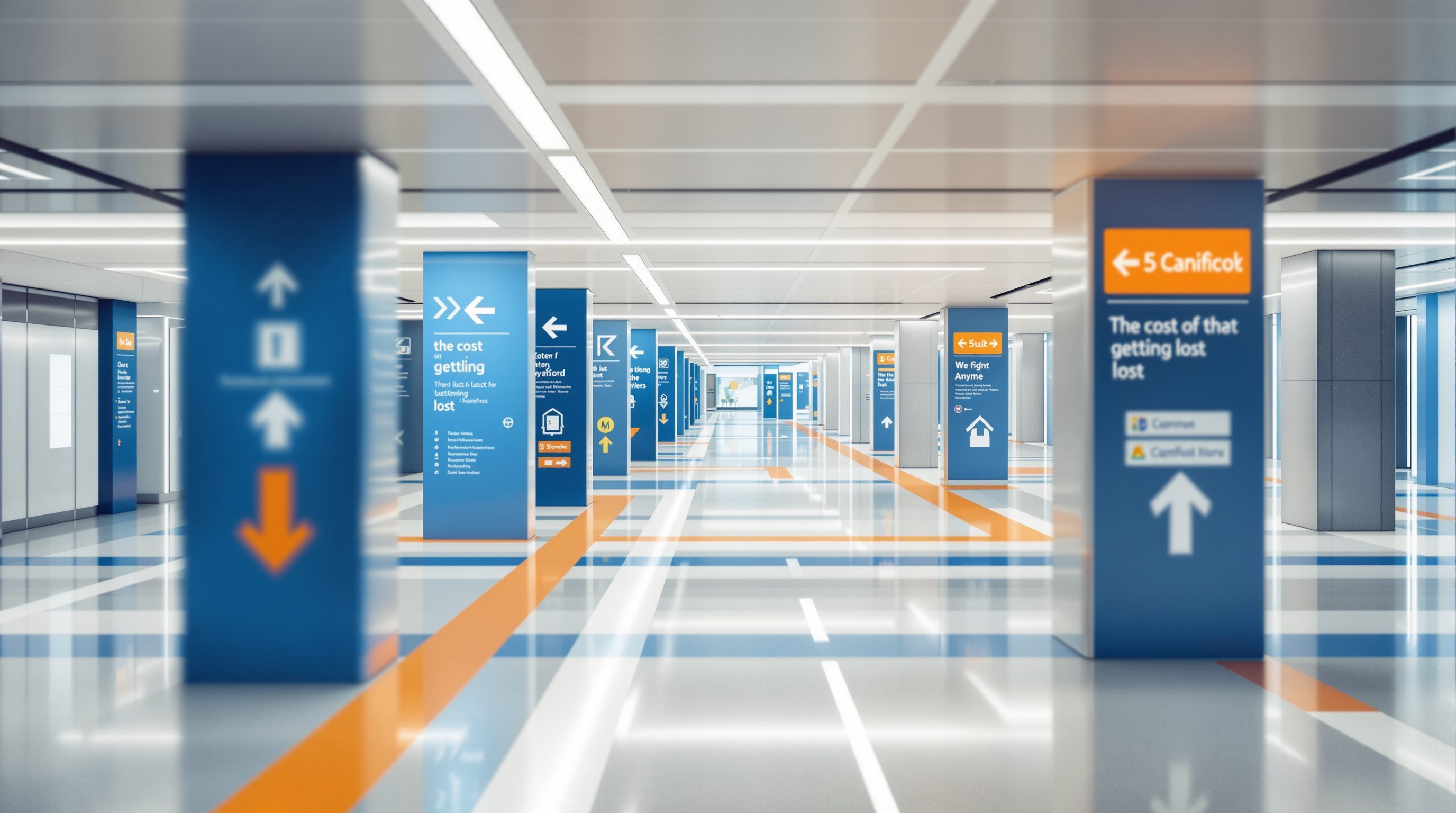
The Cost of Getting Lost
Being lost is never free - it is paid first in human anxiety and lost dignity, and again in wasted time, congestion, tied-up staff, slower evacuations and damaged reputation - which is exactly why wayfinding is worth investing in early, before the building is even built
Nobody sends an invoice for getting lost - which is exactly why the bill is so easy to ignore, and so large.
A woman arrives at a large public hospital for a scan she is already frightened about. She cannot find the department. She asks a guard, who points vaguely; she asks a nurse, who is busy; she walks the wrong corridor twice, growing more anxious, until she arrives late, flustered and near tears - and misses her slot. Multiply her by the hundreds of people moving through that building every day, and by the staff who stopped their own work to redirect them, and by the appointments that slipped, and you begin to see a cost that never appears on any invoice but is very real all the same.
This lesson is about that hidden bill. Poor wayfinding charges twice. It charges a human cost - anxiety, frustration, a loss of dignity and control - paid by the person trying to find their way, and paid most heavily by those already having the hardest time. And it charges a business and operational cost - wasted time, congestion, staff endlessly redirecting people, slower and riskier evacuation, complaints and damaged reputation - paid by the organisation that owns the place. Neither cost is optional and neither is small; both are almost entirely avoidable; and both are cheapest to prevent early, on the plan, rather than to patch later with more signs. Counting these costs honestly is how you make the case - to a client, a boss, or yourself - for taking wayfinding seriously from the start.
No one is ever invoiced for getting lost - which is why the bill is ignored, and why it is so large.
The human cost: anxiety, dignity and the person who gives up
Start with the cost that matters most, because it is the one most easily forgotten in a spreadsheet: the human cost. Being lost is not a neutral experience - it produces real, measurable stress. The heart rate rises, attention narrows, and a small practical problem (which way is Radiology?) becomes an emotional one (something is wrong, I am failing, I am going to be late). Psychologists describe the disorientation of not knowing where you are as one of the more acutely unpleasant everyday experiences, and it is compounded by a loss of dignity: having to stop strangers to ask, feeling foolish, feeling watched, feeling like a burden. For an adult used to being competent, being unable to find their way in public is quietly humiliating.
This cost is not shared evenly. It falls hardest on the people already carrying the most: the frightened patient on the way to a diagnosis; the elderly visitor in an unfamiliar city; the person with low vision or a cognitive impairment for whom a confusing layout is genuinely disabling; the traveller who cannot read the local script; the parent managing children and luggage through a vast station. For the confident regular, poor wayfinding is an annoyance. For the vulnerable first-timer, it can be the difference between reaching care and turning back. That is why the person having the hardest time, not the confident regular, is the true measure of a place - a theme that runs through this whole course.
There is a final, decisive human cost that organisations rarely see: the person who gives up. Someone who cannot find their way to a clinic and goes home without their appointment; a shopper who abandons a confusing mall and does not return; a visitor whose lasting memory of a place is the stress of being lost in it. These people vote with their feet and rarely complain, so the loss is invisible in the data - but it is a failure of the most basic promise a public place makes, which is that you can move through it. Good wayfinding is, at heart, a quiet act of care for strangers: it lowers stress, restores agency, and treats the anxious first-timer as the person the place is really for. That humane case is reason enough to do it well - and, as the rest of this lesson shows, the practical case points exactly the same way.
The worst human cost is invisible: the person who gives up and quietly goes home. Design for them.
The operational cost: wasted time, congestion and tied-up staff
Now the bill the organisation actually pays. The most direct operational cost of poor wayfinding is wasted time, and at scale it is enormous. Every minute a visitor spends lost is a minute of their life spent unproductively, and in places that run on schedules - hospitals, airports, courts, campuses - it cascades: a patient who arrives late delays a clinic; a passenger who cannot find the gate holds a flight; a late witness stalls a hearing. Studies of large hospitals have put the staff time lost to giving directions alone in the range of thousands of hours a year - nurses, guards and receptionists repeatedly stopping skilled or safety-critical work to point the way. That is real money, quietly leaking, disguised as helpfulness.
Poor wayfinding also creates congestion and inefficiency in the space itself. People who are unsure hesitate, stop, double back and cluster at the wrong points, turning smooth flow into bottlenecks - at a ticket hall, a lobby, a junction. A legible place moves people; a confusing one pools them, which in turn slows everyone, frays tempers and, in the worst cases, becomes a crowd-safety problem. Retailers know a related version of this: shoppers who cannot navigate a store confidently browse less, buy less and leave sooner, so wayfinding quietly shapes revenue. The same logic applies to any place whose value depends on people moving through it easily - which is almost all of them.
There is also a straightforward cost of the wrong fix. When wayfinding fails after a building opens, the usual response is to add signs - and then more signs, and taped-up printouts, and a member of staff at a desk to redirect people. Each addition costs money to make and mount, adds clutter that makes the remaining signs harder to read, and still does not fix a fundamentally confusing space. The organisation ends up paying, year after year, for an expensive patch that a small, cheap decision on the plan - a clearer entrance, a better sightline - would have made unnecessary. The operational costs, in short, are wasted time, tied-up staff, congestion, lost custom and perpetual patching, and they recur for the entire life of the building.
Safety, reputation and the emergency you hope never comes
Two operational costs deserve their own weight, because they are not routine - they are the ones that can turn a bad day into a disaster or a headline. The first is safety. Wayfinding is not only about finding a shop or a ward on an ordinary day; it is about finding the way out on the worst day. In a fire, a power cut or an evacuation, people must leave a building quickly, often in smoke, panic and unfamiliarity, and how well the place communicates its exits and escape routes can decide whether that happens in order or in chaos. People under stress revert to the way they came in and struggle to process complex information, so egress must be obvious, continuous and reassuring - which is a wayfinding problem before it is only a signage problem, and one governed by strict codes and specialists. A place that is confusing on a calm day is dangerous on a bad one.
Because it is safety-critical, emergency wayfinding is the clearest example of the course's boundary: this lesson makes the case that it matters, but the binding specifics - exit-sign design, illumination, spacing, photoluminescence, escape-route marking - belong to the fire and life-safety code and a qualified fire consultant, not to a designer's judgement. The design lesson is that legibility and clear egress are life-safety features, so they must be planned in from the start and coordinated with the specialists, never left as decoration added at the end.
The second weighty cost is reputation. A person's experience of a place is coloured, often decisively, by whether they could find their way in it. Getting lost in a hospital, an airport or a mall is remembered - and shared, now instantly, in reviews and posts - as a mark of a place that does not have its act together or does not care about the people in it. Conversely, a place that is effortless to navigate feels competent, welcoming and considerate, and that impression attaches to the whole institution, not just its signs. Wayfinding is one of the most direct, everyday expressions of how much an organisation respects the people who come to it - which is why its reputational cost, though it never appears on a balance sheet, is one of the largest of all.
Wayfinding on the worst day = finding the way OUT. Life-safety specifics -> fire code + consultant, always.
The case for investing early - when a fix is cheap
Add the two bills together - the human cost of anxiety, lost dignity and the visitor who gives up, and the operational cost of wasted time, tied-up staff, congestion, lost custom, safety risk and reputational damage - and the conclusion is inescapable: poor wayfinding is expensive, and good wayfinding is one of the highest-return, lowest-cost investments a project can make. The catch, and the whole point of this lesson, is that the return depends almost entirely on when you invest.
Here is the economics of it. A wayfinding problem is cheapest to fix at the plan stage, when it is just a line to be moved on a drawing - a clearer entrance, a sightline opened to a destination, a landmark added, a more logical arrangement of zones. It is more expensive to fix during construction, more expensive still once the building is occupied and can only be patched with signs and staff, and some of the cheapest, most effective fixes are simply no longer possible after the concrete is poured. The cost of a remedy rises steeply with time, while the cost of designing it in early is close to nothing. This is why wayfinding must be treated as a design discipline that starts at the master plan, not a signage package procured at the end - the single most valuable decision in the whole field is simply to start early.
Making this case is a practical skill you will use constantly, because wayfinding budgets are easy to cut precisely because the cost of not spending them is invisible. So learn to name the hidden bill out loud: the appointments missed, the staff-hours spent redirecting, the congestion, the safety exposure, the reputation - and the fact that a small, early design decision prevents years of expensive patching. In the Indian context, where places must often serve many languages, scripts and low-literacy users at very high volumes, the cost of confusion is multiplied and the value of getting it right early is greater still. The next lesson sharpens the vocabulary you will use to make that case - the difference between wayfinding, signage and environmental graphic design - so you can argue for the right thing, at the right time, in the right words.
Fire & life-safety (exit / egress)
Emergency wayfinding, exit signage, escape-route marking, illumination
The safety cost is real and this lesson makes the case; every binding specific is code-governed - defer to the fire authority and a fire/life-safety consultant. See the Fire & Life-Safety course. Module 3.
Accessibility (NBC / Harmonised Guidelines)
Inclusive wayfinding for low-vision, cognitive, elderly and non-literate users
The vulnerable visitor bears the highest human cost; principles here, binding dimensions and requirements from the current standards and an accessibility consultant. Module 7.
NBC 2016 (building performance)
Occupant movement, egress capacity and orderly evacuation
Congestion and evacuation are performance issues the code touches; treat figures as illustrative and verify against the current standard and the project.
Workshop — count the hidden bill
The value of wayfinding becomes obvious the moment you actually count the cost of its absence. In this workshop you will take a place you know that is hard to navigate and build a rough, honest cost case for fixing it - the kind of argument you would make to a client or a boss - covering both the human and the operational bills.
Just a confusing place you know and a notebook. Rough estimates are fine - the point is to make an invisible cost visible, not to produce audited figures.
Goal: a one-page cost case for better wayfinding in a real place
Inputs: a place you know that is confusing + this lesson + a notebook
Time: ~50 minutes
- 1Pick a confusing place you know well (a hospital, station, mall, campus or office) and recall or observe one common journey through it that people struggle with.
- 2Count the HUMAN cost: list who is having the hardest time here (frightened, elderly, low-vision, non-local-language, stressed), how being lost feels for them, and - the invisible one - who would simply give up and not return.
- 3Count the OPERATIONAL cost: estimate roughly how much time is wasted per lost person, how often staff are pulled off their work to redirect people, where congestion pools, and one safety or reputation exposure the confusion creates.
- 4Locate the CHEAP fix vs the EXPENSIVE patch: name one change that would have cost almost nothing on the original plan (a clearer entrance, a sightline, a landmark, a logical layout) and contrast it with what fixing it now would take (more signs, staff, workarounds).
- 5Write a one-paragraph business case: the twin costs in plain language, the highest-impact fix, and the single sentence you would say to a decision-maker to argue for investing in wayfinding early.
You’ll walk away with
A one-page cost case: the human bill and the operational bill for one confusing place, the cheap-early fix versus the expensive-late patch, and a single persuasive sentence for a decision-maker. Keep it - making this argument well is a skill you will use throughout your career.
Three altitudes on the same idea
Read the band that fits you — or all three.
The costliest wayfinding decisions are yours, and you make them earliest - which is exactly why they are so cheap to get right. A clear entrance, a sightline to the main destination, an orienting landmark, a logical arrangement of zones: these cost almost nothing on the plan and prevent years of anxiety, wasted staff time, congestion and patch-up signage after the building opens. Treat legibility and clear egress as life-safety and operational features to design in, not decoration to add later. Bring the wayfinding designer in at concept, budget for wayfinding as part of the architecture, and defer the binding fire-signage and accessibility specifics to the code and the specialists.
When wayfinding fails after handover, you are often the one asked to fix it with signs - so you see the cost of getting it wrong most directly. A confusing fit-out cannot be rescued by ever more signage; it can only be patched, expensively and imperfectly. Argue for wayfinding to be considered while the layout, zoning and sightlines are still being set, design the signage and environmental graphics as one system rather than a late add-on, and make the case to clients in the currency they feel: lost custom, congestion, complaints, tied-up staff and reputation. Coordinate emergency and accessible signage with the fire and accessibility specialists rather than deciding those specifics yourself.
Learn to see the invisible bill - it will make you a more persuasive designer for the rest of your career. Being lost costs people anxiety and dignity and costs organisations time, safety and reputation, but because no one is ever invoiced for it, the value of good wayfinding is chronically underestimated and its budget is easy to cut. Train yourself to count both costs whenever you move through a place: who is struggling, who gave up, how many staff are redirecting people, where the congestion pools. You are not expected to detail an exit sign to code yet - you are expected to understand why getting lost is expensive, and why a cheap early decision beats a costly late patch every time.
“Wayfinding is a soft, nice-to-have extra. Getting lost is a minor annoyance - people always find their way in the end - so it is a reasonable place to trim a budget, and anything missing can be fixed later by putting up more signs.”
Do it yourself
No tools needed - reason it through.
- 1Explain why getting lost is described as a cost that is paid twice, and who pays each bill.
- 2Which human cost is the most invisible to an organisation, and why does that make it so dangerous?
- 3Give three distinct operational costs of poor wayfinding and how each turns into real money or risk.
- 4Why is the safety cost of wayfinding a design issue and not only a signage issue - and where do the binding specifics belong?
- 5Explain, with the cost curve in mind, why 'we will fix it with signs later' is usually the most expensive option.
The one line to carry out
Peer-reviewed journals & authoritative standards
- 01Wayfinding — Wikipedia — Wayfinding, 2026.
- 02Environmental psychology and the experience of place — Wikipedia — Environmental psychology, 2026.
- 03Hospitals and the demands of navigation — Wikipedia — Hospital, 2026.
- 04Accessibility and inclusive wayfinding — Wikipedia — Accessibility, 2026.
To argue for wayfinding early and clearly, you need the right words for it. Next we untangle three terms people use interchangeably - wayfinding, signage and environmental graphic design - so you can name precisely what you are designing, and when.
The author
Amogh N P
Architect, interior designer, and creative polymath. Studio Matrx began in his notebooks — his vision of design made honest, useful, and open to everyone. Its Academy is written and taught in his memory, and free, forever.
More about Amogh →