
 Lesson 6.3
Lesson 6.3 · Environmental Graphic Design
Experiential & Placemaking Graphics
Graphics can do more than direct you - they can give a space a feeling and a sense of place, and a place you remember and feel something about is a place you can find your way through, because its very character tells you where you are
A place you remember is a place you can find your way through. Experiential graphics work because memory and orientation are the same thing.
Most of this course has been about helping people function - identify a place, find a direction, recognise a zone. Experiential and placemaking graphics aim higher. They set out to make a space memorable, meaningful and emotionally distinct: to turn an anonymous interior that could be anywhere into a place with character, somewhere people feel something about and remember. The discipline that names this is placemaking, and graphics are one of its most powerful, most economical tools, because they can transform how a space feels without rebuilding it.
This belongs in a wayfinding course because of a fact that runs right through it: memorable places are navigable places. The mental map people build of a building is made of distinct, recallable features - a landmark, a character, a moment you can describe. A run of identical, anonymous spaces is nearly impossible to hold in the mind; a sequence of spaces each with its own feeling is easy. So experiential graphics are not only about delight, though delight is a worthy end in itself - they support orientation by making places distinct and recallable. The feeling a space gives you is also information: it tells you what kind of place this is, which zone you are in, that you have arrived somewhere particular. This lesson is about designing that feeling deliberately, and aiming it at both goals at once.
Placemaking = turn anonymous space into somewhere. Memorable = navigable. Serve the person, root the meaning.
From information to experience - making a sense of place
So far environmental graphics have mostly helped people function - identify a place, find a direction, recognise a zone. Experiential and placemaking graphics aim higher: they set out to make a space memorable, meaningful and emotionally distinct - to give it a sense of place. The term of art is placemaking: the deliberate shaping of a space so that it becomes a place, somewhere with character and identity that people feel something about, remember, and return to, rather than an anonymous interior that could be anywhere. Graphics are one of the most powerful and economical placemaking tools, because they can transform the feel of a space without rebuilding it - a blank corridor becomes an immersive environment, a dead lobby becomes an experience, a generic floor becomes somewhere that is unmistakably itself.
This matters to wayfinding for a reason that runs through the whole course: memorable places are navigable places. The mental map that people build of a building is made of distinct, memorable features - a landmark, a character, a moment you can recall and describe (Module 1). A sequence of identical, anonymous spaces is almost impossible to remember or orient within; a sequence of spaces each with its own distinct character and experience is far easier to hold in the mind. So placemaking graphics are not just about delight - though delight is a worthy goal in itself - they actively support orientation by making places distinct and recallable. When each wing, each floor, each zone has its own memorable experience, people know where they are because the place tells them, not just through a sign but through how it feels.
The reframing, then, is from information to experience. A directional sign gives you information; an experiential graphic gives you a feeling, and the feeling is also information - it tells you what kind of place this is, which zone you are in, that you have arrived somewhere particular. A children's hospital wing that feels playful and bright, a transit hall that feels grand and calm, a heritage gallery that feels reverent, a tech campus that feels energetic - each uses graphics, colour, image and scale to create an experience that is simultaneously a wayfinding cue. The art of experiential graphics is to design that feeling deliberately, and to aim it at the two goals at once: a space people remember and feel good in, and a space people can find their way through because its very character orients them.
Placemaking = turning anonymous space into somewhere. Memorable = navigable. The feeling IS information.
The spectrum: immersive, feature, interactive
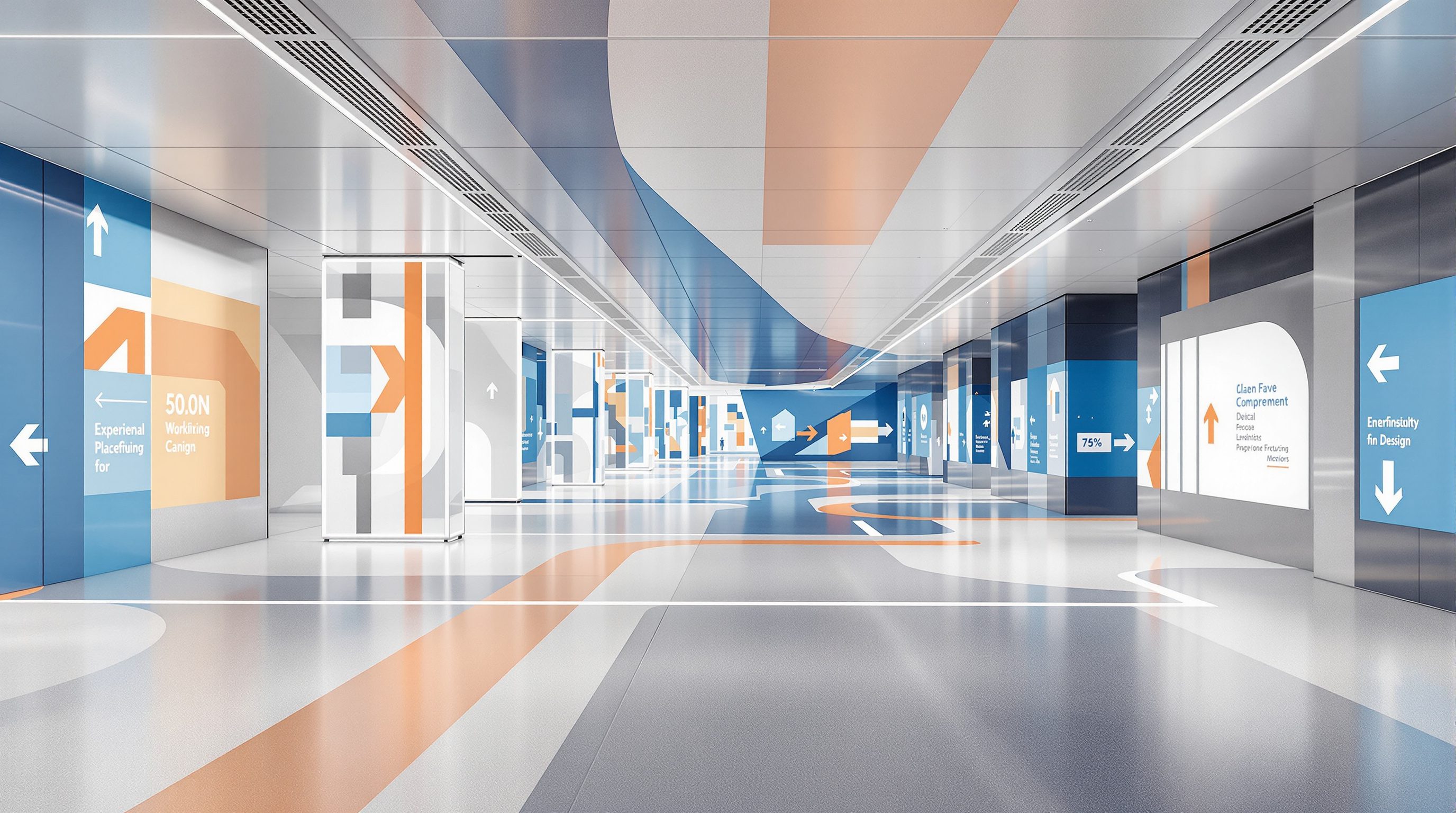
Experiential graphics come in a spectrum, from the immersive to the interactive. At one end are immersive environments - graphics that wrap a whole space so that being inside it is an experience: a floor-to-ceiling themed environment, a tunnel of colour and image, a room whose every surface carries a coordinated graphic world. These are common in children's healthcare, museums and visitor attractions, flagship retail and brand experiences, and increasingly in workplaces that want their space to express a culture. The power of immersion is total - it changes the emotional temperature of a space completely - and its discipline is to stay purposeful: an immersive environment should still let people function and find their way within it, and should mean something, not merely dazzle.
In the middle sit feature graphics and moments - not a whole immersive world but a deliberate, designed high point: a striking feature wall, a sculptural graphic element, a dramatic use of a staircase or atrium, a single memorable gesture that gives a space its identity and becomes the thing people remember and describe. These are often the most efficient placemaking moves, because a well-placed feature moment can define a whole space and double as a landmark without the cost of treating every surface. The classic wayfinding bonus returns here: the feature that makes a lobby memorable is also the landmark people navigate by and arrange to meet at.
At the active end are interactive and dynamic graphics - elements that respond to people, change over time, or invite participation: a digital media wall, a graphic that reacts to movement or touch, a changing light or projection, a participatory installation, content that shifts with the time of day or an event. Interactivity deepens engagement and memory - people remember what they took part in - and it can carry real information (a responsive directory, a live display) as well as delight. But it also raises the stakes: interactive and digital elements must be robust, maintained, accessible and genuinely useful, or they become the broken, dark screen that signals neglect. Across the whole spectrum the principle holds: experiential graphics exist to create a sense of place and support orientation, and every move, however immersive or clever, should be judged by whether it makes the place more memorable, more meaningful and easier - not harder - to navigate.
Three disciplines: service, orientation, rooted meaning
Because experiential graphics trade in feeling, they are the easiest to do badly while looking impressive - so they need the sharpest discipline. The first principle is experience in service of the place and the person, not the designer's portfolio. The test of a placemaking graphic is not how spectacular it photographs but what it does for the people who use the space every day and for the first-time visitor trying to find their way. A dazzling installation that confuses circulation, overwhelms the information people need, or says nothing about this particular place has failed, however many awards it wins. The strongest experiential graphics grow out of the place itself - its purpose, its people, its location, its story - so that the experience feels true and specific rather than applied and generic.
The second principle is the recurring one: experience and orientation must reinforce each other. The danger in experiential design is that the pursuit of atmosphere starts to fight navigation - an immersive environment so enveloping that you lose your bearings, a feature so dominant that the directional signs vanish beside it, a dark dramatic space where you cannot read the wayfinding. The discipline is to design the experience and the wayfinding as one, so that the very thing that makes the space memorable is also what helps you know where you are. Done well, the distinct character of each zone becomes a wayfinding system in itself: you orient by the feel of the place as much as by its signs, and the two never contradict each other.
The third principle is meaning and appropriateness, which matters especially in the Indian context. A sense of place is strongest when it is rooted - in the building's purpose, in local culture, craft, language, landscape and story - rather than imported wholesale. Experiential graphics that draw on a region's motifs, materials, languages and narratives create a place that could only be here, which is both more meaningful and more memorable than a generic global aesthetic. That rootedness also carries responsibility: placemaking should include rather than exclude, work across the communities, languages and literacy levels who use the space (a theme Module 7 develops), and treat local culture with respect rather than as decoration. Get these three principles right - service, integration with wayfinding, and rooted meaning - and experiential graphics become one of the most valuable things in the discipline: they make places people love and remember, and they make those places easier to navigate precisely because they are loved and remembered.
Experience must serve the person, reinforce wayfinding, and be ROOTED - a place that could only be here.
Holding the idea of the place
For the practitioner, experiential and placemaking graphics are where environmental graphic design reaches furthest beyond signage and demands the widest collaboration. A rich experiential environment may involve graphics, lighting, digital media, sound, materials, sculpture and the architecture itself, and orchestrating them into one coherent sense of place is a genuinely multidisciplinary act. The environmental graphic designer is often the person who holds the idea of the place - the concept, the story, the feeling it should create - and coordinates the specialists who realise it. That makes a clear, defensible concept the most important tool: a strong idea of what this place is and what experience it should create is what keeps a complex project coherent and stops it collapsing into a collection of disconnected effects.
It also demands honesty about cost, durability and operation - the unglamorous half of experiential design. Immersive environments, interactive installations and digital media are expensive to build and, crucially, to run and maintain: a media wall needs content, power, updating and repair for its whole life, and an interactive piece that breaks becomes a monument to neglect that damages the place more than no graphic at all. The mature designer specifies experiences the client can actually sustain, designs for maintenance and graceful ageing, and is willing to choose a simpler, robust feature moment over a fragile spectacular one. As always, the structural, electrical, fire and accessibility specifics of any built or powered installation defer to the specialists and the fabricator; the designer owns the concept and the experience, not the engineering.
Across the Indian and global settings alike, the deepest value of this work returns to the human through-line of the course. A place with a strong, rooted, well-designed sense of place is not only more pleasant - it is kinder and easier to use. People relax in a space that feels cared-for and distinct; they orient more easily where each part of a building has its own memorable character; they carry away a feeling about an institution that a thousand signs could not give them. Experiential and placemaking graphics, at their best, are where wayfinding, identity and human emotion fuse: the space becomes somewhere, the somewhere helps you find your way, and the act of moving through it leaves you feeling, in some small way, looked after. That is placemaking's quiet purpose, and it is why experience belongs in a wayfinding course at all.
Circulation, egress & accessibility of experiential spaces
Immersive environments must not block circulation or egress
A dramatic space must still let everyone move and evacuate; defer circulation, egress and accessibility specifics to the fire authority and accessibility consultant. Module 7.
Digital, interactive & media installations
Power, content systems, durability, maintenance, safety
Interactive and digital placemaking is a real electrical, IT and maintenance commitment; defer specifics to the electrical/AV/IT specialists and plan operation. Module 9.
Built & suspended feature elements
Structural fixing of sculptural graphics and installations
Feature and immersive elements are real structure; binding fixing and load specifics from the structural specialist and fabricator. Module 5.
Workshop — give a space a sense of place that orients
Take a run of anonymous, hard-to-remember spaces - a generic office floor, a repetitive hospital or hotel corridor, a bland campus building - and design a placemaking scheme that gives each part a distinct, rooted character, so people orient by how each place feels.
Paper and pens or a simple tool, plus a repetitive place you can picture. This is about rooted character and the experience-orientation link, not finished visuals or engineered installations.
Goal: distinct, memorable characters for several spaces that also aid orientation
Inputs: one repetitive/anonymous place you know + this lesson + paper or a simple tool
Time: ~75 minutes
- 1Map the problem: identify three or more spaces (wings, floors, zones) that are currently anonymous and hard to tell apart or remember, and note where people lose their bearings.
- 2Find the roots: list what is true and specific about this place - its purpose, people, location, local culture, language and story - that a sense of place could be built from rather than a generic theme.
- 3Give each space a distinct character: assign each zone its own rooted identity (a name, a colour world, a material or image, a feeling) so the three are unmistakably different and memorable.
- 4Make character do wayfinding: show how a visitor would orient by feel ('I'm near the green garden wing') and check the experience supports the directional signs rather than burying them.
- 5Reality-check operation: for any immersive, interactive or built element, note the cost, maintenance and accessibility questions you would raise, and whether a simpler robust feature would serve better.
You’ll walk away with
A one-page placemaking scheme: the anonymity problem, the local roots, three or more distinct rooted characters, a note on how each doubles as a wayfinding cue, and an honest operation/maintenance check.
Three altitudes on the same idea
Read the band that fits you — or all three.
A sense of place is created first by the architecture - by space, light, material, scale and sequence - and experiential graphics amplify and complete it, so the strongest placemaking starts with you. Give each part of a building its own spatial character and you hand people a mental map they can feel, and you give the graphics something true to build on. Conceive the experience and the circulation as one, so the character that makes a space memorable also orients people rather than confusing them, and bring the EGD and experiential designers in early to hold a single idea of the place across architecture, light, graphics and media. Defer the structural, electrical, fire and accessibility specifics of any built or powered installation to the specialists and fabricator.
Creating a sense of place through graphics, colour, material, light and feature moments is close to the heart of your craft - and here it doubles as wayfinding. Design each zone with a distinct, rooted character so people orient by how a place feels as much as by its signs, and choose deliberately along the spectrum from a single efficient feature moment to a full immersive environment. Keep every experiential move in service of the person and never let atmosphere fight navigation or bury the information people need. Be honest about cost, maintenance and graceful ageing - prefer a robust feature to a fragile spectacular - and coordinate the structural, electrical, fire and accessibility specifics of any installation with the specialists and fabricator.
This is the most emotional, ambitious end of environmental graphics - and the easiest to be seduced by, so learn to judge it by what it does, not how it photographs. Train yourself to feel a place and then ask why: what gave it character, did each part feel distinct enough to remember and orient by, did the experience help or fight your finding your way? Learn the spectrum from feature moment to immersion to interactivity, and notice the broken interactive screen that signals neglect. Above all learn that memorable places are navigable places, and that the strongest sense of place is rooted - specific to this building, this culture, this location - not an imported generic aesthetic. You are not expected to orchestrate lighting, media and sculpture yet; you are expected to understand placemaking as experience that also helps people find their way.
“Experiential and placemaking graphics are about delight and 'wow' - spectacular, Instagrammable installations that make a space impressive. They are the creative, artistic work, separate from the practical business of helping people navigate.”
Do it yourself
No tools needed - reason it through.
- 1Why is it true that 'memorable places are navigable places'? Connect it to the mental map.
- 2Describe the spectrum from feature moment to immersive environment to interactive graphics, with an example of each.
- 3What are the three disciplines that keep experiential graphics honest?
- 4How can the pursuit of atmosphere end up fighting wayfinding, and how do you prevent it?
- 5Why does a 'rooted' sense of place matter, especially in an Indian setting?
The one line to carry out
Peer-reviewed journals & authoritative standards
- 01Placemaking — Wikipedia — Placemaking, 2026.
- 02Environmental graphic design — Wikipedia — Environmental graphic design, 2026.
- 03Urban planning — Wikipedia — Urban planning, 2026.
- 04Augmented reality — Wikipedia — Augmented reality, 2026.
- 05Interior design — Wikipedia — Interior design, 2026.
A sense of place is often carried by a story - what this place is, where it came from, who it is for. Next we look at storytelling in the environment: donor walls, heritage and interpretive graphics, and narrative made spatial.
The author
Amogh N P
Architect, interior designer, and creative polymath. Studio Matrx began in his notebooks — his vision of design made honest, useful, and open to everyone. Its Academy is written and taught in his memory, and free, forever.
More about Amogh →