
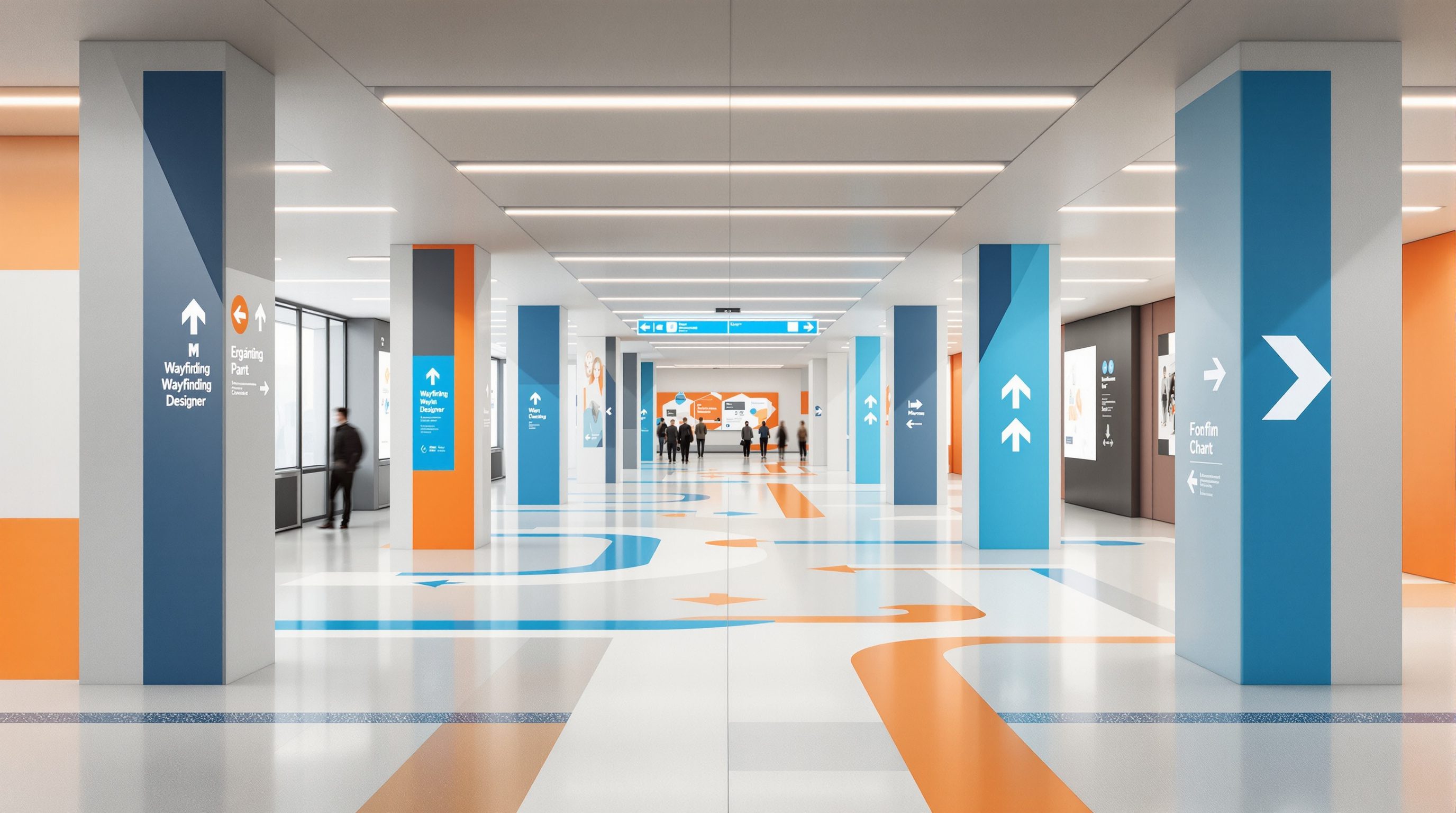
 Lesson 10.4
Lesson 10.4 · Delivery & Practice
Becoming a Wayfinding & EGD Designer
The close of the course - a synthesis of the whole discipline from the place that speaks first to the last snagged sign, an honest look at the field and its career paths, the skills that really matter, where wayfinding is heading as the physical and digital fuse, and a last loop back to the idea the whole course rests on: the building speaks first, and our job is to help everyone hear it
You began this course lost in a car park. You end it able to design your way out - and to help strangers find theirs.
Eleven modules ago, we made a single claim that everything since has been built on: wayfinding is not signage, it is how a whole place communicates where you are and where to go, and the building speaks first. Between then and now you have followed that idea all the way through - into how the mind builds a map, the four kinds of information, the sign family, the craft of a legible sign, the physical object on the wall, environmental graphics and place, accessibility, the particular demands of hospitals and airports and campuses, the digital layer, and finally the process that turns all of it into an installed, working system. This last lesson gathers the whole journey into one view, and then turns to you: what it means to practise this, where the work is, the skills that matter, and where the field is going.
It is worth saying plainly what kind of work this is. Wayfinding and environmental graphic design is one of the most quietly humane disciplines in the built environment - it is, at heart, the practice of caring for strangers you will never meet, at moments when they are often stressed, unwell, hurried or far from home. When you design it well, nobody notices; they simply move through a place with calm and confidence, and that invisibility is the whole point. Whether you become a specialist or simply carry this thinking into architecture or interiors, you now see places differently - and you can never un-see it. That is the real gift of the course, and the foundation of a practice.
You can read every place now. Go and help them speak - so everyone, especially the one having the hardest time, can hear.
The whole course in one view
Step back and the eleven modules form a single, logical arc, built in the order the work really happens: space first, then the signs and graphics that complete it. It began with why wayfinding matters - the place that speaks, the real human and business cost of getting lost, and how wayfinding, signage and environmental graphics relate (Module 0). It grounded everything in how people find their way - cognition and the mental map, legible space, real navigation, the anxiety of being lost (Module 1) - because all wayfinding design rests on how the mind actually works.
From there it built the system: the four types of information, decision points, hierarchy and the strategy (Module 2); then the sign family (Module 3); then the craft of the sign itself - typography, legibility, symbols, colour (Module 4); and the sign as a physical object - placement, sightlines, materials, light (Module 5). It widened to the whole communicating environment in environmental graphic design - brand, supergraphics, placemaking, storytelling (Module 6) - and then insisted on the thing that must never be an add-on: accessible and inclusive wayfinding for everyone (Module 7). It got specific with wayfinding by place type - healthcare, transport, retail and workplace, campus and civic and urban (Module 8) - and looked forward to the digital layer and the future (Module 9). And it closes here, with delivery and practice (Module 10): the process, the audit and testing, the documentation and fabrication, and your own path.
The through-line never changed. Wayfinding is a human-centred design discipline that begins at the plan, fuses architecture, graphics and psychology, and is a quiet act of care for the person trying to find their way - always designed for the one having the hardest time. It treats benchmarks as figures to verify, not rules, and it defers the binding specifics - accessibility dimensions, fire and exit signage, structural, electrical and mounting details - to the codes, the specialists and the fabricators. If you hold only one thing from the whole course, hold that: the space speaks first, the signs complete it, and it is all in service of a stranger's calm and dignity.
11 modules, one arc: space first (0-2), then signs & graphics that complete it (3-10). A human service throughout.
The field and its career paths
Wayfinding and environmental graphic design is a real, growing, and still under-populated field - which is good news for anyone entering it. It sits at the intersection of graphic design, architecture, interior design, information design and psychology, and it is practised in three broad settings, with a great deal of movement between them.
The first is the specialist EGD or signage design studio - practices devoted to wayfinding and environmental graphics, who take on whole systems for hospitals, airports, transit networks, campuses, museums and cities. This is where the deepest craft lives: you work across many place types, own whole strategies end to end, and develop real expertise in the system, the documentation and the fabrication. The second is the multidisciplinary architecture or interiors practice that does wayfinding as part of a larger project - here the great advantage is being in the room early, able to shape the building toward legibility rather than patching it later, which is exactly where wayfinding has the most power. The third is the in-house team of a large organisation that owns a complex estate - an airport authority, a hospital group, a transit operator, a university, a retail developer - maintaining and evolving a living wayfinding system over years, which is a different and valuable kind of practice: stewardship rather than one-off delivery.
In India specifically, the opportunity is large and growing: a wave of new airports and metro systems, large hospitals, sprawling educational and corporate campuses, and complex public places, nearly all of which must work across multiple languages and scripts and for users with a wide range of literacy - a demanding, meaningful brief that the field is only beginning to serve well. And you need not choose a single label: many people combine wayfinding with graphic design, with architecture, or with service and experience design. The common thread across all of it is the core craft this course has taught - which travels wherever you practise it.
The movement between these settings is worth noticing, because it shapes a realistic career. Many designers begin in a specialist studio to build depth across place types, move into a multidisciplinary practice to gain the early, architectural influence, and later join or advise an in-house team to steward a system over years - or weave between all three. Wherever you land, the work is collaborative by nature: you will always be in a room with architects, clients, fabricators and specialists, which is why communication and coordination matter as much as craft.
The skills that really matter
If you want to practise this well, a recognisable set of skills matters - and, tellingly, the most important ones are not software. The foundation is empathy and observation: the ability to put yourself in the place of the most lost, stressed, unfamiliar person who will use a space, and the patient habit of watching how people actually behave rather than assuming. Everything good in wayfinding flows from genuinely caring about the stranger's experience; it is the skill that cannot be faked and cannot be automated.
On that foundation sit the design crafts the course has built: spatial and architectural literacy (reading plans and sections, understanding how buildings are organised and how people move through them), graphic and typographic skill (the legible sign, the clear map, the coherent system), information design (structuring what people need to know and revealing it progressively), and systems thinking (holding a whole coherent family of signs and graphics in your head, not just one nice object). Around these sit the practical professional skills that actually get wayfinding built: clear communication with clients, architects and fabricators; rigorous documentation and attention to detail; collaboration and coordination across many disciplines; and the judgement to know what you own and what to defer to a specialist.
And underneath all of it is a mindset more than a skill set: clarity over cleverness, the user over the designer's ego, the whole system over the individual sign, the person having the hardest time over the confident regular, and the humility to test your work on real strangers rather than trust your own familiarity. Software and drawing tools matter, and you should be fluent in them, but they are instruments, not the music. The designers who do this best are not necessarily the flashiest; they are the ones who care most about whether a frightened visitor found their way - and who have the craft and the discipline to make sure they did.
One more skill deserves naming: the judgement to know your own edges. A mature wayfinding designer owns the message, the layout, the system and the placement with confidence, and hands the structural, electrical, fire-signage and binding accessibility specifics to the specialists without ego - because knowing what you do not own, and collaborating well across that line, is itself a professional skill, and the opposite of it is how safety-critical mistakes happen.
The top skill isn't software - it's empathy + observation. Clarity over cleverness. The user over the ego. Test on strangers.
Where the field is heading - and the building speaks first
The field is changing, and the most honest thing to say about its future is that the physical and the digital are fusing. The phone in every pocket is already a wayfinding device; indoor positioning, turn-by-turn routing, augmented-reality overlays, dynamic and data-driven signage, and smart-building systems are all maturing, and the wayfinding designer's role increasingly includes orchestrating a single experience across physical and digital layers rather than only designing objects on walls. Data will tell us more about how people actually move, and let systems adapt in real time. These are powerful tools, and you should learn them.
But - and this is the course's last and most important point - none of it changes the foundation. A phone cannot rescue a fundamentally confusing building any more than a sign could; an AR arrow floating in a warren is still a patch on a space that failed to speak. Technology adds layers on top of legible places; it does not replace the need for them. The deepest, most durable wayfinding move will always be the one made first and in the fabric: a clear entrance, a sightline to your destination, a memorable landmark, a legible plan. The future belongs to designers who use the new tools to complete legible spaces, not to compensate for illegible ones.
So we end where we began. The building speaks first. Long before anyone reads a sign or opens an app, a place is already telling people where to go - through its shape, its light, its sightlines, its landmarks, its plan - and the whole craft you have learned is the craft of making that conversation clear, and of completing, with signs and graphics, only what the architecture cannot say for itself. Do it well and you give a stranger something quiet and real: the calm of knowing where they are, the dignity of finding their own way, the small kindness of a place that was thought about on their behalf. That is wayfinding, and it is a good and humane thing to spend a career on. You can read every place now. Go and help them speak - so that everyone, especially the person having the hardest time, can hear.
The whole discipline
Principles, judgement and a human-centred mindset
This course teaches the design principles and craft, treating benchmarks as figures to verify against the current standard and the specific project, never as universal rules.
Accessibility, fire & safety
Binding specifics that recur across any real project
Accessibility dimensions, fire and exit signage, and structural and electrical details are code-governed - carry the habit of deferring them to the current standards, the specialists and the fabricator into your whole career.
Continuing practice
Keeping current as standards and technology change
Standards (NBC, accessibility / Harmonised Guidelines, ISO 7001) and digital tools evolve - verify the current version, and keep learning. The principles endure; the specifics move.
Workshop — read your whole world, and plan your own path
The final workshop is both a capstone and a beginning. You will apply the entire course to one ambitious real place, reading it through every lens you have built, and then turn the lens on yourself to sketch how you will keep practising this craft after the course ends.
One large, complex place you can study and everything this course has given you. The real tool now is your own trained eye - and the intention to keep using it.
Goal: a full-course reading of one place + a personal practice plan
Inputs: one large, complex place you can study + everything this course taught + a notebook
Time: ~2 hours, or spread across a few visits
- 1Choose one ambitious place - a major airport, hospital, metro network, large campus or museum - and read it through the whole course: how the SPACE speaks first (entrance, sightlines, landmarks, legible plan), then the system, the sign family, the sign craft, the physical signs, the environmental graphics, the accessibility, the place-type demands, and any digital layer.
- 2Diagnose it as a wayfinding project: what would the audit have found, what was the strategy, how well is it documented and fabricated, and how does it handle multiple languages and the most vulnerable users? Mark its single best and single worst wayfinding moment.
- 3Judge the timing and the fusion: is it a legible building completed by signs, or a confusing one patched with them - and where does any digital layer genuinely help versus merely compensate?
- 4Write the one-paragraph verdict you could now write for any place: does it communicate well, how much the space versus the signs carried it, and the single highest-impact change for a stressed first-time visitor.
- 5Turn the lens on yourself: decide which of the three settings (specialist EGD studio, multidisciplinary practice, in-house team) draws you, and which course skills you most want to build next.
- 6Write your own practice plan: three places you will audit in the next month, one skill you will deliberately develop, and one line on why this craft matters to you - then keep it.
You’ll walk away with
A two-part capstone: a full-course reading of one ambitious place with a one-paragraph verdict, and a personal practice plan naming the setting that draws you, the skill you will build next, three places to audit, and why this work matters to you.
Three altitudes on the same idea
Read the band that fits you — or all three.
You may never call yourself a wayfinding designer, but you are now one of the most important people in every wayfinding project you touch - because you hold the first and most powerful move. Carry the course's core idea into your practice: the building speaks first, so design legible buildings - clear entrances, real sightlines, orienting landmarks, plans a stranger can hold in their head - and you make every downstream sign smaller, cheaper and more effective. Bring wayfinding thinking in at the brief, give the specialist a seat early, and coordinate signage, power and fixing into the fabric. The future's digital layers will not save a confusing plan, so your legibility is more valuable than ever. Defer the binding accessibility, fire-signage and fixing specifics to the codes and specialists, and own the one thing only you can do: a building that is navigable by its own form.
This course has mapped a genuine specialism you can make central to your practice, or a craft you can fold into every fit-out - either way it raises your work. The sign family, the environmental graphics, the legible and inclusive detail, the documentation and the fabricator relationship are squarely your territory, and doing them as a coherent system rather than a late afterthought is what separates a space that merely looks good from one that truly works. Consider where your path lies - a specialist EGD studio, a multidisciplinary practice, or an in-house estate team - and keep building the craft that travels across all three. As physical and digital fuse, your ability to design a single coherent experience across both becomes a real edge. Hold the mindset above the tools: clarity over cleverness, the stressed first-timer as your client, and a relentless habit of testing on real strangers.
You finish this course able to see something most people in the built environment never learn to see - and that is a real beginning, not an end. You can read any place for how it communicates, separate the space from the signs, spot where people will get lost and why, and imagine how you would fix it. That lens is valuable wherever you go - into architecture, interiors, graphic design, or a dedicated wayfinding path - and the field genuinely needs people who carry it, especially in India's fast-growing, multilingual public places. Keep practising for free: audit every airport, hospital, mall and metro you pass through, run quiet fresh-eyes tests on friends, and build a portfolio of real places read sharply. Learn the digital tools, but never forget they sit on top of legible space, not instead of it. Above all, keep the human heart of it: this is the craft of caring for strangers trying to find their way, and that is a fine thing to give your working life to.
“Now that everyone has a smartphone with maps and indoor navigation, wayfinding design as a discipline is becoming obsolete - in the future people will just follow the blue dot on their phone, and physical signs and legible buildings will matter less and less.”
Do it yourself
No tools needed - reflect across the whole course.
- 1Summarise the course's single through-line in your own words, and why the modules are ordered space-first then signs-and-graphics.
- 2Describe the three broad settings where wayfinding is practised, and the particular strength of each.
- 3What is the single most important skill for a wayfinding designer, and why is it not software?
- 4Why will digital tools not make wayfinding design obsolete, and what is the right relationship between technology and legible space?
- 5Explain the closing idea 'the building speaks first' and what it means for how you will look at places from now on.
The one line to carry out
Peer-reviewed journals & authoritative standards
- 01Environmental graphic design — Wikipedia — Environmental graphic design, 2026.
- 02Wayfinding — Wikipedia — Wayfinding, 2026.
- 03Information design — Wikipedia — Information design, 2026.
- 04Graphic design — Wikipedia — Graphic design, 2026.
That completes the course. Take the mastery check for this final module, then carry the one idea that holds all of it together out into every place you move through: the building speaks first, and now you can help it.
The author
Amogh N P
Architect, interior designer, and creative polymath. Studio Matrx began in his notebooks — his vision of design made honest, useful, and open to everyone. Its Academy is written and taught in his memory, and free, forever.
More about Amogh →