
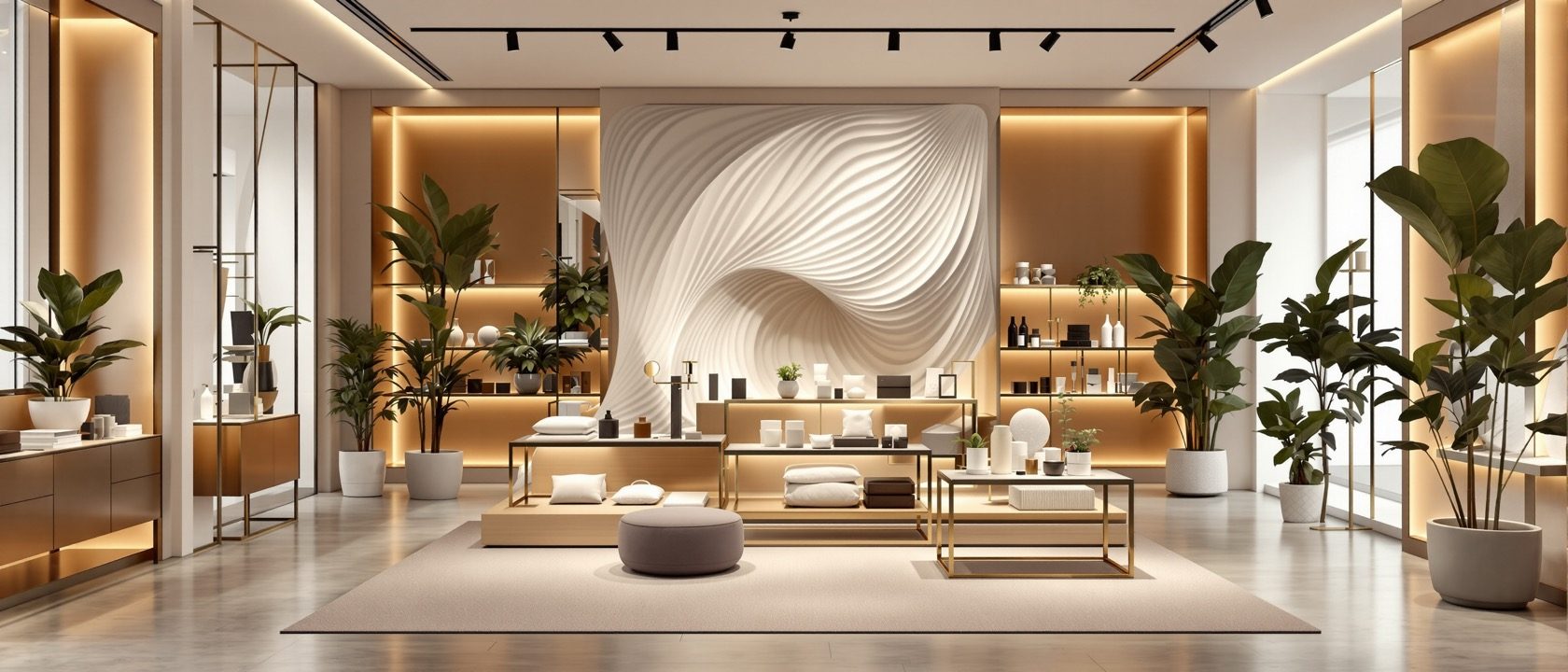
Designing a Retail Space
The whole craft, made real — and kept honest
The course comes together in a complete retail project: designing a store for a brand or product from a brief of brand, product, customer and budget, through concept, layout, fixtures, display, lighting, facade and presentation. And it closes on the craft’s honest heart: the best visual merchandising serves the shopper as much as the seller — a win-win of a store that is easy and pleasant to shop and that sells. Compelling, profitable and honest, all at once.
Learning objectives
By the end of this lesson, you will be able to — mapped to the course outcomes for Visual Merchandising:
Take a real brand or product through a complete retail-space design.
Translate a retail concept into a space with the right material, process and brand fit.
Judge a retail design by how well it serves both shopper and seller.
The brief
A retail design begins with a brief holding four things together — the brand (who this store is), the product (what is sold and how it is best shown), the customer (who shops and how), and the budget and site. Great design resolves the four into one coherent, buildable space.[1, 2]
Brand, product, customer, budget
A retail design begins with a BRIEF, and a good one holds four things together. The BRAND: who this store is, its values, personality and story — which the whole design must express. The PRODUCT: what is sold, how it is best shown, handled and grouped — which drives the fixtures and flow. The CUSTOMER: who shops here, how they behave, what they want and can afford — which the space must serve. And the BUDGET (and site): what is possible. Great retail design is the RESOLUTION of these four into one space — a store that feels unmistakably like the brand, shows the product at its best, serves its customer beautifully, and is buildable for the money. This is exactly the CO5 skill: translating a retail concept into a space with the right material, process, consumer habits and brand parameters. Start from the brief, and every later decision has a reason.[1, 2]
The design journey
The project runs the whole craft in sequence: from the brief, generate a concept; develop the layout; design the fixtures and displays; resolve the lighting and facade; and produce the presentation — boards, sketches, plans, layouts, details and a rendering or model — grounded by a mandatory expert talk.[1, 2]
Concept to presentation
The retail PROJECT runs the whole craft in sequence: from the brief, generate a CONCEPT (the big idea and brand story for the space); develop the LAYOUT and store plan (zones, circulation, the decompression zone, power wall, traffic flow); design the FIXTURES and DISPLAYS (right display for right product, focal points, composition); resolve the LIGHTING and atmospherics; design the FACADE, window and signage; and produce the PRESENTATION — concept boards, studies, design sketches, plans and layouts, furniture and fixture layouts and details, and a 3D RENDERING or physical model. Everything the course taught converges here. And an EXPERT TALK (mandatory in the syllabus) grounds it — a working visual merchandiser or retail designer bringing the real trade: the constraints, the costs, the surprises, the craft. The project is where a student proves they can take a brand from a brief to a buildable, compelling store.[1, 2]
Serve shopper and seller
The best VM is a win-win: an easy, pleasant, honest store serves the shopper (find, understand, enjoy) and sells more for the seller. Manipulation wins a sale and loses a customer; honest, skilful VM wins the sale, the trust and the return — and retail must be accessible too.[3]
The honest heart of the craft
The whole course closes on its honest heart: the best visual merchandising serves the SHOPPER as much as the SELLER. It is easy to frame VM as manipulation — and the field even has a cautionary legend, the 'Gruen effect', named after an architect who DISOWNED that cynical use. But the truth is that good VM is a WIN-WIN. When a store is easy to navigate, when product is findable and clearly shown, when the space is pleasant and the offer honest, the SHOPPER is genuinely better served — they find what they want, understand it, and enjoy the trip — AND the seller sells more. Manipulation (disorienting layouts, hidden prices, dark patterns) wins a sale and loses a customer; honest, skilful VM wins the sale AND the trust AND the return. And retail must be ACCESSIBLE too — clear aisles and step-free entrances serve every shopper (the universal-design link). Design retail that is compelling, profitable AND honest: that is the whole aim, and it is entirely possible.[3]
At a glance
| Aspect | The fact | The folklore |
|---|---|---|
| A retail design begins with | A BRIEF — brand, product, customer, budget, resolved into one space | A nice-looking idea |
| The project runs | Concept → layout → fixtures/display → lighting → facade → presentation | Straight to a render |
| The best VM serves | The SHOPPER as much as the SELLER — a win-win | Only the seller's sales |
| Manipulation | Wins a sale and LOSES a customer | Is smart business |
| Honest, skilful VM wins | The sale AND the trust AND the return | Nothing extra |
| Retail must also be | ACCESSIBLE — clear aisles, step-free — serving every shopper | For able-bodied shoppers only |
Key terms
The starting point of a retail project — brand, product, customer and budget held together — which the whole design must resolve into one coherent, buildable space.
The big idea and brand story for a store, generated from the brief, that drives the layout, fixtures, displays, lighting and facade into a unified whole.
The complete design journey — concept, layout and plan, fixtures and display, lighting, facade and signage, and a presented rendering or model — where the whole course converges.
The honest heart of visual merchandising — that good VM is a win-win: it genuinely helps the shopper find, understand and enjoy, and it helps the seller sell.
The ethical line — disorienting layouts, hidden prices and dark patterns win a sale but lose a customer; honest, skilful VM wins the sale, the trust and the return.
A store designed with clear, wide aisles and step-free entrances so every shopper can use it — the universal-design principle applied to retail.
Study task
Design a complete retail space for a brand or product of your choice, pulling the whole course together. Start from a brief: define the brand, the product, the customer and a budget. Generate a concept and brand story for the space. Develop the layout and store plan using the concepts you learned — a kept-open decompression zone, a strong power wall, a sensible traffic flow, clear accessible aisles. Design the fixtures and displays (right display for right product, clear focal points, edited compositions), resolve the lighting and atmospherics, and design the facade, window and signage. Present it as concept boards, sketches, plans, fixture layouts, key details and a rendering or model. Then judge your own design by the double test: how well does it serve the shopper (easy, clear, pleasant, honest) and how well does it serve the seller (sells, builds the brand)? Finish with one line on how your design is compelling, profitable AND honest at once. One brand, one store, made real.
Self-assessment
1. What does a retail design begin with?
2. Who does the best visual merchandising serve?
3. What does manipulation in retail achieve?
4. What does the retail project pull together?
Recap
References & further reading
- [1]Swati Bhalla & Anurag Swati, Visual Merchandising, McGraw Hill, New Delhi, 2010 — the retail design project and presentation. https://www.mheducation.co.in/
- [2]Reji Mathew, Apparel Merchandising, Book Enclave, New Delhi, 2008; and the retail design brief and process (retail-design references). https://www.wgsn.com/
- [3]The ethics of visual merchandising — serving shopper and seller; the Gruen effect and Victor Gruen's disavowal; and accessible retail (Paco Underhill, Why We Buy; universal-design guidelines). https://en.wikipedia.org/wiki/Gruen_transfer
Further reading
- Swati Bhalla & Anurag Swati, Visual Merchandising, McGraw Hill, New Delhi, 2010.
- Reji Mathew, Apparel Merchandising, Book Enclave, New Delhi, 2008.
- Paco Underhill, Why We Buy: The Science of Shopping.
Sources gathered and fact-checked June 2026. Published values vary by source, sample and method — treat as indicative and confirm against the cited standard before structural use.
The author
Amogh N P
Architect, interior designer, and creative polymath. Studio Matrx began in his notebooks — his vision of design made honest, useful, and open to everyone. Its Academy is written and taught in his memory, and free, forever.
More about Amogh →