
 Lesson 2.1
Lesson 2.1 · Ways of Growing
Soil, Container & Rooftop
Before the pumps, the sensors and the grow-lights come the simplest, oldest and most forgiving ways to grow food - in the ground, in a pot, and on the roof - and they are, more often than the hype admits, the right ones
Before hydroponics and grow-lights, remember: most food is still grown the oldest way - in soil, in the sun - and for good reason.
It is easy, reading about vertical farms and glowing LED trays, to assume the future of growing food is high-tech, soil-free and indoors. But the simplest, oldest methods - putting a seed in soil in the ground, in a pot, or in a bed on the roof, and letting the sun do the work - remain the way almost all the world's food is grown, and for building agriculture they are usually the first and best thing to try. They are robust, forgiving and cheap; they need no pumps, no power and no constant monitoring; and because the sun supplies the light energy for free, they sit at the sun-powered end of the spectrum where growing food in buildings genuinely makes sense.
This lesson takes the three simplest approaches in turn - growing in soil in the ground, growing in containers and raised beds, and growing on the roof - and is honest about both their real strengths and their real limits. The great limit of rooftop growing is not horticulture but structure and water: wet, planted soil is heavy, and putting it on a roof loads the building and demands proper waterproofing and drainage. Those are binding engineering questions for qualified structural and services engineers and the governing codes, never guesswork - so we treat the growing as design judgement and defer the loads, the membrane and the drainage to the specialists.
Soil = forgiving + cheap + sun-powered. Ground -> containers/beds -> rooftop. On the roof: WET SOIL IS HEAVY -> loads + waterproofing + drainage = engineers + codes. Simple often wins.
The oldest way: growing in living soil
Soil is the medium almost all food has ever been grown in, and it is worth remembering why before reaching for anything more complicated. Good soil is not inert dirt but a living system: mineral particles, organic matter, water, air and an enormous community of microbes, fungi and small creatures that hold nutrients, release them slowly, store water, and build structure. That living complexity is exactly what makes soil so forgiving. It buffers mistakes - a missed watering, a slightly wrong feed, a hot day - because the soil holds a reserve of water and nutrients the plant can draw on, and the root system can go looking. A soil-grown plant is far harder to kill than a plant whose roots sit in flowing water or hang in mist, and that robustness is a genuine, underrated advantage for anyone growing food in or around a building without a full-time grower on hand.
Growing in the ground - in beds of open soil - is the simplest form of all. It needs no vessel, no pump and no power; roots can go deep for water and nutrients; and it can support the widest range of crops, including larger and longer-season vegetables that container and soil-free systems struggle with. Its costs are mainly land, labour and patience: you need actual ground with decent soil and enough sun, the soil must be built up and kept healthy with compost and care, and yields per square metre are lower than the intensively controlled systems later lessons describe. It is also slower and less predictable than a tuned hydroponic rig, and more exposed to weather, pests and weeds.
But for building agriculture the point is this: where a building has access to ground - a courtyard, a garden, a plot beside it - growing food in soil is cheap, robust and low-risk, and it should be the default that any higher-tech method has to justify itself against. Soil-grown food is also, done well, deeply sustainable: it can run on compost and rainwater, build carbon and life in the soil, and demand almost no bought inputs or energy. The living soil does quietly and for free what an indoor farm spends heavily to imitate. The design skill is to notice when that free, forgiving resource is available - and not to abandon it for complexity you do not need.
Containers and raised beds: soil, but portable
Most buildings do not have open ground to spare, and this is where containers and raised beds come in - the workhorses of urban and building agriculture. The idea is simple: bring the soil to where you can grow, in a vessel. That vessel can be a humble pot or grow-bag, a trough, a repurposed drum, or a purpose-built raised bed or planter box, and it can sit on a terrace, a balcony, a courtyard, a podium or a roof. You keep most of soil's forgiving robustness while gaining something soil-in-the-ground cannot offer: you choose the growing medium, you put growing exactly where the light is, and you can move, add to or rearrange it as needs change.
Containers give real control without much complexity. You fill them with a chosen mix - often a lightweight blend of compost, coconut coir and other media rather than heavy garden earth - so you start with clean, fertile, well-draining medium and avoid poor or contaminated ground. Drainage is designed in through holes and a base layer; watering can be by hand or a simple drip line. Raised beds scale the same idea up: a contained volume of good soil, easier on the back, warming earlier, and neatly separated from paving or a roof deck below. This flexibility is why containers suit interiors and small spaces so well - a few pots of herbs and salad on a sunny windowsill or balcony is genuinely achievable and rewarding, and needs no special skill.
In India this is not a novelty but a living tradition. Terrace gardens, kitchen gardens and courtyard growing in pots and beds are deeply rooted across the country, well suited to abundant year-round sunlight and huge areas of flat roof, and they reconnect dense-city households to fresh food while greening and shading hot terraces. The honest limits are modest: containers dry out faster than open ground because the soil volume is small, so they need more regular watering; the confined root space caps how large a crop can grow; and the medium is depleted and must be refreshed over time. None of this is hard. Containers and raised beds are, for most buildings, the sweet spot - most of soil's forgiveness, placed wherever the sun falls, at low cost and low risk.
Pot / grow-bag / raised bed = soil you can put anywhere the sun is. Choose the medium, design the drainage, water a bit more often. India: living terrace + kitchen-garden tradition.
Onto the roof: the promise and the load reality
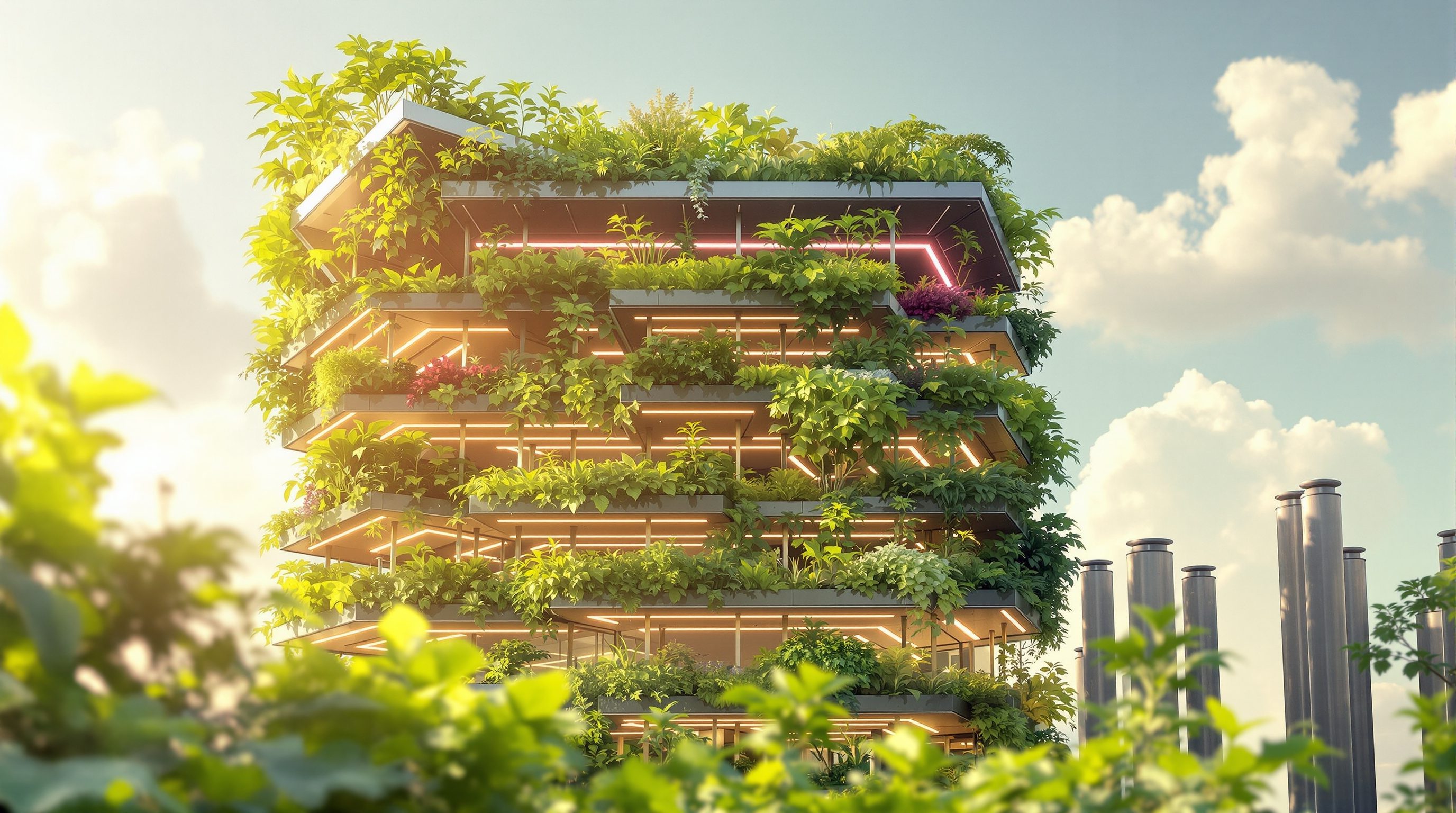
The flat roof is the great untapped opportunity of building agriculture: a large, sunny, otherwise-wasted surface, right where people live and work. Growing on it - in beds, containers or an engineered green-roof build-up - can turn dead area into fresh food, green and cool a hot roof, slow rainwater run-off, and give a building a genuinely productive skin, all while the sun does the growing. The appeal is real and, at the sun-powered end of the spectrum, well founded. But a roof is not simply the ground moved upward, and here honesty matters more than anywhere else in this lesson, because the binding constraints are not horticultural at all - they are structural and water-related.
The first hard truth is weight. Soil is heavy, and wet soil is far heavier: a growing bed that feels manageable when dry can weigh dramatically more when saturated after rain or irrigation, and that load - plus the weight of water, containers, plants, people tending them and equipment - must be carried by the roof slab and travel down through beams, columns and foundations. A roof designed only to keep out weather may not be built for a loaded, planted, in-use garden. Whether it can be, and what it can safely carry, is a question for a qualified structural engineer working to the National Building Code of India and the relevant IS standards - never an assumption, and always designed for the wet, fully-planted, in-use state.
The second is water. Putting soil and constant irrigation on top of a building is putting a permanent wet load over occupied space, so the waterproofing must be sound and durable, protected by a root barrier so roots cannot find and breach it, and paired with drainage and overflow that clears water fast and prevents ponding. A leak here is expensive and damaging. These, too - waterproofing, root barrier, drainage design - belong to the waterproofing and services specialists and the codes, not to guesswork. The design lesson is balanced, not discouraging: rooftop growing is one of the most rewarding sun-powered moves a building can make, and India's flat roofs and sunshine invite it - but you earn it by respecting the load and the water, designing for the saturated state, and bringing in the structural and waterproofing engineers early, not after the beds are built.
Strengths, limits, and why simple often wins
Set against the high-tech systems the rest of this module describes, soil-based growing - in the ground, in containers, on the roof - looks humble, and that is precisely its strength. Its virtues are exactly the ones a building without a professional grower most needs. It is simple: a person with ordinary gardening sense can run it, without pumps, sensors, dosing or a control system to learn and maintain. It is robust and forgiving: the living soil buffers mistakes and short absences, so a missed day or a small error rarely means a dead crop. It is cheap: the inputs are soil, compost, water, seed and sun, with no grow-lights burning electricity and little machinery to buy, run and repair. And it is sun-powered: the light energy that grows the plant is free, so it sidesteps entirely the energy elephant that makes indoor farming so costly. For a great many building-agriculture situations, that combination is not a compromise - it is the right answer.
The limits are real but bounded. Soil growing needs space and sun, which dense sites may lack; it needs actual ground or the structural capacity to carry beds and containers, especially on a roof; yields per square metre are lower than intensively controlled soil-free systems; and it is more exposed to weather, pests and seasons than an enclosed farm. Containers dry out and deplete; rooftops impose the load and waterproofing constraints just discussed. These matter, but they rarely overturn the basic verdict.
That verdict is the honest through-line of this whole module, and it is worth stating plainly: the higher-tech methods to come - hydroponics, aeroponics, aquaponics, full controlled-environment agriculture - buy you more control, more density and less water, but they buy it at the price of complexity, cost and fragility, and they should be chosen only when the crop, the context and the constraints genuinely demand what they offer. For most food grown in and on ordinary buildings, in a sunny country with a living terrace-gardening tradition, simple soil, containers and rooftop growing remain robust, affordable, sustainable and quietly excellent - the wise default, and the baseline every fancier system has to beat. Do not reach past it out of enthusiasm for technology; reach past it only when you must.
Design for the saturated state
Loads of a rooftop growing bed
Wet, planted soil is far heavier than dry; roof gardens must be designed for the saturated, fully-planted, in-use load - dead, live and water - carried by slab, beams, columns and foundations. A qualified structural engineer and the codes (NBC India, IS) decide what a roof can carry. Never assume.
Waterproofing + root barrier + drainage
Water over occupied space
A rooftop bed is a permanent wet load over the building; it needs a sound, durable waterproof membrane, a root barrier so roots cannot breach it, and drainage and overflow that prevent ponding. This is waterproofing and services engineering, not guesswork.
Growing medium + drainage in containers
Container and raised-bed growing
Containers need a suitable, often lightweight growing medium and designed drainage; small soil volumes dry out and deplete faster than open ground, so watering and medium refresh are part of the design. Protect floors and finishes from water indoors.
Food safety in the growing medium
Growing food people eat
Soil, compost and water quality affect the safety of food grown for consumption; contaminated ground or inputs are a real risk. Food-safety obligations belong to the governing regulation and food-safety specialists, not guesswork.
Workshop — a soil-first growing plan for a real roof or terrace
Before any pump or grow-light, most building agriculture starts with soil in the sun. In this workshop you take a real roof, terrace or courtyard you can see and sketch an honest, soil-based growing plan for it - and flag the loads and waterproofing that an engineer must confirm.
Just a real roof or terrace you can see, a notebook, and a tape measure. No growing system and no calculations you rely on - this workshop is about soil-first judgement and knowing which questions belong to the structural and waterproofing engineers and the codes (NBC India, IS).
Goal: a first, grounded soil-growing plan and a feel for the load question
Inputs: a roof/terrace/courtyard you know + this lesson + a notebook and tape measure
Time: ~45 minutes
- 1Map the sun and the surface: sketch the roof or terrace, mark where it gets good sun through the day, and note the surface (existing waterproofing? paving? bare slab?) and how you would reach it with water.
- 2Choose the form: decide, for each sunny zone, whether you would grow in containers/grow-bags, raised beds, or (if there is ground) open soil - and why, favouring the simplest that fits.
- 3Pick a light medium and drainage: specify a plausible lightweight growing medium and how each bed or container would drain, and where the water would go - so you never trap water on the roof.
- 4Face the load honestly: estimate, roughly, how much heavier your beds get when saturated versus dry, and write down that the roof's capacity for this wet, planted, in-use load must be confirmed by a structural engineer - flagged as reasoning, not a number to rely on.
- 5Write a one-paragraph verdict: what you would grow here, why soil in the sun suits it, and the three things - loads, waterproofing, drainage - you would take to a structural and waterproofing engineer and the codes before building anything.
You’ll walk away with
A one-page soil-first plan: a sunlit roof/terrace, growing forms chosen for each zone, medium and drainage noted, and an explicit list of the load and waterproofing questions for the engineers - framed as reasoning, not specification.
Three altitudes on the same idea
Read the band that fits you — or all three.
Soil-based growing - beds, containers, rooftop - is the low-risk, sun-powered baseline every building-agriculture idea should be measured against, and its binding constraints are structural and water, not horticultural. Where a site has ground or a terrace with good sun, soil growing is cheap, robust and forgiving, and it belongs in the earliest design moves - not bolted on later. The moment growing goes onto a roof, three things become non-negotiable: the load (wet, planted soil is heavy, and the slab, beams, columns and foundations must carry the saturated, in-use state), the waterproofing (a durable membrane with a root barrier over occupied space), and the drainage (fast clearance, overflow, no ponding). Design for these from the start - allow depth for the build-up, plan access and water supply, and coordinate structure and waterproofing early. Own the productive-roof vision and the placement in the sun; defer the loads, membrane and drainage design to qualified structural and waterproofing engineers and the codes (NBC India, IS). Prefer the sun-powered soil route wherever it works before considering anything that needs pumps and power.
For interiors, soil in containers is the friendly, achievable way to bring edible growing to people - a few pots of herbs and salad on a sunny sill, a planter of leafy greens in a cafe or workplace - genuinely rewarding and needing no special kit. Containers give you soil's forgiveness in a movable vessel: choose a clean, light growing medium, put it exactly where the daylight falls, design in drainage (a saucer or a sealed base so you protect floors and finishes), and water a little more often than open ground because small soil volumes dry out. This is real biophilia and a tangible connection to food, and it keeps you honest about scale - a delightful herb wall by a window is one thing; growing serious quantities indoors is the energy-hungry, specialist territory later modules cover. Coordinate anything involving weight on floors, water supply, drainage and food safety with the relevant specialists and the codes; your domain is the green, edible, human-scale interior that a sunny window and good soil make easy.
The simplest methods matter most: understand soil, containers and rooftop growing first, because they are how most food is grown, they sit at the sun-powered end of the spectrum, and they are usually the right choice. Learn why living soil is forgiving - it holds water and nutrients and buffers mistakes, so soil-grown plants are hard to kill compared with roots in flowing water or mist. Learn the three simple forms: open ground (cheapest and most robust, but needs land and sun), containers and raised beds (soil made portable - flexible, ideal for terraces and balconies, the sweet spot for most buildings, and a living Indian tradition), and rooftop growing (huge sunny opportunity, but wet soil is heavy, so loads, waterproofing and drainage are binding engineering questions for the specialists and the codes). Above all, carry the module's through-line: higher-tech systems buy control at the cost of complexity, cost and fragility, so simple soil-based growing is the wise default that fancier methods must beat - not a primitive thing to be replaced.
“Soil growing is the primitive, low-yield, old-fashioned option - serious building agriculture means moving beyond dirt to soil-free, high-tech systems like hydroponics and vertical farms, which are simply better.”
Do it yourself
No tools needed — reason it through.
- 1Explain why living soil is forgiving, and why a soil-grown plant is harder to kill than roots in flowing water or mist.
- 2Compare growing in open ground with growing in containers and raised beds - what does each gain and give up?
- 3Why are containers and raised beds so well suited to terraces, balconies and the Indian building context?
- 4A client wants a rooftop vegetable garden. What are the three binding realities you must respect, and who confirms them?
- 5State the module's through-line: when is simple soil growing the right choice, and when should you reach for higher-tech methods?
The one line to carry out
Peer-reviewed journals & authoritative standards
- 01Rooftop farming — Wikipedia — Rooftop farming, 2026.
- 02Container garden — Wikipedia — Container garden, 2026.
- 03Green roof — Wikipedia — Green roof, 2026.
- 04Soil — Wikipedia — Soil, 2026.
- 05Terrace garden — Wikipedia — Terrace garden, 2026.
Soil is forgiving and sun-powered, but it needs space, and its yields per area are modest. What if you could grow without soil at all - denser, with far less water, and precise control? That is the promise, and the price, of hydroponics, which we take up next.
The author
Amogh N P
Architect, interior designer, and creative polymath. Studio Matrx began in his notebooks — his vision of design made honest, useful, and open to everyone. Its Academy is written and taught in his memory, and free, forever.
More about Amogh →