
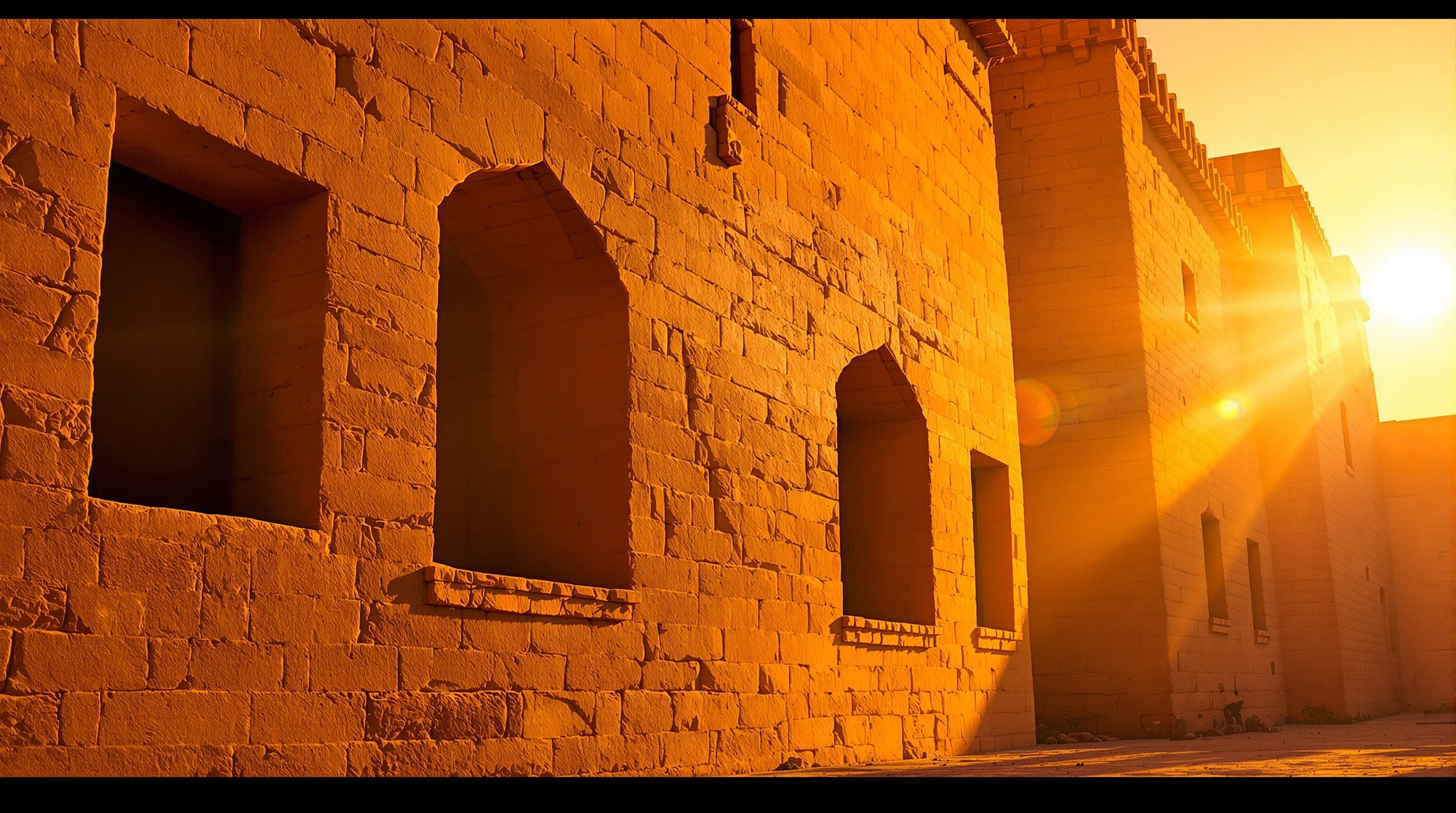
 Lesson 1.3
Lesson 1.3 · The Solar Engine
The SW Mass Rule
Why the heaviest walls and the master bedroom belong where the afternoon sun hits hardest — and where that wisdom quietly runs out.
The corner that drinks the afternoon sun
Stand on the western edge of any old Indian house at 4 p.m. in May and press your palm to the wall. The masonry is warm but not searing — and inside, the room is calmer than the day outside. Vastu calls this the rule of the heavy south-west. Physics calls it thermal mass, and for once the two are talking about exactly the same thing.
What the rule actually says
Across the Vastu tradition, the south-west (Nairutya) is treated as the corner of weight. The texts ask you to put the thickest walls, the fewest and smallest openings, the heaviest construction, and the master bedroom there. The north-east, by contrast, stays light and open — we decoded that in 1.2.
Dressed in symbolic language, this reads as a hierarchy of the four corners. Strip the language away and you are left with a single instruction that an energy engineer would recognise instantly: put your mass and your blank walls on the side of the building that takes the worst heat.
That is not a coincidence. It is the rule we are going to test against the physics — and, importantly, find conditions under which it bends.
The thermal-mass mechanism: time lag and decrement factor
Thermal mass is simply a material's ability to absorb, store and slowly release heat. Heavy, dense materials — stone, brick, rammed earth, mud, dense concrete — have high heat capacity, so they soak up a lot of energy before their own temperature rises much.
Now look at where the sun is. The west and south-west façade takes the harshest exposure of the day: the late-afternoon and evening sun strikes it low and direct, and peak air temperature lags solar noon by roughly two to three hours, landing squarely on that face. A thin, light wall there would heat up fast and dump that heat indoors almost immediately. A heavy wall does two useful things instead.
First, time lag: heat takes hours to conduct through thick mass, so the warmth that hit the wall at 4 p.m. doesn't reach the inner surface until late evening or night. Second, the decrement factor: the indoor temperature swing is strongly damped compared with the outdoor swing — the peak is flattened. A thick masonry wall can delay the heat wave by several hours and cut the indoor swing to a fraction of the outdoor one.
Think of the wall as a slow battery: it charges on heat all afternoon and only discharges, gently, after dark.
Why the master bedroom rides the lag
Here is the elegant part. A bedroom is used in the evening and at night — precisely the hours when a light west room would be at its worst, still radiating the afternoon's stored heat through a thin shell.
Put that same bedroom behind buffered south-west mass and the timing inverts in your favour. By the time you occupy it, the wall has smoothed and delayed the peak; the inner surface is releasing heat slowly and gently rather than spiking. The room you sleep in is the room the mass has been quietly protecting all afternoon.
But notice the hidden assumption. This only works if the stored heat has somewhere to go before you go to bed. The mass must be able to flush its heat at night — which means you need cool night air and a real day-to-night temperature swing. Hold that thought; it is the crack through which 1.4 will enter.
The bedroom doesn't fight the heat — it arrives after the wall has already taken the punch.
Where it shines, where it stumbles
In hot-dry India — Rajasthan, the Deccan interior, much of the arid north-west — this rule is close to perfect. Days are brutally hot, but nights drop sharply, so the mass charges by day and reliably discharges into cool night air. The forts and havelis of these regions are essentially thermal-mass machines built around exactly this logic.
Cross into hot-humid India — coastal Kerala, Konkan, the deltas — and the same heavy wall can backfire. The day-night swing is small, the nights stay warm and sticky, and there is little cool air to flush the stored heat. A massive west wall then becomes a heat reservoir that re-radiates warmth all night, making bedrooms worse, not better. Traditional architecture there responds correctly: lightweight, well-shaded, cross-ventilated construction that holds little heat and lets breezes carry it away.
So the south-west mass rule is genuinely sound building science — but it is climate-bound. It is 🟢 in hot-dry zones and slides toward 🟡 the moment you reach humid coasts or cold hills. The rule never asked which climate you were in. A good designer always does.
How each rule sorts
The mass rule earns a green stamp — with an asterisk the size of a monsoon cloud.
The west/south-west façade takes the hottest, lowest afternoon sun, and peak air temperature lags solar noon by 2-3 hours. High-heat-capacity mass there delays the heat wave (time lag) and damps the indoor swing (decrement factor), buffering the harshest exposure — excellent in hot-dry climates.
An evening- and night-used room benefits from sitting behind buffered mass that has smoothed the afternoon peak. This holds firmly in hot-dry zones with a real day-night swing, but is contingent (🟡) in humid or cold climates where the mass cannot flush its stored heat and may re-radiate warmth all night.
Small west-facing openings cut direct low-angle solar gain on the worst façade, which helps in hot climates. But the same restriction starves a humid-coast room of the cross-ventilation it needs, so the rule is contingent on climate and on having ventilation elsewhere.
What the south-west corner is really telling you
- The rule is sorting your building by exposure: heaviest mass on the harshest (west/south-west) face, lightest fabric on the gentlest (north-east) — pure passive-cooling logic.
- Two ideas do all the work: time lag delays the heat wave by hours, and the decrement factor flattens the indoor temperature swing.
- Mass is only an asset with a real day-night swing AND a way to flush stored heat at night — both true in hot-dry India, both shaky on humid coasts.
- Honour the rule for free in arid zones; negotiate it (lighter, shaded, ventilated) the moment you cross into humid or cold territory.
Those two conditions — the swing and the flush — are exactly what humid coasts and cold hills take away. In 1.4, 'Where the Honest Frame Bends', we follow the south-west rule across India's climate zones and watch the green verdict turn amber, and in cold regions invert outright.
The author
Amogh N P
Architect, interior designer, and creative polymath. Studio Matrx began in his notebooks — his vision of design made honest, useful, and open to everyone. Its Academy is written and taught in his memory, and free, forever.
More about Amogh →