
 Lesson 1.2
Lesson 1.2 · The Solar Engine
Decoding the NE Sacred Corner
Why Vastu's holiest corner is, more often than not, just good sun-sense in disguise.
The corner that gets to the sun first
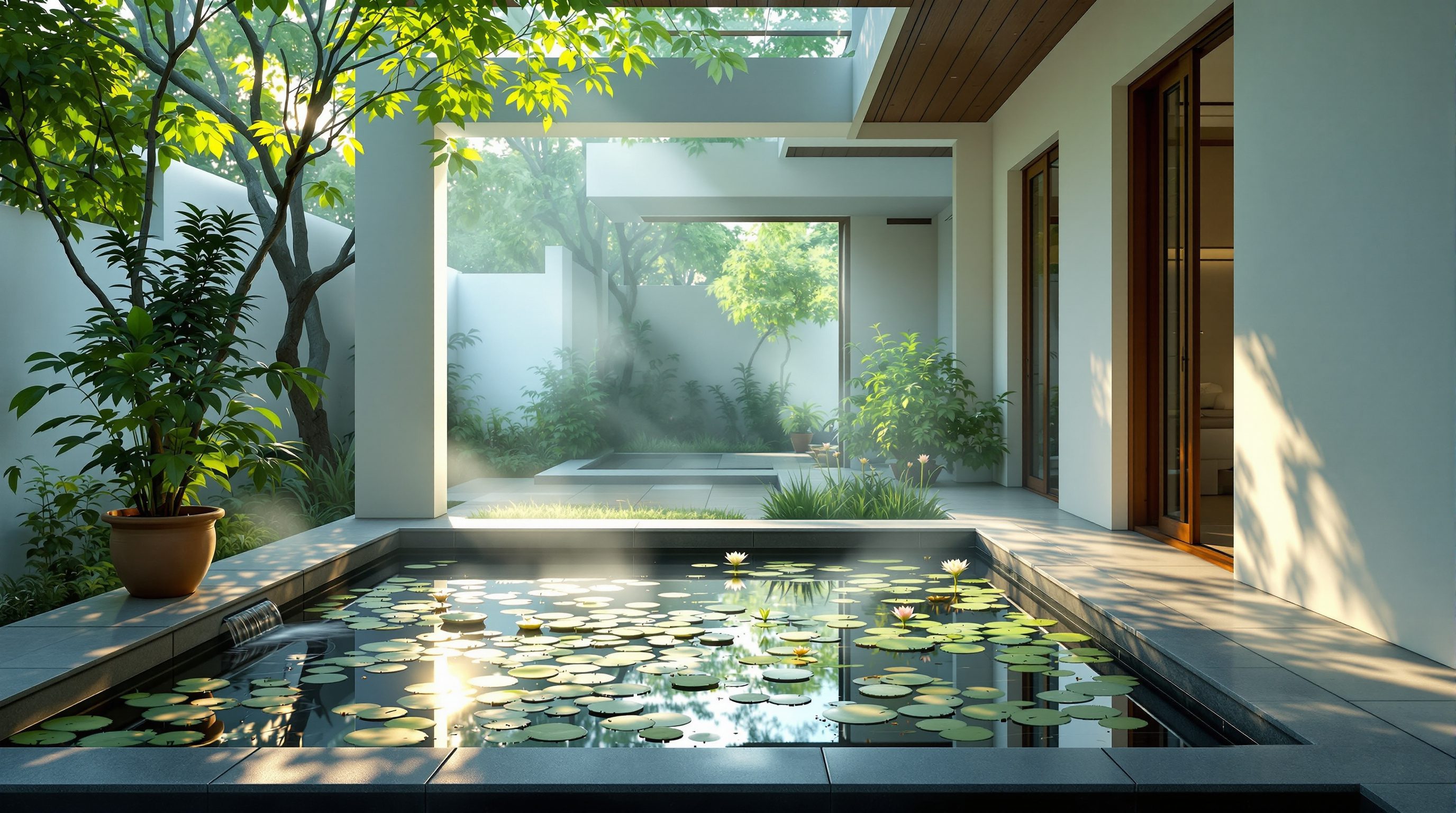
Stand in a north-facing courtyard at seven in the morning and you will feel it before you can name it: the north-east is where the day begins, gently. The light arrives low and golden, the air is still cool, and the harsh sun is hours away on the far side of the house. Long before anyone wrote it into scripture, builders simply noticed that this was the nicest corner to be alive in.
Where the morning sun actually lands
In the northern hemisphere — which is all of India — the sun rises in the east, tracks across the southern sky, and sets in the west. At sunrise it is low on the horizon and gentle: it has not yet had time to heat the air or the masonry, so the light that reaches the north-east is bright but cool. By afternoon the same sun has swung to the south-west and west, now high, fierce, and beating on walls that have been soaking up heat all day.
So the two diagonal corners of an Indian house live very different lives. The north-east greets the soft morning; the south-west absorbs the punishing afternoon. This is not metaphor — it is the same sun-path you traced in Lesson 1.1, read off a floor plan.
Vastu's instinct to treat these corners differently is therefore not superstition. It is a builder's memory of how the sun moves over this latitude, encoded as a rule of thumb.
Why "open and low" is real passive design
The classic instruction is to keep the north-east open, low and unbuilt — low compound walls, a garden, a courtyard, a water body — and never to crowd it with a tall block or a heavy store-room.
From a daylighting view this is almost exactly what a thermal engineer would advise. Letting the cool morning light and warmth in from the NE brightens the home when the air is still pleasant, and leaving that corner uncluttered keeps the coolest, most comfortable part of the plan usable. You are deliberately opening the house to the kind sun and (as Lesson 1.3 will show) shielding it from the cruel one.
The result is a gentle massing gradient across the building — lighter and lower towards the north-east, heavier and taller towards the south-west. That gradient is a genuine, defensible passive-design move for a hot climate, and it earns a green stamp.
Picture the plan as a slope: the building leans up towards the south-west to take the afternoon blow, and dips low at the north-east to let the morning in.
Water in the north-east: sensible, but only sometimes
Vastu also asks you to put water — a well, a tank, an underground sump — in the north-east. Here the logic is real but conditional.
Water stored in a shaded, cooler corner stays cooler and is pleasanter to draw and use, and the NE, kept open and lightly built, tends to be that corner in the morning. Historically the north-east was also treated as the clean, freshwater zone of the homestead, kept clear of waste. And on a plot that genuinely slopes down towards the north-east, rainwater and run-off drain that way by gravity — so collecting and storing water there is simply working with the land.
But notice the if. Modern urban plots often do not slope towards the NE at all; many are dead flat or graded for a road. A pumped, sealed overhead tank does not care which corner it sits in for temperature, and drainage today is engineered, not gravity-prayed. The rule made excellent sense for a sloping village plot with an open well; it becomes contingent the moment those conditions vanish. That is why it lands amber, not green.
The sacred corner — and an honest nuance
Finally, the north-east is Vastu's most sacred zone — Ishanya, the corner of Ishana (Shiva) — and the prescribed home of the puja or meditation room. This is where we must be precise.
There is no physical mechanism that makes the north-east holy. The deity, the divinity, the sense of the corner as a threshold to the sacred — these are cultural and religious meaning, and we respect them exactly as that: belief, never engineering. To dress sacredness up as physics would be dishonest, and to mock it would be graceless. Neither is our method.
But here is the honest nuance the green and amber rules above hand us for free: a prayer or meditation room genuinely does benefit from the NE. It is the calmest, coolest, most softly daylit corner of the house in the early morning — exactly when people pray and meditate. So the placement is sound for ordinary, explainable reasons, even though the sacredness that motivated it is not. Honour the room's quiet morning light as design; honour the deity as devotion. Just don't confuse the two.
How each rule sorts
Three NE rules, three different verdicts — exactly the discipline Module 0 promised.
Low-angle eastern/north-eastern morning sun is cool and gentle; keeping the corner open admits that pleasant light and warmth and keeps the coolest part of the plan usable, while the low-NE/high-SW massing gradient is genuine passive-solar design for a hot climate.
A shaded NE keeps stored water cooler, and a plot that truly slopes towards the NE drains there by gravity — but the benefit is contingent on the land's actual slope, shading and an open store, and largely evaporates on a flat urban plot with a pumped, sealed tank.
No physical mechanism makes a corner holy — the sacredness is cultural belief, to be respected as such; though the puja room does happen to benefit from the calm, cool, softly daylit NE for ordinary, explainable reasons.
What the NE corner is really telling you
- The NE meets the day's gentlest sun; opening and lowering it is real passive-solar logic — green.
- Water in the NE is sensible only where the plot shades and slopes that way — amber, plot-dependent.
- The corner's sacredness is belief, not physics; respect it as belief, never as engineering.
- One green rule (open NE) doesn't certify the water rule or the sacred claim — each earns its own verdict.
We've seen why the lightest corner faces the gentlest sun. In Lesson 1.3 we cross the diagonal to the opposite corner and ask why Vastu wants the south-west heavy and high — the SW mass rule — where the fierce afternoon sun makes the case.
The author
Amogh N P
Architect, interior designer, and creative polymath. Studio Matrx began in his notebooks — his vision of design made honest, useful, and open to everyone. Its Academy is written and taught in his memory, and free, forever.
More about Amogh →