
 Lesson 0.1
Lesson 0.1 · Framing
The Honest Frame
Reading Vastu as building science — the one tool you'll use across the whole course.
One rulebook, two opposite climates
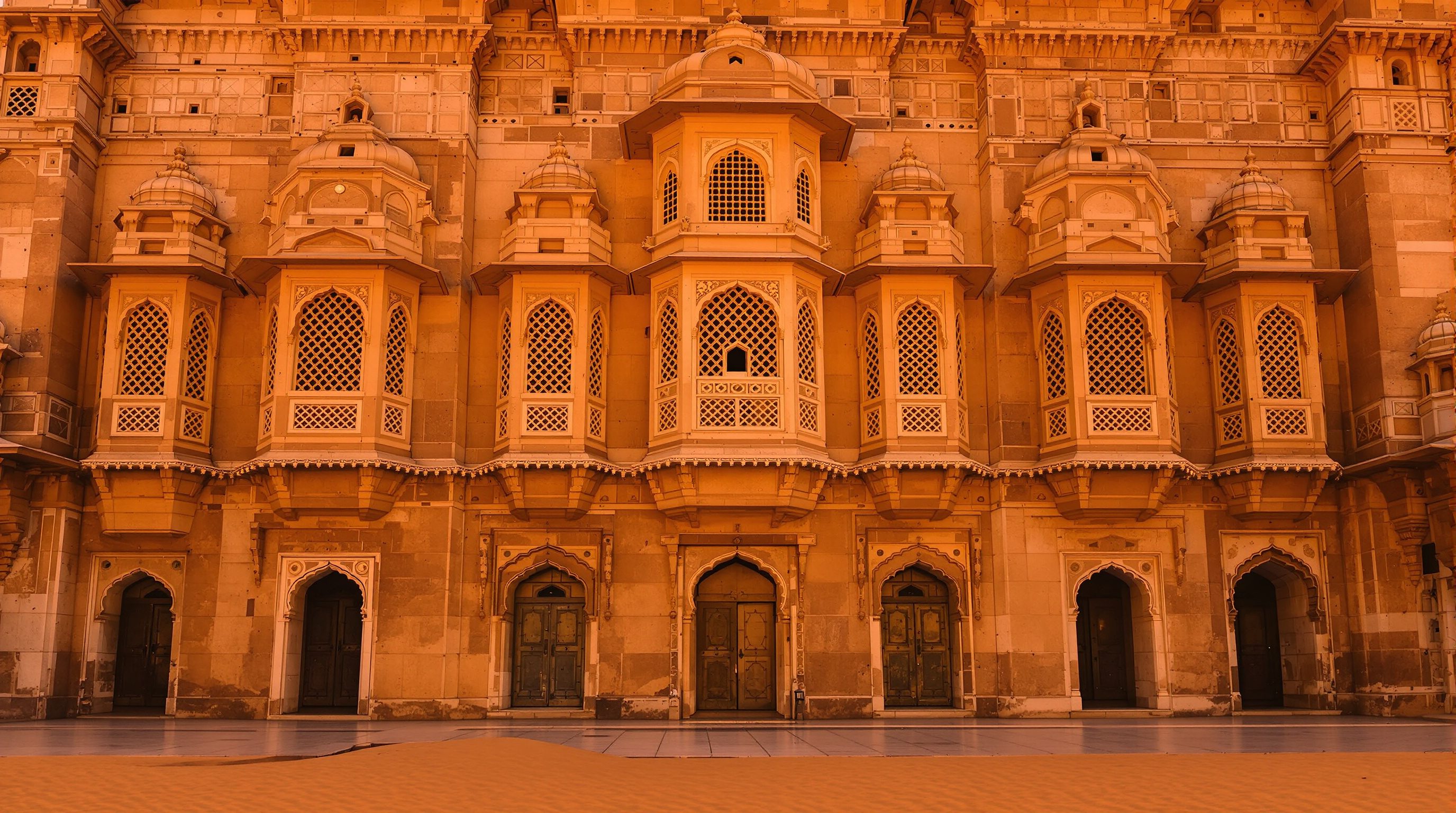
Here are two houses. Both were built to satisfy the same Vastu rules. They sit in two corners of India whose weather could not be more different.
48°C summers, almost no rain, a huge day–night temperature swing. Thick walls and small openings are survival, not style.
32°C but drenching humidity and 3,000 mm of monsoon rain. Here the enemy is trapped moisture, so airflow is everything.
Can a single rulebook really serve both — and if it can't, which parts survive the journey?
Vastu is not a religion test or a physics test. It's a constraint someone hands you. The skill is knowing which parts to keep, which to translate, and which to set down gently.
Every Vastu rule lands in one of three buckets
Instead of asking “is Vastu true?”, we ask a sharper question of each individual rule: what physical claim, if any, sits underneath it — and does building science back that claim up? The answer always falls into one of three buckets. You will sort hundreds of rules into these three bins by the end of the course.
A real environmental principle wearing cultural clothing
The rule encodes physics that genuinely works for the subcontinent's heat, light and monsoon. Honour it for free — it's good design anyway.
Example: keep the north-east open and low (soft morning light); put mass in the south-west (blocks harsh afternoon sun).
Made sense for one era, latitude or material — not universally
There's real logic, but it depends on conditions that may no longer hold. Negotiate it against the actual site and technology.
Example: kitchen in the south-east “fire corner” — excellent for a smoky wood fire in 1850, weak for an induction hob with an exhaust hood.
No physical claim — cultural, symbolic or arbitrary
No building-science mechanism supports it. Treat it with respect as belief, satisfy it cheaply or symbolically, and never pretend it's engineering.
Example: the main door must not face a T-junction; directional “defects” cured by numerology.
The Sorting Machine
Tap Sort. A real Vastu rule drops in, the machine reveals the physics underneath, and the matching bin lights up. This little device reappears between every module — it's the engine of the whole course.
What's really under this rule?
Each card carries a hidden physical claim. Watch where it lands.
Notice the pattern: the machine never asks whether the rule is “Vastu.” It only asks whether physics shows up when you lift the lid.
The Verdict Stamp
Every rule we examine in this course gets stamped. The stamp tells you the bucket at a glance, and the line beside it names the physics in one breath. Here's how it reads:
NE morning light in the northern hemisphere is gentle and cool; an open NE corner maximises soft daylight while mass elsewhere blocks the harsh south-west sun. The gods face the gentle light — so would a thermal engineer.
South-east morning sun dried and sanitised a damp, smoke-filled wood-fired kitchen, and the breeze carried smoke away from living rooms. Sound logic — for an open flame with no chimney. The rule outlived its reason.
No airflow, daylight, drainage or structural mechanism supports this. It's a symbolic rule — worth respecting as the client's belief, but not as building science.
Trap question
This is the failure mode the course exists to fix. Choose carefully.
Your first sort
Below are three rules you haven't seen explained yet. Before the next lesson, jot down which bucket you'd guess for each — and one sentence on the physical claim you think might (or might not) sit underneath.
1 · “Place water tanks in the north-east.”
Hint: think about ground slope, shade, and where cool water wants to live.
2 · “The master bedroom belongs in the south-west.”
Hint: which façade takes the most afternoon heat, and what does mass do to it?
3 · “Choose a plot number that adds up to a lucky digit.”
Hint: is there any airflow, light or structural mechanism here?
↳ Download the Three-Bucket Worksheet to record your answers and carry them through the course.
The Honest Frame, in four lines
- Don't ask “is Vastu true?” — ask of each rule, “what physical claim is underneath, and does building science back it?”
- Three buckets: 🟢 climate logic, 🟡 plausible-but-contingent, 🔴 convention.
- Honour green for free, negotiate yellow against the real site, respect red as belief without dressing it as engineering.
- One good rule never vouches for the rest. Every rule earns its own verdict stamp.
Module 1 opens on Vastu's strongest evidence — the sun. You'll trace the sun path over India and see exactly why “open north-east, heavy south-west” is sound thermal engineering, and where it quietly breaks.
The author
Amogh N P
Architect, interior designer, and creative polymath. Studio Matrx began in his notebooks — his vision of design made honest, useful, and open to everyone. Its Academy is written and taught in his memory, and free, forever.
More about Amogh →