
Structures & Systems for Transformation
The palette that transforms space — and the trade-off each one makes
This unit is the toolkit: the systems that transform a space, sorted by the action they use — slide, fold, pivot, stack or nest, lift. But its spine is one honest law: every transformation trades off. A sofa-bed is a compromise sofa and a compromise bed, and good design names the trade-off rather than pretending there is none. It also draws the line between what can flex and what cannot — you work within a fixed core of structure, wet areas and services risers — and it is blunt that a light movable partition divides sight, not sound.
Learning objectives
By the end of this lesson, you will be able to — mapped to the course outcomes for Transformable Systems & Spaces:
Classify transformation systems by the action they use — slide, fold, pivot, stack/nest, lift.
Evaluate each system by its honest trade-off, and apply the rule that every transformation trades off.
Separate the fixed core (structure, wet areas, risers) from what can flex, and judge sound versus sight division.
The ways a space moves
Almost every transformable element uses one of five actions — slide, fold, pivot, stack/nest, lift/counterbalance — and transformation runs across every scale, from a sofa-bed to a sliding wall to a mezzanine.[1]
Slide, fold, pivot, stack, lift
Almost every transformable element uses one of five ACTIONS. SLIDE — panels and doors on a track (sliding partition, pocket door, shoji, castored units). FOLD — hinged panels or tops that concertina or drop (bi-fold walls, drop-leaf tables, sofa-beds). PIVOT — turning on an axis (pivoting panel, revolving unit). STACK / NEST — pieces that tuck into one footprint (nesting tables, modular cubes, mezzanines that stack use in section). LIFT / COUNTERBALANCE — elements raised and offset by strut or weight (Murphy bed, fold-down desk). Naming the action is the first step to choosing and detailing a system. The decoder below sorts the whole palette this way.[1]
Explore — the transformable-systems decoder
The whole palette in one place. Filter by the action a system uses; each card shows what it actually does and its honest trade-off, graded VERIFIED, NUANCED or MYTH.
Transformable-systems decoder · what each system really does
Each system shows what it actually does and its honest trade-off — graded VERIFIED, NUANCED or MYTH.
Sliding partition
A wall on a track
Does: A panel (or panels) that runs on a top or floor track to open up or divide a space on demand — the workhorse of flexible interiors.
Trade-off · Divides SIGHT and SPACE instantly, but a light sliding panel is a poor SOUND barrier — it lacks the mass and edge-sealing a real wall has. Great for zoning; do not expect privacy of sound.
Pocket / cavity door
Slides away to nothing
Does: A sliding door that disappears into a wall cavity, freeing the floor swing a hinged door would need — valuable in tight rooms.
Trade-off · Saves the door-swing space and looks clean, but the cavity is hard to service if the roller fails, and the thin leaf in a stud wall leaks sound. Detail the track quality — it carries the whole door.
Shoji / fusuma screen
The oldest transformer
Does: Light timber-lattice sliding screens (paper or cloth) that the traditional Japanese house uses to reconfigure rooms, filter light and open to the garden.
Trade-off · Proof that transformable space is ancient, not a modern gimmick — the same room served for sleeping, eating and receiving guests. Diffuses light and divides space; offers almost no sound or thermal separation.
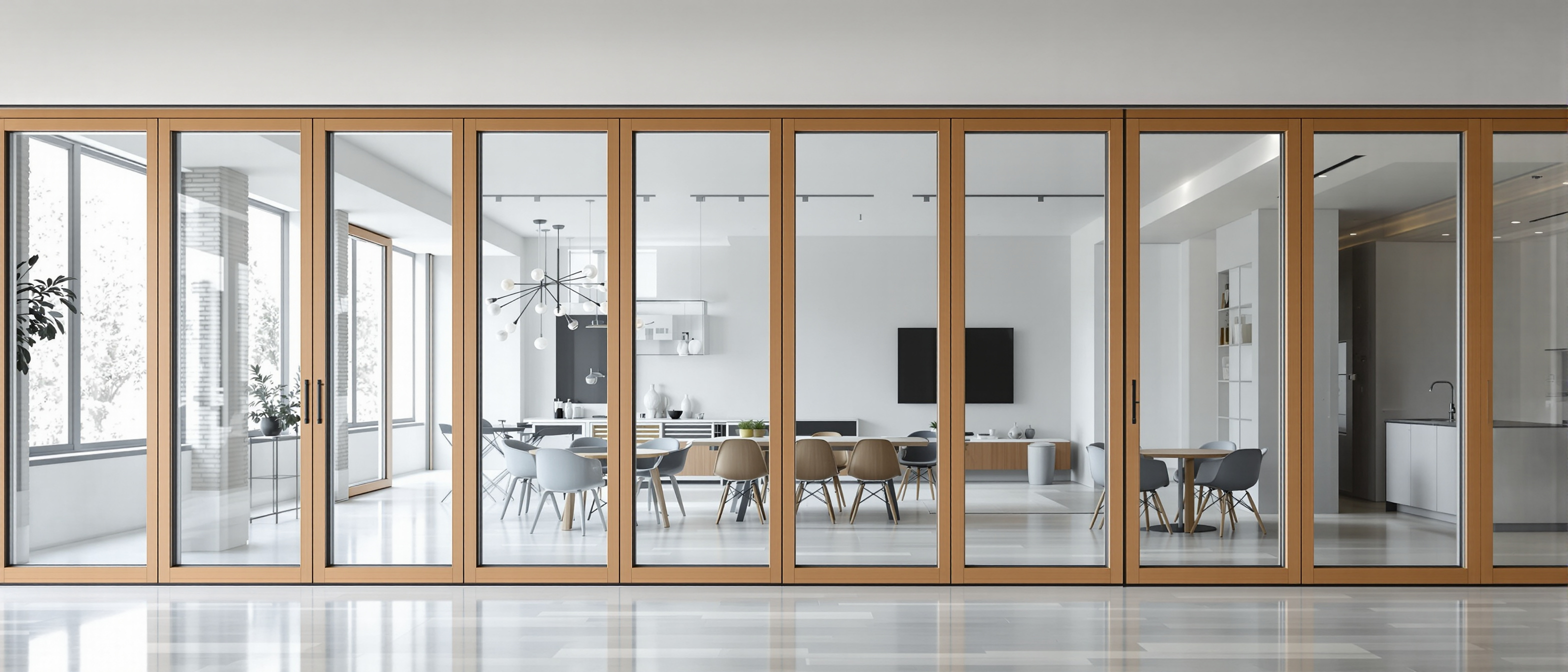
Bi-fold / folding partition
Concertina panels
Does: Hinged panels that concertina to one side, opening a wide span (a hall into two rooms, a room onto a terrace) far wider than a single door.
Trade-off · Opens a much wider clear span than a swing door, but the folded stack still occupies a jamb, the many hinges are wear points, and acoustic versions must be heavy and gasketed to actually block sound.
Murphy / wall bed
The 1900 classic
Does: A bed that folds or pivots up into a wall cabinet, freeing the floor by day — patented by William L. Murphy around 1900 to switch a one-room flat between bedroom and sitting room.
Trade-off · The archetypal time-sharing device, and the honest reason it works is a COUNTERBALANCE (spring or piston) that offsets the bed's weight — mechanization done simply. Needs a solid wall fixing and swept clearance; the cabinet depth is permanent floor cost.
Sofa-bed / convertible
One piece, two jobs
Does: Upholstered seating whose back and seat unfold into a bed — the most common convertible furniture in small homes.
Trade-off · 'It does both jobs perfectly' is a MYTH: a sofa-bed is a COMPROMISE sofa AND a compromise bed. Good transformable design ACCEPTS the trade-off and manages it (comfort, mechanism life); it never pretends the trade-off is not there.
Drop-leaf / folding table
Grows for guests
Does: A table with hinged leaves (or a wall-mounted fold-down top) that expands for dining and folds flat against a wall or to a console the rest of the time.
Trade-off · A simple, reliable, near-maintenance-free transformer — few moving parts, so little to fail. The honest limit is that the folded state still needs a home on the wall or as a slim console.
Extending / telescoping table
Leaves pull out
Does: A table whose top slides apart on runners so a stored leaf drops in, seating four to eight — the everyday mechanized dining transformer.
Trade-off · Genuinely useful, but the runner mechanism is the weak point: cheap slides rack and jam with use. The stored leaf also has to live somewhere. Spend on the mechanism, not the veneer.
Nesting / stacking furniture
Tuck away in one footprint
Does: Tables or stools sized to nest inside or stack on one another, so several pieces occupy one footprint until spread out for guests.
Trade-off · The lowest-tech transformer there is — no mechanism, nothing to break — and thus one of the most robust. It trades a little strength/size uniformity for the flexibility of appearing and disappearing on demand.
Pivoting wall / panel
Turns on an axis
Does: A panel or partition that rotates on a central or edge pivot to open, redirect a view, or double as a room divider and a display or media wall.
Trade-off · Dramatic and space-efficient at the hinge, but a pivot concentrates all the load and wear on one axis, so the bearing must be robust and the swept arc kept clear. More a signature move than an everyday one.
Revolving / rotating unit
A turning core
Does: A cylindrical or box core on a turntable presenting a different face — bookshelf, TV, bar, wardrobe — as it rotates, serving two zones from one object.
Trade-off · Clever where a single object must serve two rooms, but it is a heavy motorized-or-manual bearing that must be built and maintained well; it is a showpiece, not a default. Every rotation is load on one point.
Modular / reconfigurable units
Rearrange the kit
Does: Furniture or partitions built as repeatable modules that clip, stack or roll into different arrangements — sofa blocks, shelving cubes, demountable office pods.
Trade-off · Flexibility without a mechanism — you rearrange rather than motorize — so it is robust and future-proof. The honest cost is that reconfiguring is a manual chore, so it flexes over weeks and seasons, not minute to minute.
Mobile / castored unit
Roll it where needed
Does: Storage, islands, screens or seating on lockable castors that roll to reconfigure a space and lock in place — the simplest 'movable structure' of all.
Trade-off · Cheap, reliable and instantly flexible, but only as good as its castors and floor: soft castors on hard floors mark them, and an unlocked unit drifts. Always specify lockable, floor-matched castors.
Fold-down desk / table
Work, then vanish
Does: A wall-hinged desk or table that folds flat to the wall when not in use, turning a corner into a home office by day and reclaiming the floor by evening.
Trade-off · A pure time-sharing device with a simple, durable hinge and (often) a gas strut to ease it. Honest limit: the wall fixing carries real load, and a folded desk still needs a slim volume on the wall.
Gas-strut lift mechanism
The assist, not a system
Does: A gas piston (or spring/counterweight) that offsets the weight of a lifting bed, hatch or lid so a person can raise it easily — the 'assisted' rung of mechanization.
Trade-off · The honest middle of the mechanization ladder: it makes a heavy element movable by HAND without a motor. Gas struts weaken and leak over years and are a defined service item — plan to replace them, unlike a plain hinge.
Motorized transforming system
Power the movement
Does: An electric-motor-driven bed, wall, ceiling or table that transforms at the push of a button — the top rung of mechanization.
Trade-off · 'More motors and more automation is better' is a MYTH. A motor adds power dependence, cost, noise and the most failure points of any option; justify it only by heavy loads or frequent use. Manual or assisted first; motorize last, and keep a manual override.
Mezzanine / loft platform
Borrow the height
Does: A raised platform (loft bed, mezzanine deck) that stacks one use above another where ceiling height allows — sleeping over living, storage over work.
Trade-off · It transforms in SECTION rather than plan, multiplying floor by using height — but it needs real headroom top and bottom, a safe stair or ladder and guarding, and it is a fixed structure, not a daily transformer.
Every transformation trades off — name it and manage it; the simplest reliable mechanism usually wins.
Every transformation trades off
The honest law of the whole subject: a sofa-bed is a compromise sofa and bed; a movable partition divides sight and space but not sound, which needs mass. Name the trade-off and manage it — never pretend it is absent.[1, 2]
A sofa-bed is both, imperfectly
The honest law of the whole subject: EVERY transformation TRADES OFF. A sofa-bed is a COMPROMISE sofa AND a compromise bed — never as good at either as a dedicated piece. An extending table stores a leaf that must live somewhere. A Murphy bed costs permanent cabinet depth. 'It does both jobs perfectly' is always a MYTH. Good transformable design does not deny the trade-off — it NAMES it, then MANAGES it: choosing where to spend comfort, where to accept less, and making the compromise as small as the budget and mechanism allow.[1]
Fixed core, flexible field
Transformable design works within a fixed core — load-bearing structure, wet areas and services risers cannot casually move. Map the permanent anchor first, then concentrate the flexibility in the field that remains.[1, 3]
The fixed core
Transformable design works WITHIN a fixed core. You cannot casually move a LOAD-BEARING wall or column (it holds the building up), a WET AREA (kitchen and bathroom plumbing is tied to drains and stacks), or a SERVICES RISER or shaft (the vertical routes for water, waste, power and air). These are the permanent skeleton. So the first move in any transformable scheme is to MAP what is fixed, then concentrate the flexibility in the space that remains — which is exactly how Gary Chang worked, anchoring services and storage and letting the rest slide.[1, 3]
At a glance
| Aspect | The fact | The folklore |
|---|---|---|
| Transformation actions | Slide, fold, pivot, stack/nest, lift — name the action first | Every mechanism is unique and ad hoc |
| Every transformation | TRADES OFF — name it and manage it | Does both jobs perfectly |
| A sofa-bed | A compromise sofa AND a compromise bed | As good as a real sofa and a real bed |
| A light movable partition | Divides SIGHT and space, not SOUND | Blocks noise like a solid wall |
| The fixed core | Structure, wet areas and risers cannot casually move | Anything can be moved |
| A transformable plan | A permanent anchor plus a flexible field around it | Everything is flexible |
Key terms
The five basic ways an element moves: slide (on a track), fold (hinged), pivot (on an axis), stack/nest (into one footprint), lift/counterbalance (raised and offset).
Every transformation compromises — a sofa-bed is a compromise sofa and bed; good design names the trade-off and manages it, never pretends it is absent.
A light movable partition divides sight and space but not sound; blocking sound needs mass and sealed edges, which a thin movable panel lacks.
The parts that cannot casually move — load-bearing structure, wet areas (kitchen/bathroom plumbing) and services risers/shafts — the permanent skeleton flexibility works within.
A transformable plan reads as a permanent anchor (structure, wet core, risers, main storage) plus the flexible field that transforms around it.
A raised platform that stacks one use above another using ceiling height — transforming in section rather than plan, where headroom allows.
Study task
Choose a real small flat and plan it as a transformable space. First, map the fixed core — mark the structure, the wet areas (kitchen and bathroom) and any services riser as the permanent anchor. Then choose three transformation systems from the decoder to flex the space that remains, naming the action each uses (slide, fold, pivot, stack, lift). For every system you choose, write its honest trade-off in one line — what it gives up to do its job. Finally, mark one place where you have used a light partition to divide sight and note that it will not give sound privacy. The test is a plan that flexes only where it can, with every trade-off named.
Self-assessment
1. What are the five basic transformation actions?
2. What is the honest law of every transformation?
3. What does a light movable partition actually divide?
4. What forms the 'fixed core' a transformable plan works within?
5. How should a transformable plan be read?
Recap
References & further reading
- [1]Transformable systems and convertible furniture — sliding/folding partitions, Murphy beds, telescoping and modular systems, and their trade-offs (Anna Yudina, Furnitecture; Robert Kronenburg, Flexible). https://www.archdaily.com/
- [2]Movable partitions and acoustics — a light partition divides sight not sound; the mass law and the need for sealed, heavy assemblies for real sound separation. https://www.bis.gov.in/
- [3]Fixed core and flexible field — structure, wet areas and services risers as the permanent skeleton around which transformable space is planned (space-planning texts). https://www.archdaily.com/
Further reading
- Anna Yudina, Furnitecture: Furniture that Transforms Space.
- Robert Kronenburg, Flexible: Architecture that Responds to Change.
- Michael Fisher & others, transformable / small-space design references.
Sources gathered and fact-checked June 2026. Published values vary by source, sample and method — treat as indicative and confirm against the cited standard before structural use.
The author
Amogh N P
Architect, interior designer, and creative polymath. Studio Matrx began in his notebooks — his vision of design made honest, useful, and open to everyone. Its Academy is written and taught in his memory, and free, forever.
More about Amogh →