
Fittings, Fixtures & Mechanisms
The hardware is the transformation — and its quality is the lifespan
The syllabus lists the humble fittings — screws, hinges, clamps, glue, nails, locks, rivets, connectors — and this unit shows why, in a transformable element, they are everything. The panel is inert; the fitting is the transformation. So the hardware — the hinge, track, roller, pivot or gas strut — is the real design work, and its quality is the lifespan. The rules echo the mechanization ladder: the simplest reliable mechanism beats the cleverest fragile one, a gas strut is an honest assist but a service item, and you match each fixing to whether the joint is meant to be permanent or to come apart.
Learning objectives
By the end of this lesson, you will be able to — mapped to the course outcomes for Transformable Systems & Spaces:
Identify the fittings that make elements move — hinges, tracks, pivots, struts, locks, connectors.
Choose hardware simplest-first and match its quality and load rating to the duty.
Select the right fixing for permanent versus demountable connections (screws, bolts, rivets, glue, KD).
The moving hardware
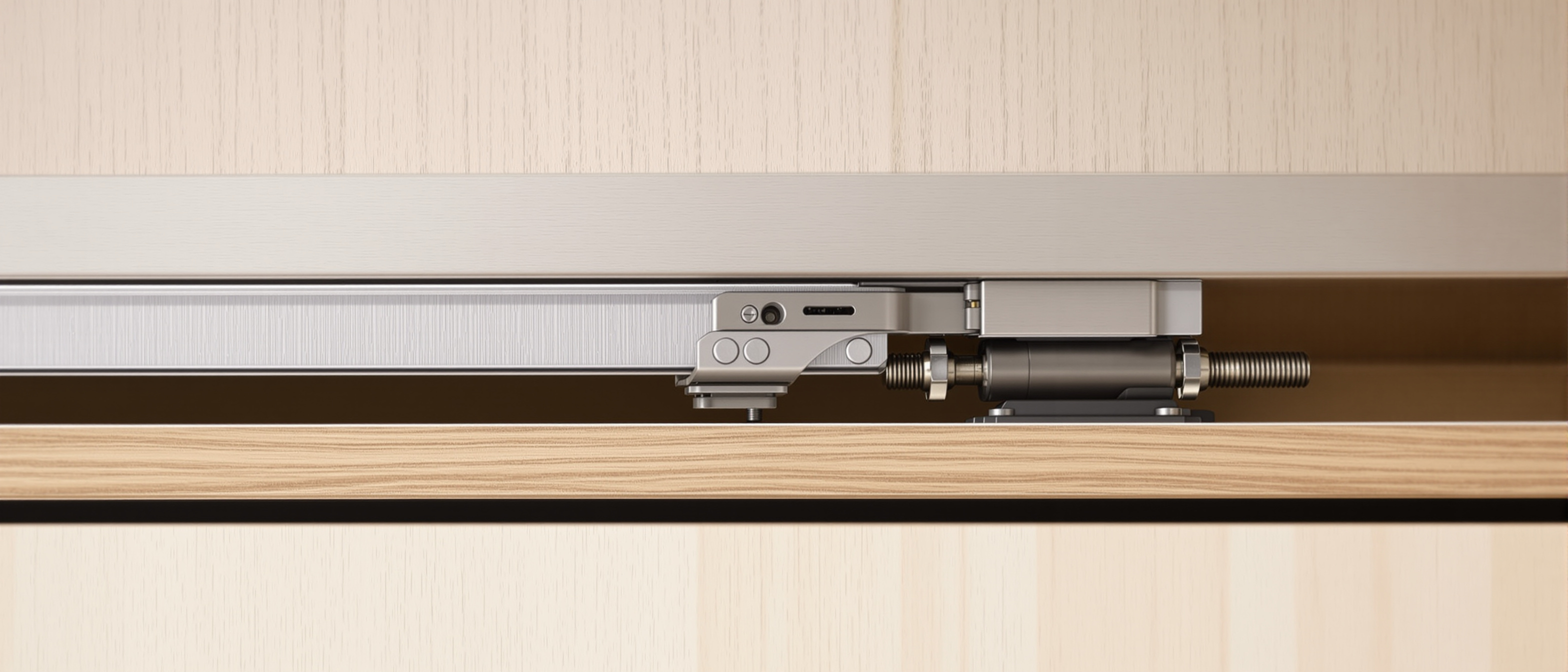
In a transformable element the fitting — hinge, track, roller, pivot, strut — is what actually moves; the panel is inert. So its quality, rated for the load and the cycles, decides the lifespan: spend on the mechanism, not the veneer.[1]
The fitting is the transformation
In a transformable element the FITTING IS the transformation — the panel is inert; the HINGE, TRACK, ROLLER, PIVOT or STRUT is what lets it move. HINGES swing (from simple butts to concealed and self-closing); TRACKS and ROLLERS carry sliding and folding panels (top-hung or bottom-rolling); PIVOTS turn a panel on an axis; GAS STRUTS, springs and COUNTERWEIGHTS lift and hold; LOCKS and CATCHES secure it in each state. Choosing and detailing this hardware — not the panel — is the real design work of a transformable piece.[1]
Simplest reliable wins
The simplest reliable mechanism beats the cleverest fragile one — every extra moving part is another thing to wear or jam. The gas strut is the honest middle of mechanization: an assist that moves a heavy element by hand, but a defined service item to replace.[1, 2]
Fewer parts, fewer failures
Echoing the mechanization ladder: the SIMPLEST reliable mechanism beats the cleverest fragile one. A plain, robust sliding track outlasts an intricate multi-link folding gear; a good hinge and a gas strut do what a motor does, with less to break. Every extra moving part is another thing to wear, misalign or jam. So prefer FEW, well-made, well-understood fittings over many clever ones, and reach for a motorized fitting only when the load or frequency truly demands it — always leaving a manual way to operate it.[1, 2]
Fixings — permanent or demountable
The basic fixings divide by whether a joint should ever come apart: glue, nails and rivets make permanent joints, screws, bolts and knock-down connectors make demountable ones — which is what lets modular, reconfigurable furniture flat-pack and rebuild.[1, 3]
Match the joint to its life
The basic FIXINGS — screws, bolts, nails, rivets, glue, dowels — divide by whether the joint is meant to be PERMANENT or DEMOUNTABLE. GLUE, NAILS and RIVETS make permanent joints (you break them to undo them). SCREWS and BOLTS make demountable ones (you can undo and remake them). For transformable and modular furniture that must be flattened, moved or reconfigured, that difference is central: use demountable fixings where the piece must come apart, permanent ones where it never will. Choosing wrong — gluing what must be dismantled — defeats the flexibility.[1, 3]
At a glance
| Aspect | The fact | The folklore |
|---|---|---|
| In a transformable element | The FITTING is the transformation — the panel is inert | The panel does the moving |
| Hardware quality | Decides the lifespan — rate it for load and cycles | Doesn't matter much |
| Where to spend | On the mechanism, not the veneer | On the visible finish |
| Choosing a mechanism | Simplest reliable wins — fewer parts, fewer failures | The most complex is the best |
| A gas strut | An assist AND a defined service item — plan to replace it | A permanent fitting like a hinge |
| Fixings | Demountable (screws/bolts/KD) for parts that come apart; permanent (glue/nails/rivets) for those that don't | Glue everything |
Key terms
In a movable element the hinge, track, roller, pivot or strut is what actually moves — the panel is inert, so the hardware is the real design work.
The running gear that carries sliding and folding panels (top-hung or bottom-rolling); their quality and rating decide whether a partition glides or jams.
A piston, spring or weight that offsets an element's weight so it moves by hand — the assisted rung of mechanization; a defined service item that weakens over years.
Prefer few, well-made, well-understood fittings over many clever ones; every extra moving part is another thing to wear, misalign or jam. Motorize only when the duty demands.
Glue, nails and rivets make permanent joints; screws and bolts make demountable ones — match the fixing to whether the joint must ever come apart.
Cam-and-dowel and similar fittings that let furniture assemble, flat-pack and re-assemble without glue — the basis of modular, reconfigurable transformable furniture.
Study task
Take one transformable piece — a wall bed, a sliding partition or a modular unit — and specify its hardware in full. Name the fitting that actually makes it move (hinge, track and rollers, pivot, gas strut or counterweight) and state the load and cycles it must survive, choosing quality to match. Justify the simplest reliable option over any cleverer one, and if you use a gas strut, note that it is a replaceable service item. Then list every joint in the piece and mark it permanent (glue, nail, rivet) or demountable (screw, bolt, knock-down connector), making sure anything meant to flat-pack or reconfigure uses demountable fixings. The test is that the piece keeps moving for years, and comes apart only where it should.
Self-assessment
1. In a transformable element, what actually 'is' the transformation?
2. What decides how long a transformable piece keeps working?
3. What is the honest truth about a gas strut?
4. How do permanent and demountable fixings differ, and why does it matter here?
5. Why does 'simplest reliable wins' apply to transformable hardware?
Recap
References & further reading
- [1]Furniture and interior fittings — hinges, tracks and rollers, pivots, gas struts, locks, connectors and knock-down fittings; selection, load rating and application (Bill Hylton, Illustrated Cabinetmaking; Eric Roberts, Fittings for Furniture). https://www.archdaily.com/
- [2]Mechanism reliability — simplest-reliable selection and the maintenance cost of moving parts in transformable furniture (Robert Kronenburg, Flexible). https://www.archdaily.com/
- [3]Fixings and joints — screws, bolts, nails, rivets, glue and knock-down connectors; permanent versus demountable connections (Rangwala / carpentry and joinery references). https://www.bis.gov.in/
Further reading
- Bill Hylton, Illustrated Cabinetmaking.
- Ernest Joyce, The Technique of Furniture Making.
- V. Mays / trade references, Fittings and Ironmongery for Furniture.
Sources gathered and fact-checked June 2026. Published values vary by source, sample and method — treat as indicative and confirm against the cited standard before structural use.
The author
Amogh N P
Architect, interior designer, and creative polymath. Studio Matrx began in his notebooks — his vision of design made honest, useful, and open to everyone. Its Academy is written and taught in his memory, and free, forever.
More about Amogh →