
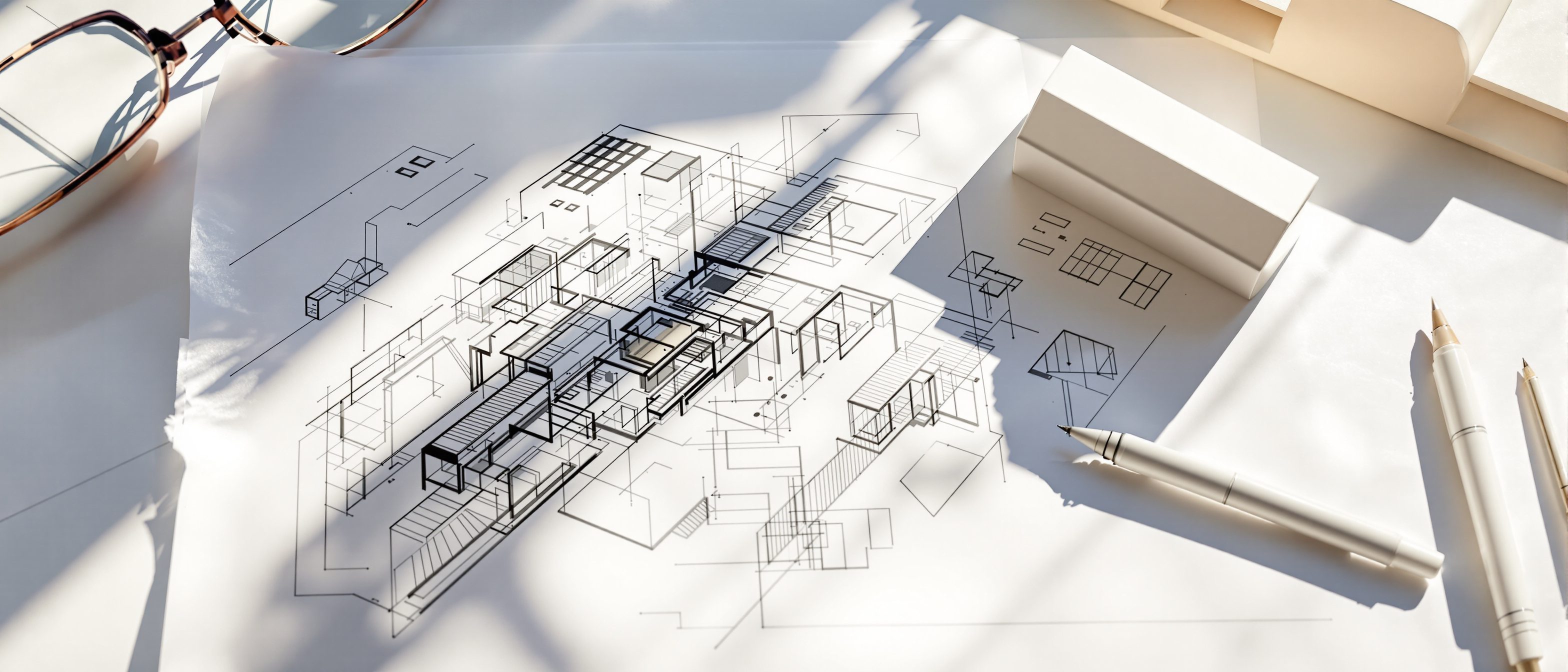
Concepts in Architecture
The design idea, the parti, and how a concept becomes form.
Every good building starts with an idea — a concept — and the best way to test an idea is to draw it small. The parti is that drawing: the essence of the scheme in a single diagram. This lesson is where theory meets the studio: how a concept is found, fixed as a parti, and grown into form.
Learning objectives
By the end of this lesson, you will be able to — mapped to the course outcomes for Building Materials & Construction I:
Distinguish a design concept (the idea) from a parti (its diagram).
Explain the parti diagram and the Beaux-Arts esquisse.
Identify common sources of architectural concepts.
Reduce an idea to a parti and develop it toward form.
Concept and parti
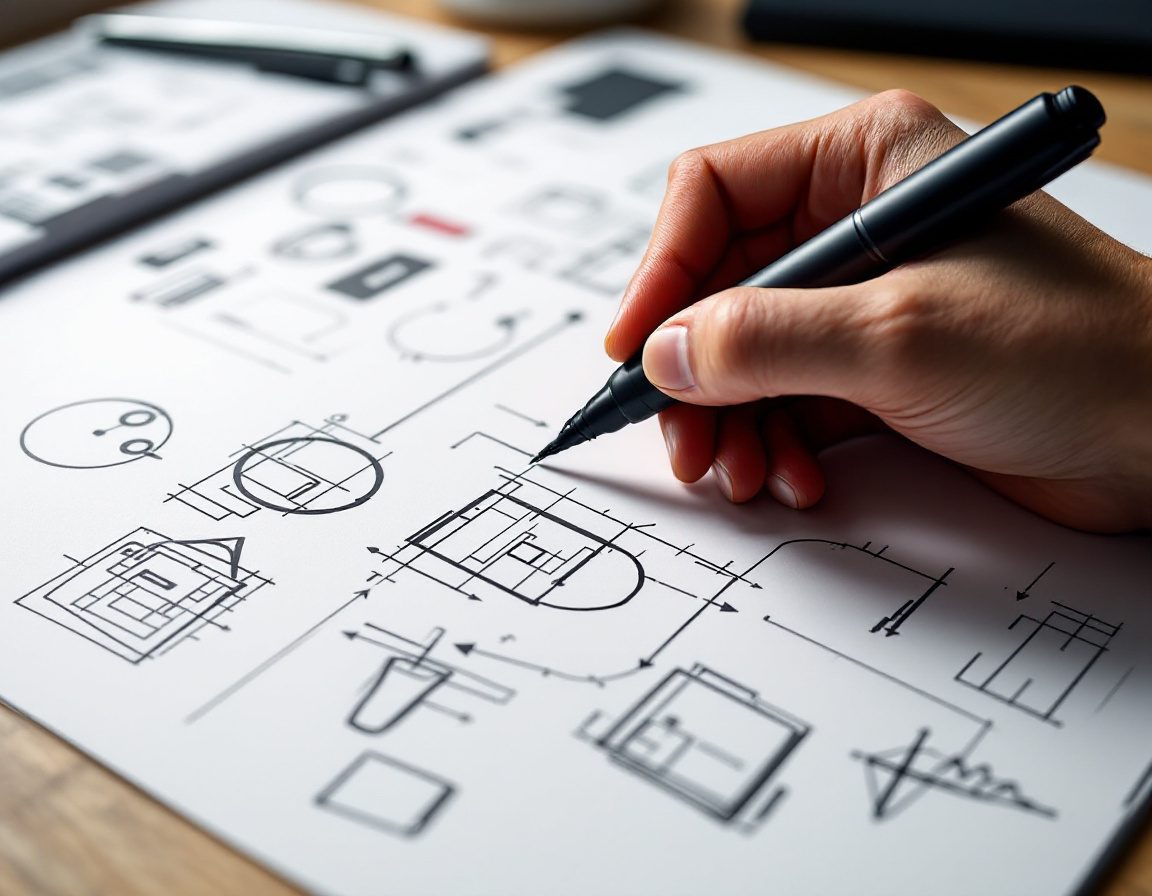
The concept is the organising idea; the parti (from the French parti pris, “decision taken”) is its diagrammatic essence — often a single sketch. At the École des Beaux-Arts, capturing the parti in a quick esquisse was the first and most important act of design.[1, 2]
Where concepts come from
Organising ideas & parti types
Clark & Pause showed that buildings across history share a small set of recurring organising ideas — and most plans resolve into a handful of parti organisations.[4]
How the plan and section relate as one idea.
How a repeated unit builds the whole.
Ordinary parts set against a special one.
An underlying geometric order.
Form built up, or carved away.
How the scheme is weighted and mirrored.
Self-assessment
1. The parti is best described as:
2. 'Parti' comes from the French 'parti pris', meaning:
3. Clark & Pause's Precedents in Architecture analyses buildings through their:
Recap
References & further reading
- [1]What is a parti? — the organising idea and parti diagram. archisoup studio guide. https://www.archisoup.com/studio-guide/what-is-an-architecture-parti
- [2]Parti (architecture) — parti pris, the esquisse and the École des Beaux-Arts. Wikipedia. https://en.wikipedia.org/wiki/Parti_(architecture)
- [3]Metaphor and analogy in architectural concept generation. Buildings 9(2):52, 2019. https://www.mdpi.com/2075-5309/9/2/52
- [4]Clark, R.H. & Pause, M. Precedents in Architecture: Analytic Diagrams, Formative Ideas, and Partis (4th ed., Wiley, 2012). https://www.wiley.com/en-us/Precedents+in+Architecture:+Analytic+Diagrams,+Formative+Ideas,+and+Partis,+4th+Edition-p-9781118170847
Further reading
- Clark, R.H. & Pause, M. (2012). Precedents in Architecture (4th ed.). Hoboken, NJ: Wiley.
- Unwin, S. (2014). Analysing Architecture (4th ed.). Abingdon: Routledge.
- Ching, F.D.K. (2014). Architecture: Form, Space and Order (4th ed.). Hoboken, NJ: Wiley.
Sources gathered and fact-checked June 2026. Published values vary by source, sample and method — treat as indicative and confirm against the cited standard before structural use.
The author
Amogh N P
Architect, interior designer, and creative polymath. Studio Matrx began in his notebooks — his vision of design made honest, useful, and open to everyone. Its Academy is written and taught in his memory, and free, forever.
More about Amogh →