
 Lesson 10.2
Lesson 10.2 · Practice, Delivery & Career
Avoiding Greenwashing
How to recognise green-painted claims - in marketing, in projects, and in your own work - and how to make sustainability claims you can actually defend
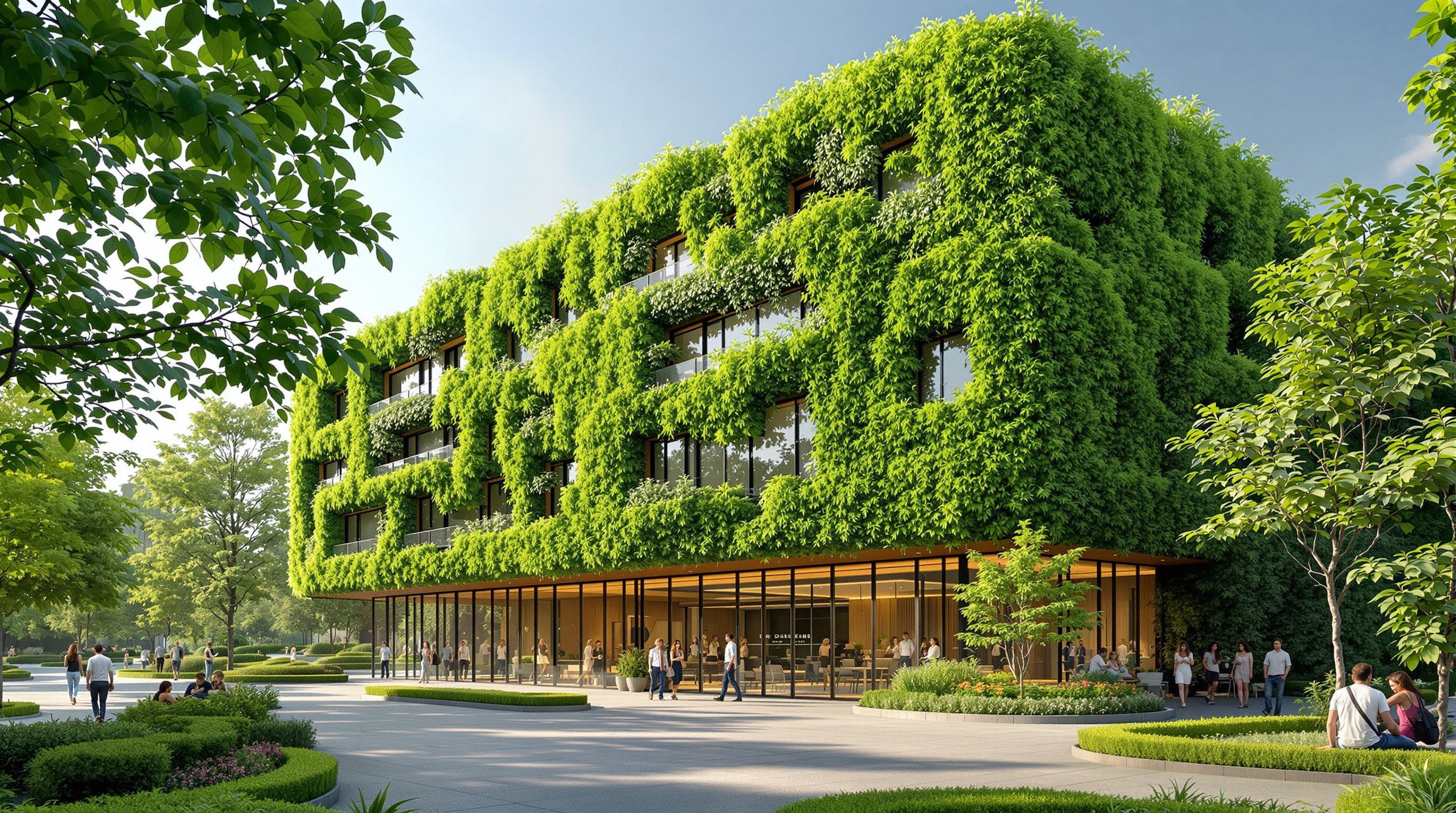
A green wall on a diesel-cooled tower is not sustainability. It is a costume - and the public is learning to see through it.
Greenwashing is making a building or product look more sustainable than it is: a render full of trees, a 'net-zero' badge with no evidence, a single showy feature standing in for real performance. It is tempting because it is cheap, it sells, and everyone else seems to do it.
It is also increasingly dangerous. Regulators are cracking down on unsubstantiated environmental claims, clients and the public are more literate every year, and a claim that collapses under scrutiny takes your credibility with it. The antidote is not silence - it is precision. This lesson teaches you to spot the red flags, to resist committing them under commercial pressure, and to make claims that are specific, measured and defensible.
'How do you know that?' - ask it of every claim, especially your own.
What greenwashing actually is - and why it is tempting
Greenwashing is the gap between the appearance and the reality of environmental performance, tilted deliberately or carelessly toward looking good. It sits on a spectrum. At the honest end is legitimate marketing of real achievement. In the murky middle is selective emphasis - foregrounding a genuine but minor feature while staying quiet about the concrete, the glass, the energy demand. At the dishonest end are claims that are simply untrue: a 'net-zero' label on a building that has never been metered, savings numbers with no basis, certifications implied but never earned.
It is tempting for structural reasons, not just bad character. Sustainability sells - tenants, buyers and investors reward it - so there is commercial pressure to claim it. Real performance is invisible and slow to verify, while a green render or a living wall is instant and photogenic. And the vocabulary is loose: words like 'eco', 'green', 'natural' and 'sustainable' have no fixed meaning, so they can be stretched without technically lying. Understanding these pressures matters because the person most likely to greenwash your project is not a cynical marketer - it is a well-meaning team, including you, rounding up under a deadline. Recognising the temptation is the first defence against it.
It is worth separating deliberate deception from the far more common careless kind. Outright lying - a certification never earned, a fabricated saving - is rare and legally dangerous. Most greenwashing is softer and more insidious: optimistic rounding, a design-stage prediction quietly hardening into a stated fact as it passes from the modeller to the brochure, a genuine feature promoted until it eclipses the building's real (mediocre) performance. Because no one in the chain feels they lied, it slips through. This is why the defence has to be a system, not just good intentions: a habit of asking 'how do we know that?' of every claim before it leaves the office, and a rule that no environmental number is published without its baseline and its source attached. Slogans are the enemy of that discipline; precision is its friend.
The red flags: seven patterns to catch
Most greenwashing follows a small set of recognisable patterns. Learn them and you can audit a claim in seconds.
Vagueness. 'Eco-friendly', 'green', 'sustainable materials' with no specifics. A real claim names the metric: kgCO2e/m2, kWh/m2/yr, litres/person/day, a recycled-content percentage.
Single-feature tokenism. One visible feature - a green wall, a few solar panels, bamboo in the lobby - presented as if it made the whole building green, while the dominant impacts go unmentioned. Ask: what share of the real impact does this feature actually move?
Unverified numbers. 'Saves 40% energy' against what baseline, measured or modelled, by whom? A number with no baseline, no method and no source is decoration, not evidence.
Modelled-as-measured. Quoting design-stage predictions as if they were operational reality. The 'performance gap' between modelled and measured energy is real and often large; honest claims say which one they are quoting.
Offset over-reliance. 'Carbon neutral' achieved mainly by buying offsets while the building itself stays high-carbon. Offsets of variable quality substituting for actual emission cuts is one of the most criticised moves in the field.
Irrelevant or self-evident claims. Trumpeting compliance with the law as if it were an achievement, or a benefit that is standard practice - 'free of a substance that was banned years ago' is the classic tell, dressing the unavoidable as a virtue.
Hidden trade-offs. Highlighting one good attribute (say, low operational energy) while ignoring a bad one (very high embodied carbon). Genuine sustainability is whole-systems; a claim that looks at one flow in isolation is suspect by construction.
Vague, token, unverified, modelled-as-measured, offset-heavy, irrelevant, hides trade-offs. Seven flags.
How to make a claim you can defend
The cure for greenwashing is not to stop talking about sustainability - the field needs its wins celebrated - but to make claims that survive a hostile question. A defensible claim has a predictable anatomy.
Be specific and quantified. Replace adjectives with numbers and units: not 'highly efficient' but 'an energy-use intensity of 60 kWh/m2/yr, roughly half the local benchmark'. Numbers can be checked; adjectives cannot.
State the baseline and the method. Every saving is relative to something. Name it ('versus an ECBC-compliant base case', 'versus the previous building on this site') and say how you know (simulation, sub-metered data, third-party audit).
Distinguish modelled from measured, and target from achieved. 'Designed to reach net-zero' is a legitimate claim; 'is net-zero' requires a year of metered data. Use the future tense honestly, and do not let a design aspiration silently harden into a stated fact as it moves from the drawings into the marketing - the single most common way honest teams drift into overstatement.
Point to third-party evidence. Certifications (LEED, GRIHA, IGBC, Passivhaus, EDGE), Environmental Product Declarations for materials, and independent verification carry weight precisely because they are not self-issued. Claim the certification you earned, at the level you earned, and no more - and never imply a rating you merely pursued or a level above the one awarded, which is one of the most common and most easily debunked overstatements in the field.
Show the whole picture, including trade-offs. A claim that names both the win and its cost - 'we cut operational energy by half; embodied carbon is our next frontier' - reads as credible exactly because it is not perfect. Honesty about limits is the strongest signal that the good news is real.
There is a useful hierarchy for the strongest claim of all - carbon neutrality. Credible practice reduces first, supplies clean second, and offsets only a small, genuinely-residual remainder with high-quality credits. So the honest version of a 'carbon neutral' claim discloses the split: how much came from real, on-site reduction versus purchased offsets, and what quality those offsets are. A building that is ninety-percent reduced and ten-percent offset is a wholly different achievement from one that is twenty-percent reduced and eighty-percent offset, even when both wear the same badge - and refusing to hide behind the badge is precisely what earns trust. The same logic applies to any headline number: the credible claimant volunteers the caveat before anyone has to ask for it, because a claim that pre-empts its own weakest question is almost impossible to attack.
The regulatory and reputational stakes
Greenwashing is moving from a soft ethical concern to a hard commercial and legal risk, which changes the calculus for every practice.
Regulation is tightening. Consumer-protection and advertising regulators in a growing list of jurisdictions - the UK, EU, Australia, India and others - have issued guidance and taken enforcement action against unsubstantiated environmental claims, with rules that increasingly demand claims be specific, evidenced and not misleading by omission. Broad codes against 'green' claims that cannot be backed up now apply to how buildings and developments are marketed. The direction is clear: if you cannot substantiate it, you cannot safely say it.
Reputation is fragile and networked. A single debunked claim - a 'net-zero' tower shown to run on the grid, a 'sustainable' material revealed to be high-carbon - travels fast and sticks. For a practice whose value rests on trust and expertise, being caught overstating is far more costly than having modestly stated real achievement. The asymmetry is stark: years of quiet, genuine work can be undone by one viral exposure of a rounded-up figure, so understating and over-delivering is not only more ethical, it is the better strategy - reputations compound slowly and collapse quickly.
Your professional duty aligns with honesty. Architects and designers advise clients who rely on that advice; overstating performance can expose you to professional liability if a building fails to deliver what was promised. The safe and the right course coincide: claim what you can evidence, in the terms you can defend, and let the certifications and the metered data do the boasting for you. In a field defined by the fight against greenwashing (Module 0.1's warning about the word 'green'), your credibility is your most valuable asset - protect it by never spending it on a claim you cannot back.
Environmental Product Declaration (EPD)
Third-party-verified environmental data for a product, based on LCA
Turns a vague 'eco material' claim into checkable numbers; the credible answer to 'is this actually low-impact?'
Third-party certification
LEED, BREEAM, GRIHA, IGBC, Passivhaus, EDGE and similar
Independent verification carries weight because it is not self-issued; claim only the system and level you actually earned.
Performance gap
The difference between modelled/design energy and measured/operational energy
Often large and real; honest claims say whether a figure is predicted or metered, and never quote a model as if it were reality.
Anti-greenwashing regulation
Advertising and consumer-protection rules on environmental claims
Tightening across the UK, EU, Australia, India and elsewhere; demands claims be specific, substantiated and not misleading by omission.
Workshop — audit a real green claim, then rewrite it
The fastest way to inoculate yourself against greenwashing is to dissect it. Take a real piece of building or product marketing and run it through the red-flag list, then rebuild its best claim into something you could defend under questioning.
One piece of real green marketing, the seven-flag list, and a willingness to ask 'how do you know that?'. No software required.
Goal: sharpen the 'how do you know that?' reflex on real material
Inputs: one green building/product brochure, webpage or press release + the seven red flags
Time: ~25 minutes
- 1Find a real green claim - a developer's 'sustainable' project page, a material's 'eco' marketing, or a 'net-zero' announcement. Copy out its specific environmental sentences.
- 2Run each sentence against the seven red flags: vague, single-feature, unverified number, modelled-as-measured, offset-reliant, irrelevant, hides a trade-off. Tag every flag you find.
- 3For each number, ask the three questions: against what baseline? measured or modelled? verified by whom? Note which questions the claim cannot answer.
- 4Pick the one claim that seems to have real substance behind it. Rewrite it to be defensible: add a metric and unit, a baseline, a method, and, if honest, a stated limit or trade-off.
- 5Compare your rewrite to the original. Note how much shorter the list of defensible claims is than the original marketing - and how much more credible it reads.
You’ll walk away with
A marked-up copy of one real green claim with its red flags tagged and its three unanswered questions noted, plus one rewritten, defensible version of its strongest claim - a before-and-after you could show a marketing team.
Three altitudes on the same idea
Read the band that fits you — or all three.
You are the guardian of the project's claims, because your name and stamp lend them authority. Push back when marketing wants 'net-zero' on a building with no metering plan; insist that renders reflect what is actually being built, not a forest that will never be planted; and make sure any performance figure in a brochure carries a baseline and a method. A claim you let pass becomes a claim you are answerable for.
Material claims are where interiors greenwash most - and where you can be most rigorous. Distrust 'eco', 'natural' and 'recycled' without numbers; ask for Environmental Product Declarations and recycled-content percentages; and be wary of single showpiece materials standing in for a fit-out that is otherwise high-impact. Specifying honestly - and telling the client what you do not yet know - builds exactly the trust that discerning clients now pay for.
Train your eye now by auditing the marketing around you, because you will spend a career under pressure to round up. Take any 'green building' press release and mark its red flags: what is vague, what is token, what number lacks a baseline. Practise rewriting a puffed claim into a specific, defensible one. The habit of asking 'how do you know that?' - of yourself as much as others - is the single most valuable thing you can carry into practice.
“Adding a green wall, some solar panels and natural materials makes a building sustainable.”
Do it yourself
No tools needed - test your greenwash radar.
- 1Name four of the seven greenwashing red flags.
- 2What three things must a credible savings number carry?
- 3Why is 'carbon neutral via offsets' on a high-carbon building a red flag?
- 4Rewrite 'made with eco-friendly materials' into a defensible claim.
- 5What is the performance gap, and why does it matter to honest claims?
The one line to carry out
Peer-reviewed journals & authoritative standards
- 01Greenwashing — Wikipedia, 2026.
- 02Environmental product declaration — Wikipedia, 2026.
- 03Carbon neutrality — Wikipedia, 2026.
- 04Life-cycle assessment — Wikipedia, 2026.
Making rigorous, evidence-based claims is hard to do alone. Next we meet the specialist who helps a team verify and deliver real performance: the sustainability consultant, and how to work with one.
The author
Amogh N P
Architect, interior designer, and creative polymath. Studio Matrx began in his notebooks — his vision of design made honest, useful, and open to everyone. Its Academy is written and taught in his memory, and free, forever.
More about Amogh →