
Daylight, Ventilation & Acoustics
Daylight without the heat, ventilation without the machine, quiet by design
The passive comfort trio, each with a catch worth knowing. Daylight is not the same as solar heat — the craft is to admit the light while excluding the heat and glare. Ventilation can cool and freshen with no machine at all, if you understand wind and buoyancy. And acoustic comfort turns on the same distinction the services course drew: absorption tames the echo inside a room, but blocking sound to the next room is a different job. Get these three right and a space is comfortable before a single watt of mechanical conditioning is spent.
Learning objectives
By the end of this lesson, you will be able to — mapped to the course outcomes for Sustainable Interior Design:
Bring daylight into interiors while keeping out solar heat and glare (shading, orientation, north light).
Use natural and hybrid ventilation to cool and freshen a space, adding efficient systems only as needed.
Set indoor noise-comfort targets and apply absorption and insulation correctly to meet them.
Daylight, not solar heat
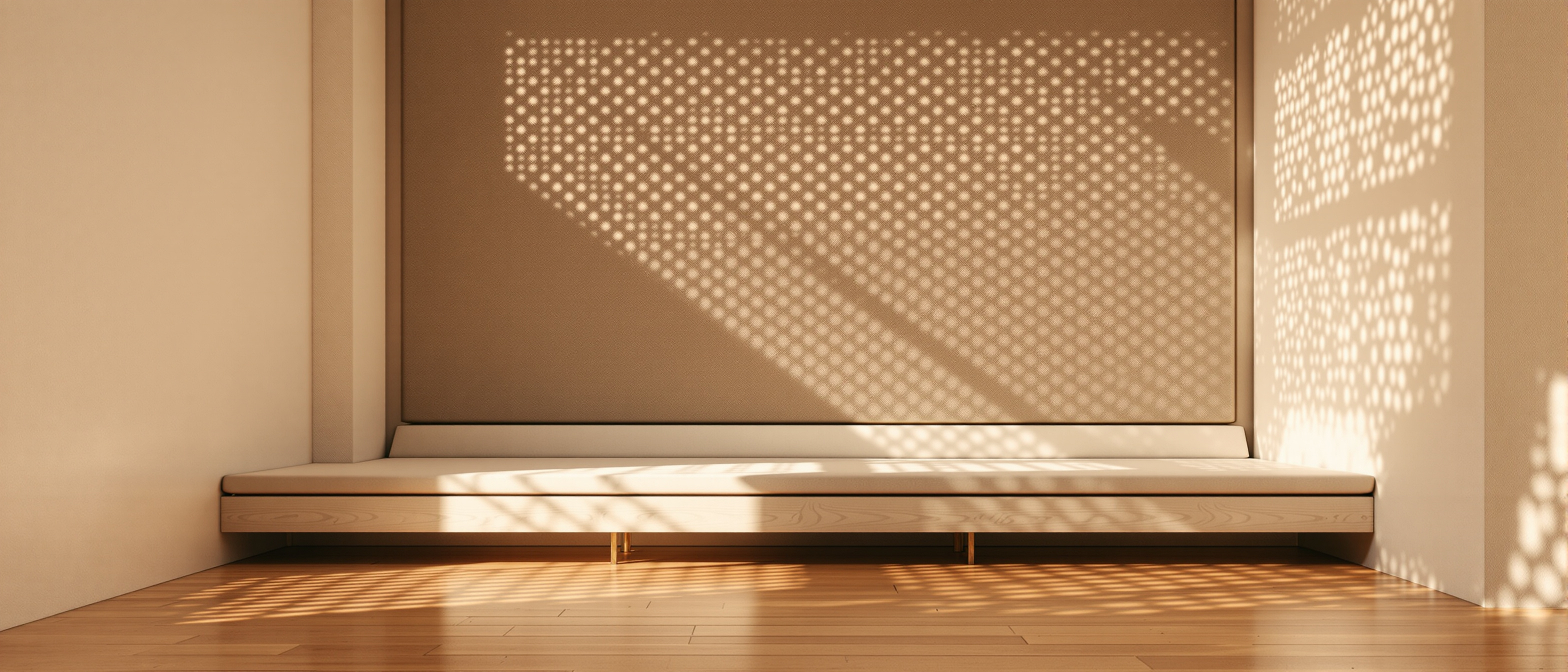
Daylight cuts electric lighting and lifts mood, but the sun also brings heat and glare. The craft is to admit the light while excluding the heat — shading, good orientation, soft north light, light shelves — then top up with efficient LED only where daylight can’t reach.[1]
Light in, heat out
'More sun means more daylight, which is good' is too simple. DAYLIGHT (illumination) is wonderful — it cuts electric-light energy, lifts mood and reveals materials — but the SUN also brings HEAT and GLARE, which are not. The whole craft of daylighting is to admit the LIGHT while excluding the HEAT and glare: shade the glass, orient openings well, and prefer soft NORTH light (in the northern hemisphere) that gives even illumination without the harsh, hot direct beam.[1]
Natural & hybrid ventilation
Natural ventilation moves air by wind (cross-ventilation) and buoyancy (the stack effect), cooling and freshening for free; hybrid ventilation adds fans or mechanical systems only when the weather won’t allow natural airflow — passive first, machine as backup.[2]
Cooling without a machine
NATURAL VENTILATION moves air with no fan or duct, by two forces: the WIND (cross-ventilation, with inlets and outlets on different pressures) and BUOYANCY (the STACK effect, warm air rising and leaving high while cool air enters low — the courtyard's trick). It both COOLS (air movement on skin, and flushing heat out) and freshens (removing stale air and pollutants). Designed well, it does much of the year's cooling for free.[2]
Acoustic comfort
Every space has a noise-comfort target — meet it with layout, fabric and treatment. And the key correction: absorption cuts echo inside a room, while insulation blocks sound to the next room (mass and decoupling) — foam does not soundproof.[3]
Quiet is a target
Every space has a target NOISE level for comfort — a bedroom needs quiet, a library near-silence, an open office a controlled hum. Interior noise comes from outside (traffic), from services (AC, ducts), and from within (people, echo). Sustainable, comfortable design sets the target and then meets it with layout (put noisy uses away from quiet ones), the fabric, and treatment — noise control is part of indoor environmental quality, not an afterthought.[3]
At a glance
| Aspect | The fact | The folklore |
|---|---|---|
| Daylight | The light, admitted while heat and glare are excluded | The same as letting the sun in |
| Best daylight | Soft, shaded, even (north light, light shelves) | Maximum direct sun through big glass |
| First cooling move | Natural ventilation (cross + stack) | Turn on the AC |
| Hybrid ventilation | Natural airflow first, machine only as backup | Seal up and mechanically condition |
| Acoustic foam | Absorbs echo inside a room | Soundproofs against the next room |
| Blocking sound between rooms | Needs mass, decoupling, sealed gaps | Needs more foam |
Key terms
Daylight is illumination (good — cuts electric light, lifts mood); the sun also brings heat and glare (not). Good design admits the light while excluding heat and glare.
Soft, even, indirect daylight (from the north in the northern hemisphere) and external shading (overhangs, fins, jaalis) that blocks high summer sun — daylight without the hot direct beam.
Air moved by wind (cross-ventilation) and buoyancy (the stack effect) with no fan or duct — it both cools and freshens, doing much of the year's cooling for free.
Using natural airflow when the weather allows and switching to fans or mechanical systems only when needed — passive first, machine as backup.
The target ambient sound level a space needs (quiet bedroom, near-silent library, controlled-hum office) — set it, then meet it with layout, fabric and treatment.
Absorption cuts echo INSIDE a room (soft/porous materials); insulation blocks sound passing THROUGH to the next room (mass + decoupling) — different jobs, constantly confused.
Study task
Redesign one room for passive comfort. For daylight, show how you would bring in even, glare-free light while shading out the direct sun and heat — name the orientation, the shading device and any light shelf or courtyard. For ventilation, mark the inlets and outlets that would drive cross-ventilation and the high opening that would drive the stack effect, and say when a fan takes over (the hybrid point). For acoustics, set a noise-comfort target for the room and specify one absorption measure (for echo) and one insulation measure (to block a neighbouring noise) — being explicit about which problem each solves. The aim is a room that is comfortable before any mechanical conditioning is switched on.
Self-assessment
1. Why is 'more sun means better daylight' too simple?
2. What two forces drive natural ventilation?
3. What is hybrid ventilation?
4. What does acoustic foam on a wall do?
5. How do you meet an indoor noise-comfort target?
Recap
References & further reading
- [1]Daylighting — daylight vs solar heat, shading, orientation, north light and light shelves; efficient artificial lighting (Olgyay & Olgyay, Solar Control and Shading Devices; daylighting references). https://www.wbdg.org/resources/daylighting
- [2]Natural and hybrid ventilation — cross-ventilation, the stack effect, fresh-air supply (Koenigsberger, Manual of Tropical Housing and Building; passive-cooling references). https://www.ashrae.org/
- [3]Room acoustics and noise — comfort levels, absorption vs insulation, reverberation (architectural-acoustics references). https://www.acoustics.org/
Further reading
- Victor & Aladar Olgyay, Solar Control and Shading Devices (Princeton University Press).
- Otto Koenigsberger & others, Manual of Tropical Housing and Building (Orient Longman).
- Arvind Krishan & others, Climate Responsive Architecture (Tata McGraw-Hill).
Sources gathered and fact-checked June 2026. Published values vary by source, sample and method — treat as indicative and confirm against the cited standard before structural use.
The author
Amogh N P
Architect, interior designer, and creative polymath. Studio Matrx began in his notebooks — his vision of design made honest, useful, and open to everyone. Its Academy is written and taught in his memory, and free, forever.
More about Amogh →