
 Lesson 5.3
Lesson 5.3 · The keystone
The Indian Things
Western storage advice houses a Western household. But an Indian home holds particular things — the pooja items, the festival vessels, the trunk, the quilts, the shoe pile at the door. This lesson is about storing what we actually own.
No imported storage guide has a place for the steel trunk, the festival degchi, the pooja thali, or the twelve pairs of chappals by the door. Yet these are the things that actually fill an Indian home — and the things a generic plan leaves homeless.
You now have a storage system and you know where it hides. This lesson makes it specific to the Indian household — because what we own, and how we use it, differs from the assumptions baked into most storage advice.
Indian homes carry distinct storage loads: devotion (the pooja things), celebration (the gathering vessels and festival kit), the seasons (quilts, woollens), provisions in bulk (pulses, ration, the spice arsenal), and the threshold (the daily churn of footwear we remove at the door). House these five well and an Indian home reads as ordered rather than overflowing.
Some things need dignity, not just a shelf
Everywhere else in this course, frequency set the storage rule: rare things go high and deep. The Indian household adds a second dimension the reach rule doesn't capture — dignity. Some things aren't stored by how often they're used, but by what they mean.
The pooja items are the clearest case. A pooja thali might be used daily or weekly, but it can't simply go in a kitchen drawer with the ladles — placement carries respect. It wants a clean, considered, often slightly elevated home, away from feet and shoes, frequently facing a particular direction. The same logic touches heirlooms, religious texts, and gifts of significance: their storage is about regard, not just retrieval.
So in an Indian home, two questions decide placement: how often is it used? (the reach rule) and what does it deserve? (the dignity rule). Most things answer only the first. A meaningful few answer the second, and getting those right is what makes a home feel respected, not just organised.
Go deeper — the joint-family multiplier
Indian storage loads are often sized for more people than currently live in the home. A joint family stores for gatherings of twenty even when five live there day to day; a nuclear flat still keeps the vessels, the bedding, and the folding chairs for when the extended family visits. This is rational — the home is a node in a larger family network, and hosting is an obligation, not an occasional event. Storage that ignores it leaves families stuffing festival kit into impossible corners twice a year.
The design response is to plan deliberately for the peak, stored at the periphery. The gathering vessels, the extra bedding, the folding chairs — size for the largest realistic gathering, but house it all in the rarely-reached zones (the loft, the high band, the deep under-bed) so it doesn't crowd daily life. The home then lives small for five and expands gracefully for twenty, with the peak-load kit dormant but present. Designing for the gathering, not just the residents, is one of the most distinctly Indian moves in storage — and one imported plans never make.
Five loads every Indian home carries
The five categories of things an Indian household must store, each with its frequency, where it belongs, and the particular thing to watch. Tap through — these are the loads a generic storage plan forgets.
Pooja & the sacred
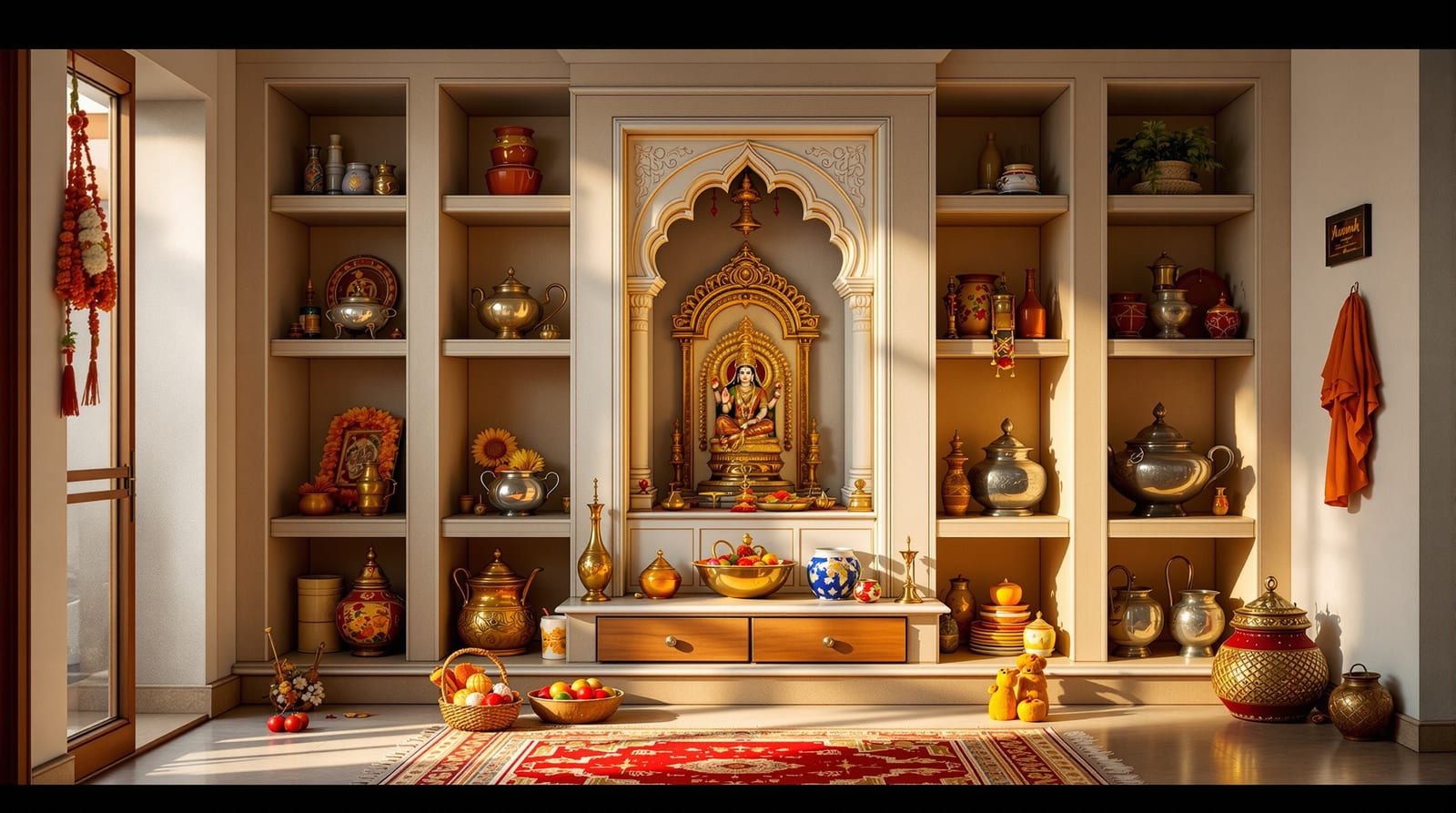
A clean, considered, slightly elevated home — a dedicated niche, a shelf or small mandir, away from feet, shoes and everyday clutter, often facing a preferred direction. Placement carries respect, so this is decided first, not from leftover space.
Never a kitchen drawer with the ladles, never low near the floor or footwear. The dignity rule overrides frequency here — meaning sets the place, not convenience.
Fig 5.3a — Each Indian load has a natural home, set by how often it’s used and how it’s treated.
Fig 5.3a — Each Indian load has a natural home, set by how often it's used and how it's treated.
A family uses their pooja thali daily. By the reach rule alone, daily things go at easy hand height in the nearest convenient spot — say, a kitchen drawer. Is that the right call here?
Run the method yourself
Go through the five Indian loads for your own home, assigning each a home from the spaces the levers opened (Lesson 5.2).
- 1Pooja: decide its considered home first — a clean niche or shelf, elevated, away from feet, ideally facing the right direction. This is a dignity decision, not a leftover-space one.
- 2Festival & gathering kit: size it for your largest realistic gathering, then house it in the rarely-reached zones — the loft, the high band, the deep under-bed.
- 3Seasonal: quilts and woollens go up or deep-under in the off-season, swapping places with the season that's arriving. Vacuum bags shrink the bulk.
- 4Provisions & threshold: bulk pulses and ration near the kitchen in airtight steel; footwear in a closed shoe unit at the door, sized for the real daily pile, not a token rack.
- Indian homes carry five distinct loads: pooja, festival/gathering, seasonal, provisions, and the threshold (footwear).
- Beyond frequency, the Indian home adds a dignity rule — sacred and meaningful things are placed by what they deserve, not just how often they're used.
- Pooja items get a clean, considered, elevated home away from feet — even when used daily.
- Plan for the gathering, not just the residents: size festival kit for the peak, store it at the periphery (loft, high band, deep under).
- Bulk provisions in airtight steel near the kitchen; the real footwear pile in a closed unit at the door.
You have the system, the hidden places, and the Indian things to house. Time to put it all together — what does a complete storage plan look like on one real, full, lived-in Indian home?
The author
Amogh N P
Architect, interior designer, and creative polymath. Studio Matrx began in his notebooks — his vision of design made honest, useful, and open to everyone. Its Academy is written and taught in his memory, and free, forever.
More about Amogh →