
 Lesson 1.2
Lesson 1.2 · Construction Robotics Foundations
From Factory to Site
Robots conquered the factory first because the factory is everything a robot wants - structured, repetitive, bounded and the same every day - and understanding exactly why that setting suited them tells us precisely what carries over to construction and what breaks the moment a robot leaves the controlled floor for the open site
Robots have welded and assembled in factories for half a century. So why, after all that time, is a robot that can build a house on an ordinary site still mostly a demonstration?
Industrial robots have been at work since the 1960s. In that time they have transformed car plants, electronics lines and warehouses, becoming so ordinary that we barely notice them. If a robot can assemble a car with superhuman speed and precision, the obvious question is why the same half-century has not given us robots that simply build our buildings. The answer is not that nobody tried, nor that the robots are not good enough. The answer is the setting.
Robots conquered the factory first because the factory is, almost by design, the perfect home for a robot - and the reasons it suits them are exactly the reasons the construction site does not. To understand robotic construction you first have to understand this gap honestly: what made the factory easy, which of those advantages a robot can carry with it onto a site, and which ones vanish the instant it leaves the controlled floor. Getting this clear does more than explain history; it predicts, with surprising reliability, where robotic construction succeeds today and where it stalls - and why so much of the field quietly retreats back to a factory to win.
Factory to site: the robot travels fine, its skills travel fine - but the environment does not. So we take the work to the factory, or build a little factory around the work.
Why the factory was made for robots
The factory and the robot grew up together, and the factory's whole logic happens to be everything a robot needs. Consider what an industrial robot enjoys on a production line. The environment is structured and controlled: a clean, level, well-lit indoor space, arranged deliberately, that does not change from day to day. The task is repetitive: the robot does the same motion - the same weld, the same pick-and-place - thousands of times, identically. The work is standardised: every part that arrives is the same as the last, positioned the same way, within tight and known tolerances. The robot is fixed in place at a station, bolted down, and crucially, *the work comes to it* on a conveyor rather than it going to the work. And it operates in a bounded, fenced cell, separated from people, so safety can be guaranteed by keeping humans out.
Every one of those conditions plays to a robot's strengths and hides its weaknesses. A robot is superb at repeating a precise motion tirelessly and accurately - so give it the same motion every time. A robot has a limited reach - so bring the work to it. A robot struggles to understand a messy, unpredictable scene - so make the scene clean, known and identical. A robot cannot easily judge whether a human has wandered into its path - so fence it out. The factory is not just a place that happens to contain robots; it is an environment engineered, over decades, to make automation possible, by removing variability and uncertainty until what remains is a task a machine can nail.
This is the single most important lesson to carry forward, and it inverts the usual intuition. We tend to think automation advances by building ever-cleverer robots. In truth, a great deal of automation's success came from structuring the environment and the task so that a relatively simple robot could cope. The factory automated not only because robots got good, but because the work was shaped - standardised parts, fixed stations, repetitive sequences - into something a robot could do. That insight - structure the world, and the robot follows - is the key that unlocks the whole of robotic construction, because it tells you immediately where to look for success: wherever the construction environment can be made more factory-like.
Factory = structured + repetitive + standardised + fixed station + fenced. The work comes to the robot. We engineered the WORLD to fit the machine.
What carries over to the site
Not everything breaks on the way to a building site; a good deal of the factory's gift travels. The robot itself carries over almost entirely. The actuators, sensors and controllers are the same technology; a six-axis arm that welds car bodies is mechanically much the same as one that could weld steelwork or carry a printing nozzle. The core skills carry over too: precise, tireless, repeatable motion, the ability to follow a path exactly, and the link from a digital model to physical action - the same computer-aided-manufacturing idea that drives a factory tool can drive a construction tool. Where a construction task can be made to resemble a factory task - repetitive, well-defined, with parts in known positions - the robot performs much as it would on a line.
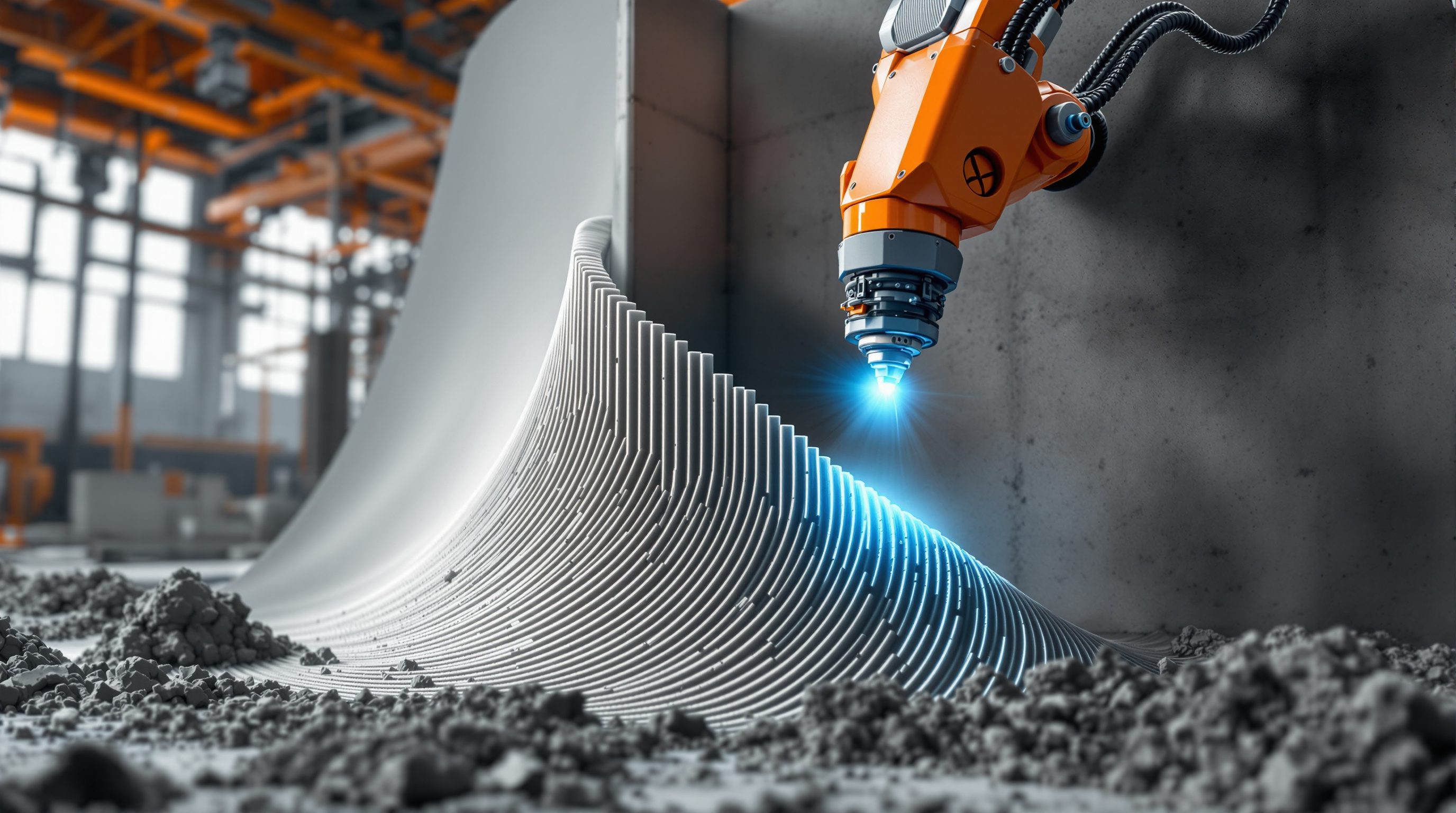
Two moves let builders capture that carry-over deliberately. The first is to bring construction into a factory: prefabrication. If you manufacture walls, floor cassettes, bathroom pods or whole room modules in a controlled plant and then transport and assemble them on site, you get to keep the structured environment where most of the work happens. This is why so much of the real, economically successful robotic construction today is off-site - it is construction reorganised to suit the robot, and it is the single most reliable way the field delivers value now (Module 2.2 is devoted to it). The second move is to make the site itself more structured in pockets: set up a controlled zone, survey it precisely, fix reference points, feed the robot an accurate model, and within that bubble a robot can work almost as it would in a plant. A gantry 3D printer erecting a controlled rig over a slab is, in effect, building a small temporary factory around the work.
So the honest picture is not "robots work in factories but not on sites". It is that robots work wherever the environment is structured enough, and the great strategic question of robotic construction is how much structure you can bring to - or manufacture around - the work. Carry the robot's real strengths with you, engineer as much factory-like order as the situation allows, and a surprising amount becomes possible. The failures come not from the robot but from asking it to work where no such order can be had - which is the subject of what breaks.
What breaks on the move to the site
Now the hard half. The moment a robot leaves the factory for an ordinary construction site, the conditions that made it succeed are removed one by one, and each removal is a genuine engineering problem rather than a detail. The fixed station breaks: on a site there is no conveyor bringing identical parts to a bolted-down arm. The workpiece - a wall, a floor, a whole building - is enormous and fixed in place, so the robot must travel to the work, over rough ground, and know exactly where it is at every moment. Mobility and localisation, free in a factory, now must be solved.
The known, unchanging world breaks: a site is never the same twice, not even hour to hour. The ground is uneven and shifting, materials are stacked in different places, other trades rearrange everything, and the weather intrudes with heat, rain, wind and dust that a factory never sees. The robot can no longer assume the world matches its program; it must sense and understand a messy, changing scene, which is far harder than executing a known motion. The standardised part breaks: construction is full of one-offs and loose tolerances - a "300 mm" block is roughly 300 mm, a wall is plumb to within a few millimetres over metres, and almost nothing arrives in a precisely known position. A robot tuned to sub-millimetre factory tolerances must now cope with slop and variation that a human absorbs without thinking.
The fenced cell breaks: a site is full of people - other trades working alongside, in the open, unpredictably. You cannot simply fence everyone out, so the robot must be safe to work near humans, which is a profound and still-maturing challenge that Module 7.3 treats as binding. And the repetitive sequence breaks: a building is assembled in a long, interdependent sequence of different tasks that never repeats identically between projects, so there is far less of the sameness that lets a robot pay back its cost through sheer repetition. The pattern is unmistakable and worth stating plainly: it is almost never the robot that breaks - it is the environment. The machine is capable; the site is hostile to the conditions it needs. That realisation is the doorway to the next lesson, where we give this hostile environment its proper name and examine it in full.
On site: fixed station GONE, known world GONE, standard part GONE, fence GONE, repetition GONE. The robot is fine - the environment breaks it.
The strategic consequence: structure the work, or specialise
Put the carry-over and the breakage together and a clear strategy for robotic construction falls out - one that explains almost everything you will see in the rest of this course. Because robots succeed in proportion to how structured the environment is, the field has three honest routes, and real projects use one or a blend of them.
The first route is move the work to the structure - prefabrication and off-site manufacture. Rather than fight the site, take as much of the building as possible into a factory where the robot's advantages survive intact, then transport and assemble. This is the most mature and commercially successful path today, and it is why "robotic construction" in practice so often means a factory making building components rather than a humanoid on a muddy site. The second route is bring structure to the site - survey it precisely, establish reference points, create a controlled zone, feed the machine an accurate digital model, and operate within that engineered bubble. A 3D concrete printer working from a fixed gantry on a prepared slab is doing exactly this: manufacturing a patch of factory-like order around the work.
The third route is specialise and support - accept that a truly general site-building robot is not near, and instead deploy narrow machines that do one well-bounded task (a single repetitive operation, a survey, a material move) with plenty of human help around them. This is why real on-site construction robots are overwhelmingly specialised and human-supported rather than general and autonomous - a theme Module 2 explores machine by machine. What you will almost never see working reliably is the fantasy version: a general-purpose autonomous robot turned loose on an ordinary, unstructured site to build freely. The honest frontier is structured work, off-site manufacture, and specialised supported machines - and the binding judgements about whether any particular deployment is safe, reliable and economic belong to the engineers, the manufacturers' evidence and the project team, not to the marketing. Keep the factory-to-site lens and you can predict, better than most, which robotic construction claims are plausible and which are theatre.
Feasibility on a real project
Whether a robotic/off-site approach suits a specific job
How much structure a given project can offer a robot - off-site manufacture, a controlled zone, repetitive tasks - is a project-specific judgement for the design and construction team, informed by the manufacturers' evidence. The lesson gives the lens, not a verdict.
Prefabrication & assembly design
Moving work off-site to keep the structured environment
The structural design, connections and tolerances of prefabricated and modular elements are engineering matters for qualified engineers and the relevant codes (NBC India and local regulations). Module 2.2 explores prefab robotics; the binding design is deferred.
Working safely near people
On-site robots sharing space with workers
Because the site cannot simply fence the robot off, safe human-robot working follows the manufacturer's requirements and safety regulation - treated as binding in Module 7.3, not assumed here.
Workshop - score a construction task for robot-readiness
The practical skill from this lesson is judging how factory-like a piece of construction work is - because that predicts how well a robot could do it. In this workshop you will take real construction tasks and score each against the factory conditions.
No equipment - a notebook and, ideally, a real project or task you can picture. This is about judgement, not operating a machine.
Goal: predict robot-readiness from how structured a task is
Inputs: this lesson + a notebook; optionally a real project you know
Time: ~40 minutes
- 1Pick three construction tasks of different kinds - for example: making identical wall panels, plastering a uniquely shaped room on site, and repetitively drilling fixing holes in a precast beam.
- 2Score each task 1 (unlike a factory) to 5 (very factory-like) on five conditions: structured/controlled environment, repetition, standardisation of parts, ability to bring the work to a fixed machine, and ability to keep people safely clear.
- 3Add up the scores and rank the tasks from most to least robot-ready. Note which score sank each low-ranking task.
- 4For the lowest-scoring task, propose how you could make it MORE robot-ready: move it off-site? Standardise the parts? Create a controlled zone and set-out? Or accept a specialised, human-supported machine instead?
- 5Write a short reflection: does your ranking match where you have actually seen robotic construction used? Flag where real evidence, not the score, would be needed before committing.
You’ll walk away with
A one-page scored comparison of three construction tasks for robot-readiness, with a ranking, the reasons, and one worked idea for making the hardest task more structured. Keep it; the unstructured-site lesson sharpens the same lens.
Three altitudes on the same idea
Read the band that fits you — or all three.
The factory-to-site lens tells you where robotic construction will actually deliver on your project, and where it is wishful. The reliable value is off-site: components, panels, pods and modules made in a structured plant and assembled on site, which pushes you toward prefabrication and design-for-manufacture thinking early in a project. On-site robots are real but specialised and human-supported, and they pay off where you can give them structure - a prepared zone, accurate setting-out, repetitive well-defined tasks. When you assess a robotic or printed approach, ask how much of the work can be moved into, or surrounded by, factory-like order; that single question predicts feasibility better than any spec sheet. Leave the binding calls on reliability, safety and economics to the specialists and the manufacturers' evidence; own the strategic judgement of fit.
For interiors the factory-to-site story is almost entirely good news, because your work naturally lives off-site. Bespoke panels, screens, furniture, moulds and decorative elements are fabricated in exactly the structured workshop setting where robots thrive, then delivered and installed - you are already on the winning side of the gap. That is why robotic fabrication of interior components is more mature and accessible than on-site building robotics: it keeps the machine in a controlled environment doing well-defined, repeatable work. Understanding this helps you see why fabrication happens in a shop rather than on the wall, why piece sizes suit transport and handling, and why a well-specified, standardised component is far more economical to robotically fabricate than a chaotic one-off. Design to the structured-workshop reality and the technology rewards you.
This lesson is the hinge of the whole course, so internalise the pattern: robots succeed in proportion to how structured the environment is. Learn why the factory suited robots (structured, repetitive, standardised, fixed station, fenced), what carries over to a site (the robot and its core skills, the digital-to-physical link) and what breaks (mobility, a changing world, loose tolerances, people, non-repetition). Then hold the strategic consequence: the field moves work off-site, brings structure to the site, or specialises with human support - never a general robot loose on a messy site. This single framework lets you predict where robotic construction works and cuts through an enormous amount of hype. It is one of the most powerful ideas in the course and a strong thread for your own thinking and portfolio.
“Robots have been building cars for fifty years, so building houses with robots is basically the same problem - the technology is proven and it is just a matter of pointing the same robots at construction. If it has not happened yet, the robots must just need to get a bit better.”
Do it yourself
No tools needed - reason it through.
- 1List the conditions that made the factory suit robots, and explain why each plays to a robot's strengths.
- 2What is the deeper lesson - did automation succeed mainly by making cleverer robots, or by doing something else?
- 3Name three things that carry over from factory to site, and three that break.
- 4Why does so much successful robotic construction happen off-site, in factories?
- 5What are the three strategic routes for robotic construction, and which one is NOT realistic today?
The one line to carry out
Peer-reviewed journals & authoritative standards
- 01Industrial robot — Wikipedia - Industrial robot, 2026.
- 02Automation — Wikipedia - Automation, 2026.
- 03Construction robot — Wikipedia - Construction robot, 2026.
- 04Prefabrication — Wikipedia - Prefabrication, 2026.
We keep circling one idea: robots love structure, and the site destroys it. That hostile, ever-changing setting has a name and deserves a lesson of its own. Next we meet the unstructured site problem head-on - the crux of this whole course.
The author
Amogh N P
Architect, interior designer, and creative polymath. Studio Matrx began in his notebooks — his vision of design made honest, useful, and open to everyone. Its Academy is written and taught in his memory, and free, forever.
More about Amogh →