
Survey & Field Study Methods
Pilots, sampling, questionnaires — and how big a sample.
Field research lives or dies on its craft. Learn the pilot study; field surveys and collecting physical, architectural, environmental and organisational samples; sampling — probability vs non-probability methods and the bias each risks; the distinct ideas of reliability (consistency) and validity (accuracy); questionnaire design (open vs closed, the Likert scale, questions to avoid); and how big a sample you actually need. Try the sample-size calculator.
Learning objectives
By the end of this lesson, you will be able to — mapped to the course outcomes for Research Methods & Field Studies:
Explain the pilot study and field collection of samples.
Choose a sampling method and name the bias it risks.
Distinguish reliability from validity and design an unbiased questionnaire.
Compute a required sample size with Cochran's formula.
Pilots & sampling
A pilot trials the instrument first; then sampling decides who is studied — probability methods generalise, non-probability methods do not, and a biased large sample is worse than a small representative one.[2]
Trial run first
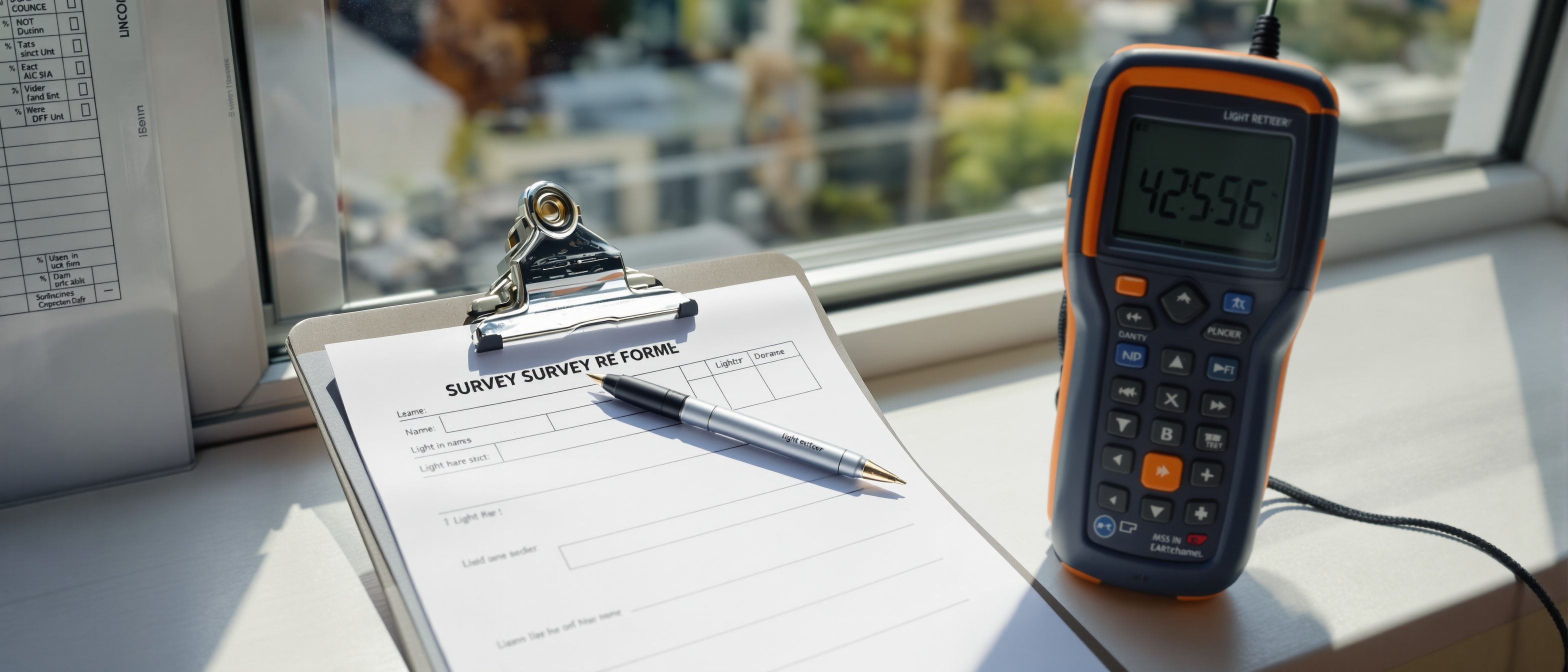
A PILOT STUDY is a small-scale trial of the instrument and procedure BEFORE the main study — to test the clarity and wording of a questionnaire, estimate time, check feasibility, refine sampling and get preliminary reliability evidence; its findings are not the main results. A FIELD SURVEY collects data in the real setting, where 'samples' may be PHYSICAL (material/soil), ARCHITECTURAL (building cases, plan types), ENVIRONMENTAL (temperature, light, noise readings) or ORGANISATIONAL (institutions, user groups).[2, 3]
Instruments & sample size
Reliability is consistency and validity is accuracy — a measure can be reliable yet invalid; design questions that don't bias the answer, and calculate the sample size rather than guessing it.[2]
Consistency vs accuracy
RELIABILITY is CONSISTENCY — the same instrument under the same conditions gives the same result (test–retest, inter-rater, internal consistency via Cronbach's α). VALIDITY is ACCURACY — does the instrument measure what it claims (content, construct, criterion validity)? The dartboard image: tight-but-off-target = reliable but INVALID; scattered-around-the-bullseye = valid but unreliable. A measure can be reliable yet invalid (a consistently mis-calibrated lux meter). MISCONCEPTION→correct: 'reliability and validity are the same' — consistency is not accuracy; validity needs reliability, not the reverse.[2]
How big a sample?
Set the confidence level, the estimated proportion and the margin of error; the calculator applies Cochran's formula and an optional finite-population correction to give the sample size you need.
Sample-size calculator · Cochran's formula
At 95% (z 1.96), p 0.5, e 5% the formula gives n₀ ≈ 385; for N = 2,000 the corrected sample is ≈ 323.
At a glance
| Aspect | Probability | Non-probability |
|---|---|---|
| Selection | Probability: random, known chance | Non-probability: non-random |
| Generalisable? | Probability: yes (statistically) | Non-probability: not reliably |
| Example | Random, systematic, stratified, cluster | Convenience, purposive, quota, snowball |
| Reliability | = consistency / repeatability | Validity = accuracy / measures intent |
| Can a measure be… | Reliable but invalid? Yes | Valid but unreliable? Essentially no |
Key terms
A small trial of the instrument/procedure before the main study; not the main results.
Known random chance (generalisable) vs non-random selection (not).
Sample within subgroups / randomly pick whole clusters.
Consistency of measurement vs accuracy — measuring what you intend.
An ordered agreement scale, typically 5 points, balanced with a neutral midpoint.
n₀ = z²·p·(1−p)/e²; finite-corrected n = n₀/(1+(n₀−1)/N).
Studio task
Design a short questionnaire (six items) to study resident satisfaction in an apartment complex of 2,000 households. Use at least one Likert item, fix any leading or double-barrelled wording, and state which sampling method you would use and why. Then use the calculator to find the sample size for 95% confidence and a 5% margin of error — and confirm it is about 323 with the finite-population correction.
Self-assessment
1. Reliability differs from validity because reliability is about —
2. Using Cochran's formula with z = 1.96, p = 0.5, e = 0.05, the required sample (infinite population) is about —
3. Which is a NON-probability sampling method?
Recap
References & further reading
- [1]Linda Groat & David Wang, Architectural Research Methods — survey research, sampling, field tactics.
- [2]C.R. Kothari, Research Methodology: Methods and Techniques — sampling, reliability/validity, questionnaire design, sample size.
- [3]Ranjit Kumar, Research Methodology: A Step-by-Step Guide — pilot studies, data collection.
- [4]W.G. Cochran, Sampling Techniques (Wiley) — the sample-size formula and finite-population correction.
Further reading
- C.R. Kothari — Research Methodology: Methods and Techniques.
- W.G. Cochran — Sampling Techniques.
- Linda Groat & David Wang — Architectural Research Methods.
Sources gathered and fact-checked June 2026. Published values vary by source, sample and method — treat as indicative and confirm against the cited standard before structural use.
The author
Amogh N P
Architect, interior designer, and creative polymath. Studio Matrx began in his notebooks — his vision of design made honest, useful, and open to everyone. Its Academy is written and taught in his memory, and free, forever.
More about Amogh →