
 Lesson 1.3
Lesson 1.3 · Why Water Must Change
The Closed-Loop Idea
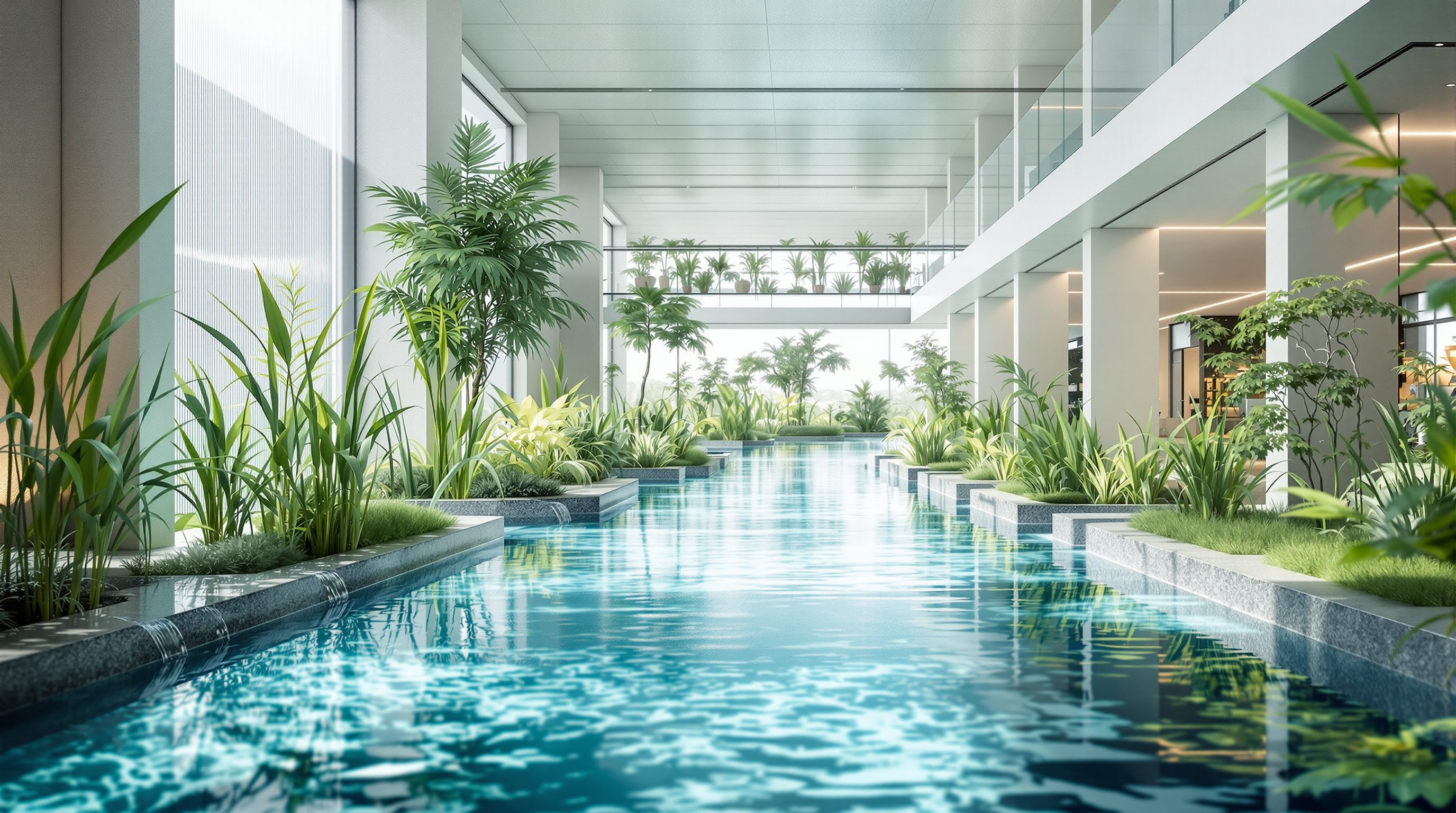
Bend the straight line into a loop: capture water where it falls, use it, reuse it, treat it on site and return it clean - making the building a participant in the water cycle, more self-reliant and resilient, and ambitiously aiming to give back as much clean water as it takes, or more
What if the building stopped being a one-way drain on the water cycle and became part of it - capturing water where it falls, using it more than once, cleaning it on site, and giving back as much as it takes?
We have seen the crisis and dissected the linear model that makes it worse. The response is almost embarrassingly simple to state: stop drawing a straight line and draw a loop instead. Where the linear model takes water from far away, uses it once and discards it, the closed-loop idea has the building capture water where it naturally arrives, use it, reuse it for a second purpose, treat it on site to whatever quality the next use needs, and ultimately return clean water to the environment - closing the circle so the building participates in the water cycle rather than punching a one-way hole through it.
This single shift - from line to loop - is what the whole field of regenerative water technology is built on, and it changes the building's relationship to water at a fundamental level. A looped building is no longer a passive consumer that imports clean water and exports sewage; it becomes a small, partly self-contained water system, capturing and recirculating much of what it needs on its own site. That brings two benefits this lesson develops: resilience, because a building that provides some of its own water is far less exposed when a distant supply fails, and, at the ambitious end, the genuinely exciting prospect of a building that gives back as much clean water as it takes, or more - net-positive water. But the loop is a shape, not a shortcut, and the same disciplines still govern it: reduce demand first, mind the energy, and never compromise health. This lesson introduces the idea; the rest of the course makes it real.
Bend the line into a LOOP: CAPTURE (rain/storm) -> USE (fit-for-purpose) -> REUSE (greywater) -> TREAT (on site, living systems) -> RETURN (clean, recharge). Building INSIDE the water cycle, not a drain on it. Decentralised = resilient (no single point of failure). Ladder: wasteful -> efficient -> net-zero -> net-positive. Climb in order: demand first, mind energy, never compromise health.
From line to loop - capture, reuse, treat, return
The closed-loop idea replaces the linear line's three one-way steps with four moves that bend back on themselves, and the whole rest of the course is organised around them. CAPTURE: instead of relying only on distant piped supply, the building collects water where it naturally arrives - rainwater falling on the roof, stormwater running across the site. What the linear city treats as a nuisance to be flushed into a drain, the loop treats as a free resource to be gathered and stored. CAPTURE alone begins to loosen the building's total dependence on the far-off source. REUSE: instead of discarding water after a single job, the loop uses it again - collecting lightly-used greywater from showers, basins and laundry and putting it to a second, lower-grade use such as flushing or irrigation, and at the ambitious end even treating blackwater (sewage) for safe reuse. This directly attacks the single-use waste of the linear model.
TREAT: because captured and reused water must be clean enough for its next use, the loop treats water on site, bringing each stream up to the quality its purpose requires - increasingly with natural, living systems such as constructed wetlands and biological treatment that clean water the way an ecosystem does, alongside engineered methods. Treatment is what makes reuse safe, and it is where the health discipline bites hardest. RETURN: at the most ambitious, the loop gives back as much clean water as it takes, or more - recharging groundwater, releasing clean water to the environment - so the building becomes a net contributor to the water cycle rather than a net drain. Underneath all four moves runs the organising principle introduced earlier: fit-for-purpose matching, deliberately matching the quality of water to the quality each task genuinely needs, so precious drinking-grade water is reserved for drinking and cooking while lower grades serve the flushing, washing and irrigation that dominate demand. Get the matching right and the four moves let a building draw far more of its needs from water it captures and recirculates on site. That is the loop in one picture - and every later module takes one of these moves in depth, always deferring the binding water-quality and treatment judgements to qualified specialists and the codes.
The building as part of the water cycle
The deeper idea beneath the four moves is a change of identity for the building. In nature, water already moves in a great loop - the water cycle - evaporating, forming clouds, falling as rain, running through soils and rivers and aquifers, and evaporating again, endlessly recirculated and cleaned by natural processes. The linear model stands entirely outside this cycle: it reaches in far upstream to abstract clean water, runs it through the building in a straight line, and dumps it far downstream as waste, contributing nothing back and treating the cycle as merely a source and a sink. The closed-loop idea reinserts the building into the cycle. A building that captures the rain that falls on it, holds and uses that water, cleans it through living systems, and returns it clean to the ground or a stream is behaving less like a machine bolted onto nature and more like a part of the landscape's own water movement.
This reframing is not merely poetic; it changes how you design. Once the building is understood as part of the water cycle, rain is not a drainage problem to be shed as fast as possible but a resource that has arrived; greywater is not waste to be expelled but water partway through its useful life; the site's soil and planting are not decoration but part of the treatment and storage and recharge system. This is the mindset behind water-sensitive design and, at neighbourhood and city scale, ideas like the sponge city, where whole districts are shaped to absorb, hold, clean and slowly release water rather than rushing it away in pipes - subjects later modules develop in full. It also connects the building to place and heritage in a powerful way: India's magnificent traditional water systems - stepwells, temple tanks, johads, terrace and rooftop catchment - were regenerative water avant la lettre, buildings and settlements consciously designed as part of the local water cycle, tuned over centuries to a monsoon climate. Reviving and modernising that wisdom is one of the most rooted paths for Indian design. Seeing the building as a participant in the water cycle, rather than a drain on it, is the conceptual heart of the closed-loop idea - and the shift that everything practical in this course follows from.
Nature's water cycle already loops: evaporate -> cloud -> rain -> soil/river/aquifer -> evaporate. Linear building stands OUTSIDE it (takes upstream, dumps downstream). Loop building sits INSIDE it: catches rain, cleans through living systems, returns clean. Rain = resource, greywater = mid-life water, soil = treatment. India's stepwells/tanks/johads did this for centuries.
Decentralisation and resilience
One of the most practical consequences of the loop is a shift from centralised to decentralised water, and with it a large gain in resilience. The linear model is intensely centralised: a few large, distant sources and treatment plants serve everything, and every building hangs off that single system by one connection. As the last lesson showed, this makes each building - and the city as a whole - fragile, because there is no fallback when the central source fails, which is precisely what day-zero crises exposed. The closed-loop idea distributes water function outward: when many individual buildings and sites capture, store, reuse and treat some of their own water, water production and recycling happen in many places at once rather than in one. No single point of failure can cut everyone off, because each building carries some of its own supply and some of its own treatment.
The resilience this buys is real and increasingly valuable. A building that harvests and stores rainwater and recycles its greywater can keep essential functions running through a supply interruption, a drought-driven rationing, or a mains failure that would leave a purely linear building helpless. Spread across a neighbourhood, decentralised water reduces the load on stressed central systems, cuts the long-distance pumping energy of hauling water in and sewage out, and can even ease flooding by holding stormwater locally instead of dumping it all into overwhelmed drains at once. This does not mean abandoning the centralised system - for most buildings the sensible model is hybrid, using on-site capture and reuse to supply much of demand while staying connected to the mains as a backup and for the uses that genuinely need it, which also keeps the public-health safety net in place. Decentralisation is a matter of degree and judgement, not an all-or-nothing leap off the grid. And it does not relax any discipline: decentralised treatment multiplies the number of systems that must be run safely and maintained, so the health discipline becomes, if anything, more demanding, and the binding design, safety and public-health decisions for every on-site system stay firmly with qualified specialists under the codes (NBC India, IS, CPHEEO). Resilience through distribution is a genuine strength of the loop - claimed honestly, and never at the expense of safety.
The appeal - and the ambition - of net-positive
At the far, aspirational end of the closed-loop idea sits a genuinely inspiring goal: a building that is net-positive on water, giving back to the water cycle at least as much clean water as it takes from it, and ideally more. It helps to see this as a ladder of ambition. At the bottom is the wasteful linear building that takes a great deal and returns nothing usable. A rung up is the efficient building that has reduced its demand and reuses water, so it takes much less. Higher still is net-zero water, where over a year the building's own captured and reused water balances what it draws in, so on balance it adds no net burden to external supply. At the top is net-positive water, where the building actually returns more clean water to the environment than it takes - recharging aquifers, releasing treated water to streams, contributing to the wider water system rather than only drawing from it. A building can move from being a drain on the water cycle to being a small spring feeding it.
This is a real and worthwhile ambition, and later modules (especially Module 7) develop what it takes to approach it. But two honest cautions belong right here, at the moment the idea is most exciting, because they are the theme of the very next lesson. First, net-positive is a demanding goal that depends heavily on context - a building in a rainy climate with generous space for capture, storage and natural treatment can approach it far more readily than a dense tower in a dry city, and chasing it everywhere regardless of context is a mistake. Second, and always, the ambition is disciplined: you climb the ladder in the right order, reducing demand first (a smaller demand is far easier to match with captured water than a wasteful one), you count the energy of all that capturing, pumping and treating so you do not solve a water problem by creating a carbon one, and you never, ever compromise health in pursuit of a positive water balance. Net-positive water is a beautiful destination and a powerful way to reframe what a building can be, but it is reached by discipline, not by enthusiasm - which is exactly why the next lesson turns to the honest caveats that govern the whole course.
Capture, reuse, treat, return
The four moves of the loop
Collect water where it falls, use it more than once, treat it on site to the needed grade, and return clean water - the structure of the whole course. Each move's binding engineering belongs to qualified specialists. Modules 3, 4, 5, 7.
Fit-for-purpose matching
The organising principle
Match water quality to the need: drinking-grade only for drinking and cooking; lower grades for the flushing, washing and irrigation that dominate demand. What grade is safe for which use is a public-health judgement for specialists and the codes. Modules 2.3, 4.4.
Decentralisation as resilience
Usually hybrid, not off-grid
Distributed on-site capture and reuse remove the single point of failure, best kept as a hybrid with mains backup. Multiplying on-site systems multiplies the maintenance and safety duty. Modules 7.4, 8.4.
Net-positive water
A disciplined ambition
Returning as much clean water as taken, or more, is context-dependent and reached by climbing the ladder in order - reduce demand first, count the energy, never compromise health. Modules 7.2, 7.3.
Workshop - redraw a building's water as a loop
In the last workshop you drew a building's linear water line. Now redraw it as a loop. This exercise has you propose, qualitatively, how the four moves could apply to a real building - turning the straight line you dissected into a circle, and testing where it realistically could and could not close.
The building from the previous workshop and a sketch sheet. No sizing or engineering is required; this is a conceptual loop proposal, and the binding capture, storage, treatment, plumbing and safety design of any real system stays with qualified specialists under the governing codes.
Goal: a first, qualitative loop proposal for a real building, honest about limits
Inputs: the building from the previous workshop (or another you know) + this lesson + a sketch sheet
Time: ~45 minutes
- 1Start from the line: redraw the take-use-discard line, then bend it into a loop by adding the four moves as return arrows - capture, reuse, treat, return.
- 2Place CAPTURE and REUSE: mark where rain and stormwater could be caught (roof, paving) and which greywater streams (showers, basins, laundry) could serve a second, lower-grade use such as flushing or irrigation.
- 3Add TREAT and RETURN: note where on-site treatment would be needed to make reuse safe (flagging that its design and safety are for specialists), and where clean water could be returned - recharging the ground or releasing to a stream.
- 4Apply fit-for-purpose: match each use to the lowest grade that suits it, reserving drinking-grade water only for drinking and cooking.
- 5Be honest about limits: mark where the loop realistically cannot close for this building (space, density, climate, cost, energy), and note that reducing demand first, counting the energy, and confirming all safety with specialists and the codes come before any of it - flagged as reasoning.
You’ll walk away with
A one-page 'loop proposal': a building's water redrawn as capture-reuse-treat-return with fit-for-purpose matching, honest about where it can and cannot close, and explicit that demand reduction, energy and specialist-verified health come first - framed as reasoning, not a design specification.
Three altitudes on the same idea
Read the band that fits you — or all three.
The closed-loop idea is a design strategy, not a product: you bend the building's water from a line into a loop through four moves - capture (rain, stormwater), reuse (greywater, ambitiously blackwater), treat (on site, increasingly with living systems), and return (toward net-positive) - organised by fit-for-purpose matching. For the architect this reframes the whole project: the building becomes a participant in the water cycle, so roof and site are catchment, soil and planting are storage, treatment and recharge, and drainage becomes a resource system. The great practical prize is resilience through decentralisation - a building that supplies and recycles some of its own water is far less exposed when a distant source fails, usually as a hybrid that keeps the mains as backup. Net-positive water is a worthy, context-dependent ambition reached by climbing the ladder in order: reduce demand first, then capture and reuse, always counting the energy. Own the water strategy and the loop's architecture; leave the binding water-quality, plumbing, treatment and safety engineering to qualified specialists under the codes (NBC India, IS, CPHEEO).
At the interior scale the closed-loop idea shows up as reuse at a human scale and as the fixtures that make a loop worth building. The four moves are mostly building- and site-scale, but interiors are where reuse becomes tangible - a basin draining to a toilet cistern, point-of-use choices, and above all the demand reduction that makes any loop achievable (a loop is far easier to close around a small demand than a wasteful one). Understanding that the building is meant to be part of the water cycle helps you specify with the loop in mind: efficient, low-flow, dual-flush and waterless fixtures that shrink demand first, and layouts and fittings that make sensible greywater reuse possible where a plumber and the codes permit. You are not designing the treatment system or sizing tanks; your contribution is the water-efficient, reuse-ready, healthy interior that lets the building's loop actually close - with any reuse plumbing and its safety confirmed by the plumber and public-health engineer under the codes.
The closed-loop idea is the positive core of this course: the answer to the linear model's failures. Learn the four moves cold - CAPTURE (collect rain and stormwater where they fall), REUSE (use water more than once, greywater then ambitiously blackwater), TREAT (clean it on site to the grade the next use needs, increasingly with living systems), RETURN (give back clean water, toward net-positive) - all organised by fit-for-purpose matching. Grasp the big reframing: the building becomes part of the natural water cycle rather than a one-way drain on it, which is exactly what India's stepwells, tanks and johads did for centuries. Understand why decentralisation brings resilience (many buildings each partly self-reliant means no single point of failure) and what net-positive water means (returning as much clean water as taken, or more). And hold the discipline even here: you climb the ladder in order - reduce demand first, mind the energy, never compromise health. This is the shape of the whole field; the later modules fill it in.
“Closing the loop means going fully off-grid: a truly regenerative building should cut itself free of the municipal water and sewer system entirely, capturing, recycling and treating all of its own water on site, and the more completely it does this, the better and greener it is.”
Do it yourself
No tools needed - reason it through.
- 1Describe the four moves of the closed-loop idea (capture, reuse, treat, return) and how each answers a flaw of the linear model.
- 2What does it mean to see the building as part of the water cycle rather than a drain on it, and how does that change design?
- 3Explain how decentralisation brings resilience, and why a hybrid (looped but mains-connected) is usually wiser than going fully off-grid.
- 4Define net-zero and net-positive water, and place them on the ladder of ambition above a wasteful linear building.
- 5Why must the loop still be climbed in order - reduce demand first, mind the energy, never compromise health - rather than chasing maximum recycling?
The one line to carry out
Peer-reviewed journals & authoritative standards
- 01Reclaimed water — Wikipedia - Reclaimed water, 2026.
- 02Water reclamation — Wikipedia - Water reclamation, 2026.
- 03Rainwater harvesting — Wikipedia - Rainwater harvesting, 2026.
- 04Water-sensitive urban design — Wikipedia - Water-sensitive urban design, 2026.
- 05Green infrastructure — Wikipedia - Green infrastructure, 2026.
The closed-loop idea is genuinely exciting, and that is exactly why it needs a counterweight. The next lesson delivers the honest caveats that govern this whole course - reduce demand first, mind the energy-water nexus, and never compromise health - the disciplines that keep the loop from becoming a gadget-led mistake.
The author
Amogh N P
Architect, interior designer, and creative polymath. Studio Matrx began in his notebooks — his vision of design made honest, useful, and open to everyone. Its Academy is written and taught in his memory, and free, forever.
More about Amogh →