
 Lesson 5.2
Lesson 5.2 · Treating Water Naturally
Biological Treatment
Almost every way we clean dirty water - a septic tank, a constructed wetland, a steel reactor at a city sewage works - runs on the same quiet miracle: living microbes that treat the pollution in the water as food and eat it, breaking it down into harmless substances, and once you understand that single principle, and that these are living systems that need feeding, warmth, oxygen and time and can be starved, shocked or killed, the whole landscape of water treatment falls into place
The real workers at a sewage plant are too small to see - and they are hungry. Water treatment is mostly the art of keeping the right microbes fed, warm and alive.
Here is one of the most useful ideas in this whole course, and it is almost embarrassingly simple. The organic pollution in dirty water - the food scraps, the body waste, the soap and grease and everything else that makes it foul - is, to a microbe, food. Enormous, invisible communities of bacteria and other micro-organisms make their living by consuming exactly this material, breaking it down for energy and growth, the same way they have recycled organic matter on Earth for billions of years. Almost everything we call 'water treatment' is really the craft of gathering these microbes in one place, giving them the dirty water to eat, and letting them do what they do - then separating the cleaned water from the microbes afterward.
This is biological treatment, and once you grasp it, the bewildering zoo of treatment systems collapses into one idea wearing different costumes. A septic tank, a constructed wetland, the trickling filter or activated-sludge tank at a municipal works, a compact package plant, a farmyard biodigester - all of them are, at heart, containers for hungry microbes. What differs is only the housing: how much land it takes, how much energy it uses, how much control it gives, and whether the microbes work with oxygen or without. But there is a catch that this lesson will not let you forget: microbes are alive. A living treatment system must be fed steadily, kept warm enough, given the oxygen it needs (or deliberately denied it), and protected from poisons - and it can be starved, overloaded, shocked or killed. It takes time to start and time to work, and it is never a set-and-forget box. Understanding both halves - the beautiful principle and the living fragility - is what makes you able to think clearly about treating water.
Pollution = FOOD for microbes. Treatment = gather microbes, let them eat, separate clean water. AEROBIC (O2): fast, energy-hungry, more sludge. ANAEROBIC (no O2): slow, low-energy, makes biogas. Same biology from septic tank -> wetland -> activated sludge -> membrane bioreactor; only land/energy/control differ. LIVING: feed it, warm it, aerate it, don't poison it - or it dies and discharges unsafe water. 'Treated' is not 'safe'.
The core principle - pollution is food
The heart of biological treatment is a single, powerful reframing: the organic pollution in wastewater is not just dirt to be filtered out, it is food for micro-organisms. Dissolved and suspended organic matter - the biological load that makes sewage and greywater foul and oxygen-hungry - is energy and carbon that bacteria, fungi, protozoa and other microbes will happily consume if you give them the chance. Biological treatment simply gives them that chance, in a controlled place, and then harvests the result: water with most of its organic load eaten away.
To picture it, follow what happens in any biological system. Dirty water arrives carrying its load of organic pollution. It meets a dense population of microbes - either suspended as loose flocs floating in the water, or fixed as a biofilm growing on surfaces like gravel, plastic media or roots. The microbes take up the organic matter and metabolise it: they use it to power themselves and to build more microbial cells, so the population grows and multiplies as it feeds. What leaves the process is fundamentally different from what entered. The water is much cleaner, because its organic load has been consumed. Some of the carbon leaves as gas - carbon dioxide where oxygen is present, or a methane-rich biogas where it is not. The multiplied microbes themselves become surplus sludge or biomass that settles out and must be periodically removed and managed. That removal is not a footnote: a biological system is always producing more microbes, and dealing with that surplus is a real, ongoing part of running one.
The standard way engineers measure this whole business is by the water's demand for oxygen - loosely, how much oxygen the microbes would need to eat all the organic matter present. High demand means a heavy organic load; the job of biological treatment is to bring that demand down by letting the microbes consume the load before the water is released. The elegant thing about this principle is its universality. Whether the microbes live in the gravel of a constructed wetland, the still depths of a septic tank, the churning aerated tank of a city plant, or a sealed biodigester, they are doing the same fundamental job - eating the pollution. Grasp that, and every treatment system in this module becomes a variation on one theme rather than a separate mystery to memorise. What changes between them is chiefly how the microbes are supplied with oxygen - the distinction we turn to next.
Organic pollution = FOOD. Dirty water -> meets microbes (loose flocs or biofilm on surfaces) -> they eat it, grow, multiply -> out comes: cleaner water + gas (CO2 or biogas) + surplus sludge to remove. Measured as reduced oxygen demand.
Aerobic and anaerobic - with oxygen, or without
The single most important fork in biological treatment is whether the microbes work with oxygen (aerobic) or without it (anaerobic), because that one choice changes the speed, the energy cost, the by-products and the smell, and it explains most of the differences between real systems.
Aerobic treatment uses microbes that need dissolved oxygen to breathe while they eat, exactly as we do. Give them plenty of oxygen and they work fast and thoroughly, breaking organic matter down efficiently into carbon dioxide and water and producing a clean, low-odour effluent. This is why aerobic systems dominate where high, reliable treatment is needed - activated-sludge tanks, trickling filters, the aerated zones of wetlands, most compact package plants. But there is a price: in a tank, that oxygen usually has to be forced in by blowing air or stirring, and aeration is energy-hungry - often the single largest energy cost of a sewage works. Aerobic systems also grow microbes vigorously, so they produce more surplus sludge to handle. Fast and thorough, but energy- and sludge-heavy.
Anaerobic treatment uses different microbes that work in the absence of oxygen, in sealed, airless conditions. They break organic matter down more slowly and less completely, but they bring three real advantages. First, because you are not forcing air in, they need little or no aeration energy. Second, they produce far less surplus sludge. Third, and remarkably, their by-product is biogas - a methane-rich gas that can be captured and burned as a fuel, so the process can generate energy rather than only consuming it. This is why anaerobic treatment shines for strong, concentrated wastes and is the principle behind septic tanks, farm and kitchen biodigesters, and the large sealed reactors used for heavy industrial and municipal loads. The trade-offs are that it is slower, less complete on its own (often leaving water that still needs polishing), sensitive to temperature, and its gases smell and, in the case of methane, are potent if released rather than captured.
Because each has complementary strengths, many real systems use both in sequence: an anaerobic step first to knock down a heavy load cheaply and recover some biogas, followed by an aerobic step to polish the water to a higher standard. Understanding which mode a system uses tells you most of what you need to know about its energy appetite, its by-products and what it is good for.
AEROBIC (with O2): fast, thorough, low odour, makes CO2 - but aeration = big energy cost + more sludge. ANAEROBIC (no O2): slower, less complete - but no aeration energy, less sludge, makes BIOGAS (fuel!). Often used in sequence: anaerobic then aerobic polish.
The same biology, from a wetland to a steel reactor
Once you hold the core principle - microbes eat the pollution, aerobically or anaerobically - the entire range of treatment systems reveals itself as one biology housed in different ways, sitting on a spectrum from natural and low-energy to engineered and high-control. This is the single most clarifying idea in the module, so it is worth walking the spectrum deliberately.
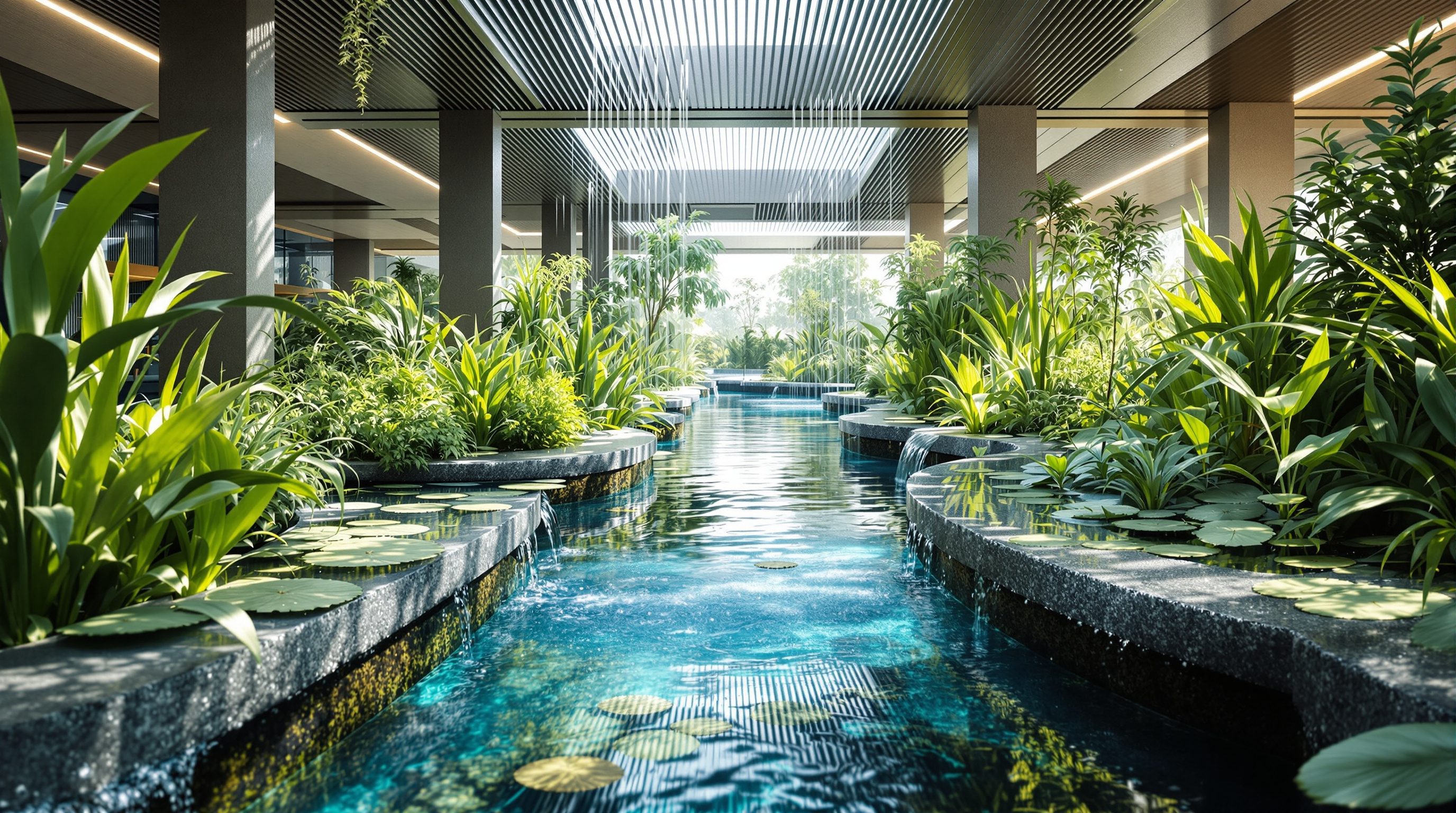
At the natural, low-energy end sit the systems this module celebrates. A septic tank is, at heart, a simple anaerobic chamber where microbes partly digest sewage with no energy at all. A constructed wetland is a biofilm reactor wearing a garden's clothes: the microbes on its gravel and roots do the eating, powered by sunlight and the oxygen the plants deliver, again with little or no energy. Waste-stabilisation ponds do the same in open water. These systems are cheap to run, robust and often beautiful, but they trade those virtues for land and time.
Move along the spectrum and the same biology gets more engineered and controlled. A trickling filter trickles wastewater over a bed of media coated in aerobic biofilm - the microbes are the same, but now we have built them a purpose-made home and improved their air supply. Activated sludge, the workhorse of large municipal treatment, keeps a dense, aerated soup of suspended microbes churning in a tank, then settles them out and recycles most of them back to keep the population high - fast, powerful, compact, but hungry for aeration energy and needing skilled operation. At the most engineered end, a membrane bioreactor combines an activated-sludge process with fine membranes that physically strain out the microbes and solids, producing very high-quality water in a small footprint - at a correspondingly high energy and maintenance cost.
The crucial insight is that nothing fundamental changes across this whole range - it is the same microbes eating the same pollution the same way. What changes is only the housing and its consequences: how much land the system needs, how much energy it draws, how much control and consistency it gives you, and how much skill it demands to run. A wetland and a membrane bioreactor are cousins, not opposites. This is exactly why the next lesson can pose the natural-versus-mechanical choice as a genuine trade-off rather than a contest between good and bad: both are biological treatment, and the honest question is only which housing fits the land, energy, climate, skills and standard your particular situation actually has.
One biology, a spectrum of housings: septic tank + wetland + pond (natural, low-energy, needs land/time) -> trickling filter -> activated sludge -> membrane bioreactor (engineered, high-control, high-energy, small footprint). Same microbes throughout; only land/energy/control change.
Living systems need care and time - and are never a magic box
Everything above makes biological treatment sound almost effortless - just let the microbes eat. The honest counterweight, and the reason this lesson matters as much as it does, is that these are living systems, and living things must be kept alive and well to work. This is where enthusiasm meets reality, and where health discipline reasserts itself.
A microbial community needs conditions to thrive, and each is a way the system can fail. It needs a steady supply of food at a manageable rate: starve it and the population crashes; overload it suddenly and it cannot keep up and the effluent turns foul. It needs the right temperature - biology slows in the cold, which is why warm climates like India's suit natural treatment and why cold snaps degrade performance. Aerobic systems need a reliable oxygen supply, so if the aeration fails the good microbes die off and are replaced by smelly, ineffective ones; anaerobic systems need to be kept genuinely airless. And crucially, the community can be poisoned: a slug of bleach, strong disinfectant, industrial chemical or other toxic input can shock or kill the microbes, and a killed biological system does not clean water at all until it painstakingly regrows. On top of all this, biology takes time - a new system needs days to weeks to mature its microbial population before it performs, and treatment itself happens over hours, not instantly - and it continuously produces surplus sludge that must be removed and managed, which is a real, recurring maintenance duty, not an optional extra.
The conclusion follows directly and firmly: a biological treatment system is never a set-and-forget box. It is more like a living animal or a garden that must be fed, kept warm, given air, protected from poisons, monitored and maintained - and when neglected, it degrades or dies, and a failed or overwhelmed system can discharge inadequately treated, unsafe water. This is exactly why 'natural' does not mean 'safe' and why good intentions are not enough: the water leaving any biological system is only genuinely clean when the system is healthy and functioning, and whether that water is safe for any particular use is a matter for verified testing and qualified public-health and water-treatment engineers under the governing codes (NBC India, IS, CPHEEO and the health regulations), never an assumption from the fact that a biological process was involved. Respect the biology - feed it, warm it, protect it, maintain it, verify its output - and it will clean water beautifully. Neglect it, and it becomes a health hazard wearing a green label.
Aerobic vs anaerobic
The defining choice
With oxygen: fast, thorough, but energy-hungry and more sludge. Without: slower and less complete, but low-energy, less sludge, and makes biogas. Process selection and sizing are engineering determinations under the codes. Illustrative here.
Living systems can be shocked or killed
The operating reality
Microbes need steady food, warmth, oxygen (or its absence) and protection from toxic inputs; they take time to mature and produce surplus sludge. A starved, overloaded or poisoned system discharges unsafe water. Not set-and-forget. Modules 8.4, 5.4.
'Treated' is not 'safe'
The absolute discipline
Water from any biological system is only clean when the system is healthy, and pathogen removal is not guaranteed. Fitness for a use is decided by verified testing and qualified public-health and water-treatment engineers under NBC India, IS and the health regulations - never assumed. Modules 5.3, 8.3.
Sludge and by-products are real
The ongoing duty
Every biological system continuously produces surplus sludge (and gas) that must be removed and managed safely - a recurring maintenance obligation, not an afterthought. Handling and disposal follow the governing norms (CPHEEO, IS).
Workshop - read a treatment system as biology
The point of this lesson is a lens: seeing any treatment system as microbes being fed, aerated (or not) and kept alive. This workshop trains that lens on a real or described system and, just as importantly, on the ways it could be starved, shocked or neglected into failure.
A treatment system you can observe or research and a notebook. No sampling or lab work - and definitely no interfering with a live system. All binding process selection, sizing, operation and any safe-reuse determination stay with qualified public-health and water-treatment engineers and the governing codes.
Goal: to read a treatment system in terms of its biology - what feeds it, how it gets oxygen, and how it could fail
Inputs: a treatment system you can observe or research (a home septic tank, a campus or apartment package plant, a described municipal works, or a constructed wetland) + this lesson
Time: ~40 minutes
- 1Identify the biology: where do the microbes live in this system (loose flocs, or biofilm on media/roots/gravel), and is it working aerobically, anaerobically, or both in sequence? Note the clues (is air blown in? is it sealed? is there open water or planted gravel?).
- 2Trace food and by-products: what organic load feeds it, and where do the by-products go - the cleaned water, the gas (CO2 or biogas), and the surplus sludge? Note whether and how the sludge is removed.
- 3Find the energy: does this system need aeration or pumping energy, or does it run on gravity and sunlight? Relate this to the energy-water nexus - is it a low-energy natural housing or an energy-hungry engineered one?
- 4List the failure modes: name at least four ways this specific system could be degraded or killed - starvation, sudden overload, loss of aeration, a toxic slug (bleach/chemicals), cold, or neglected sludge removal - and what its effluent would be like if it failed.
- 5Write the honesty note: state what would have to be true for this system's output to be genuinely clean, and record that whether the water is safe for any use is a matter for verified testing and specialists under the codes - not an assumption. Frame as reasoning.
You’ll walk away with
A one-page biological read of a real system: where the microbes live, aerobic or anaerobic, its food and by-products (including sludge), its energy demand, at least four failure modes, and an honest note that safe use depends on a healthy system plus verified testing and specialists. A reasoning exercise, not an operating manual.
Three altitudes on the same idea
Read the band that fits you — or all three.
Biological treatment is the one principle behind nearly every treatment option you will encounter: microbes eat the organic pollution, aerobically (fast, thorough, energy-hungry, more sludge) or anaerobically (slower, low-energy, makes biogas, less sludge) - and every system from a septic tank to a membrane bioreactor is that same biology in a different housing. Use this to think clearly: choosing a treatment approach is really choosing where on the natural-to-engineered spectrum you sit, trading land and time against energy and control. Design in the conditions the biology needs - steady load, warmth, oxygen (or its deliberate absence), protection from toxic shocks - and design in the recurring reality of sludge handling and startup time. Hold the disciplines: reduce demand first so the system is small; count aeration energy honestly; and remember a living system can be starved, shocked or killed and then discharge unsafe water. Own the strategy and the spatial and energy integration; defer sizing, process selection, and any safe-reuse determination to public-health and water-treatment engineers, verified testing and the codes (NBC India, IS, CPHEEO).
You will not design a bioreactor, but biological treatment shapes two things you do control: what goes down the drain, and how any treated water returns to the space. Because these systems are living microbial communities that can be poisoned, the interior matters: harsh drain cleaners, bleach, strong disinfectants and chemicals poured down a sink can shock or kill the microbes in a septic tank, package plant or wetland downstream and stop it cleaning water - so specifying and communicating gentler, biology-friendly cleaning is a genuine contribution. The order still holds: efficient low-flow fixtures and sensible appliances cut the load first, keeping any treatment system small and stable. Where biologically treated water returns for flushing or irrigation, treat it as any non-potable supply: rigorously separated, labelled, never cross-connected, and never assumed safe because a natural process was involved - its fitness for a use is verified by testing and specialists. Your domain is the healthy, low-load, biology-respecting interior; the treatment engineering and its safety belong to specialists and the codes.
Learn this one principle and a huge amount of water treatment becomes clear: the organic pollution in dirty water is food for microbes, and biological treatment is simply gathering microbes, letting them eat the pollution, and separating the clean water afterward. Know the fork that explains most systems: aerobic (with oxygen - fast, thorough, but aeration costs energy and makes more sludge) versus anaerobic (no oxygen - slower and less complete, but low-energy, less sludge, and it makes biogas you can burn). Know that a septic tank, a constructed wetland, a trickling filter, activated sludge and a membrane bioreactor are all the same biology in different housings, arranged on a spectrum from natural-and-low-energy to engineered-and-high-control. And know the honest half: these are living systems - they must be fed, kept warm, given air, protected from poisons, and given time; they produce sludge; and they can be shocked or killed, after which they discharge unsafe water. So 'natural' is not 'safe', and whether treated water is fit for a use is decided by verified testing and specialists, never assumed. That principle-plus-honesty is real water literacy.
“Biological treatment is a natural, self-sustaining process - you set it up, the microbes do their job, and it keeps cleaning water on its own with no real inputs or attention. Because it is biological rather than chemical or mechanical, it is inherently gentle, low-maintenance and safe, and the water it produces is naturally clean.”
Do it yourself
No tools needed - reason it through.
- 1State the core principle of biological treatment in one sentence, and name the three things that come out of the process besides cleaner water.
- 2Compare aerobic and anaerobic treatment on speed, energy, sludge and by-products, and give an example system of each.
- 3Explain why a septic tank, a constructed wetland and an activated-sludge plant are 'the same biology in different housings', and what actually differs between them.
- 4Give four ways a living treatment system can be degraded or killed, and what happens to its effluent when it fails.
- 5Why does 'biological' or 'treated' not mean 'safe', and who decides whether treated water is fit for a use?
The one line to carry out
Peer-reviewed journals & authoritative standards
- 01Sewage treatment — Wikipedia - Sewage treatment, 2026.
- 02Bioremediation — Wikipedia - Bioremediation, 2026.
- 03Membrane bioreactor — Wikipedia - Membrane bioreactor, 2026.
- 04Wastewater — Wikipedia - Wastewater, 2026.
If a wetland and a membrane bioreactor are the same biology in different housings, the real design question is which housing fits your situation - natural or mechanical. Next we take that trade-off head-on, honestly, and puncture the idea that 'natural' is automatically better or safer.
The author
Amogh N P
Architect, interior designer, and creative polymath. Studio Matrx began in his notebooks — his vision of design made honest, useful, and open to everyone. Its Academy is written and taught in his memory, and free, forever.
More about Amogh →