
The Design Process
From a need to a product — design thinking, ideation and prototyping.
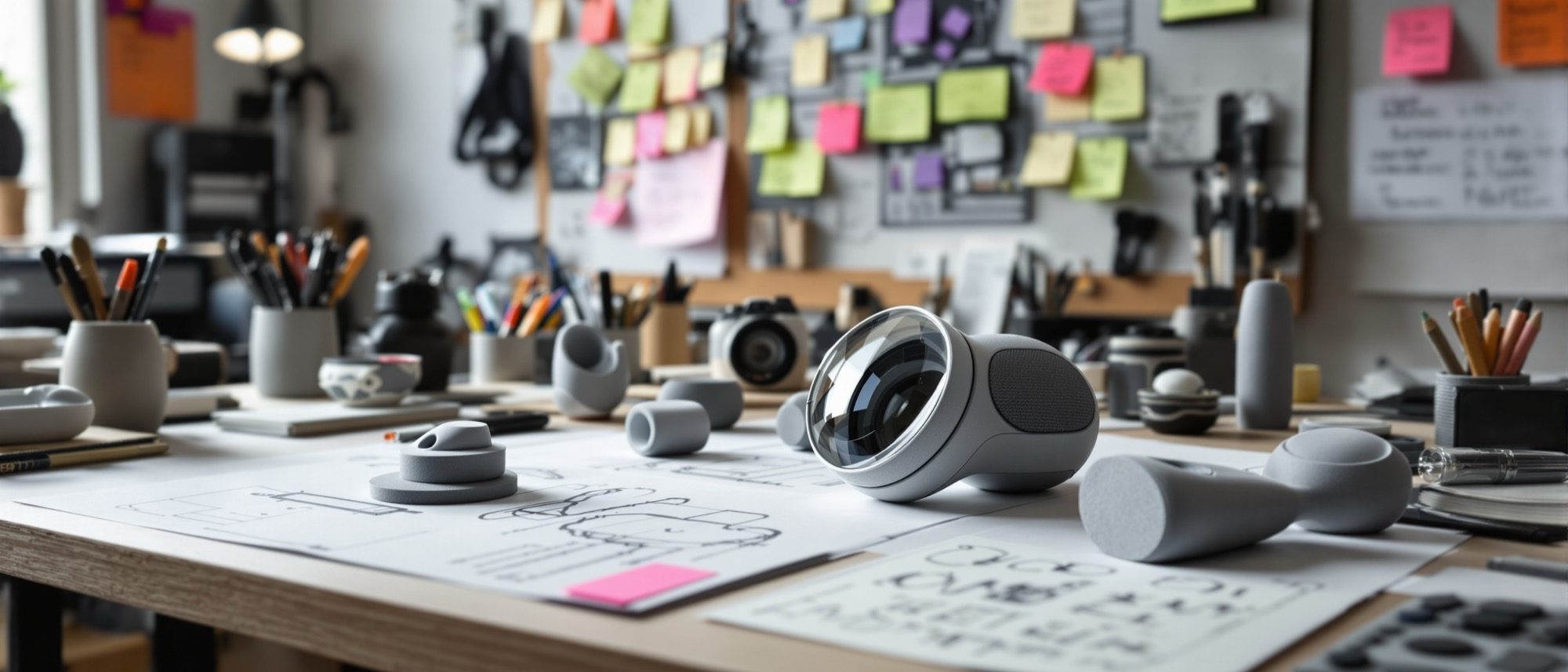
Good products are not guessed; they are worked out by a process. This unit covers the arc from need to production, the human-centred frame of design thinking and the Double Diamond, and prototyping to LEARN — the craft of building (often in Computer Studio III). Step through the stages in the explorer below.
Learning objectives
By the end of this lesson, you will be able to — mapped to the course outcomes for Product Design:
Describe the product-design process from need to production.
Apply design thinking (empathise, define, ideate, prototype, test) and the Double Diamond.
Use ideation methods to generate and select concepts.
Prototype to learn — matching fidelity to the question.
The process & its frames
The process loops; design thinking (empathise → test) and the Double Diamond (discover, define; develop, deliver) frame it.[1, 4]
Design thinking · step through the five stages
Stage 1 · Understand the user
Empathise
Observe and interview the people you design for — set your assumptions aside and learn their real needs, context and frustrations.
…and it loops — testing can send you back to empathise.
Need to production
The product-design process runs: NEED/PROBLEM identification → research → the BRIEF → ideation and concept generation → concept selection → development → detailing → prototyping → testing → production. Ulrich & Eppinger frame it as planning → concept development → system-level design → detail design → testing & refinement → production ramp-up. FLAG: it is ITERATIVE, not a one-way line — you loop back as you learn.[1]
Ideation & prototyping
Diverge widely before converging, and prototype to learn — matching fidelity to the question, not making a pretty model.[1]
Generate before you judge
IDEATION diverges to find many possibilities before converging on a few. Methods: BRAINSTORMING (Osborn's rules — defer judgement, go for quantity, build on others); MIND-MAPPING; rapid SKETCHING and thumbnails; the MORPHOLOGICAL CHART (list each function and its options, then combine across rows for novel concepts); SCAMPER and mood boards. The cardinal rule: separate idea generation from idea judgement — judging too early kills the best ideas.[1]
At a glance
| Aspect | One | The other |
|---|---|---|
| Two design-thinking poles | Empathise & define: the right problem | Prototype & test: the right solution |
| Double Diamond | Diamond 1: discover → define (problem) | Diamond 2: develop → deliver (solution) |
| Ideation rule | Diverge: generate many, defer judgement | Converge: select a few to develop |
| Prototype fidelity | Low-fi: fast, cheap, early questions | High-fi: refined, specific later questions |
| Why prototype | Myth: to make a pretty model | Reality: to learn and test a hypothesis |
Key terms
The framed problem statement — goals, constraints and needs — that the design must answer.
A human-centred frame — empathise, define, ideate, prototype, test — that is non-linear and iterative.
The Design Council's two-cycle model — discover, define (right problem); develop, deliver (right solution).
Opening up to many possibilities, then narrowing to a chosen few — the rhythm of design.
A matrix of functions × options; combining across rows generates novel concepts.
A rough or refined model built to learn and test — fidelity matched to the question.
Quick rough mock-ups for early questions vs refined models for specific later ones.
3D printing (FDM/SLA/SLS) and similar — fast physical iterations from CAD.
Studio task
Take a small product problem through one loop of design thinking — write an empathy note, define the problem in one sentence, sketch ten ideas, and describe the rough prototype you would build to test the best one.
Self-assessment
1. The five stages of design thinking (Stanford d.school) are —
2. The first diamond of the Double Diamond is about finding —
3. The main purpose of a prototype is to —
Recap
References & further reading
- [1]Karl T. Ulrich & Steven D. Eppinger, Product Design and Development. McGraw-Hill.
- [4]Stanford d.school — Design Thinking process; and the UK Design Council — the Double Diamond. https://www.designcouncil.org.uk/our-resources/the-double-diamond/
Further reading
- Ulrich & Eppinger, Product Design and Development. McGraw-Hill.
- Tim Brown, Change by Design (IDEO). Harper Business.
- Tom Kelley, The Art of Innovation (IDEO). Currency/Doubleday.
Sources gathered and fact-checked June 2026. Published values vary by source, sample and method — treat as indicative and confirm against the cited standard before structural use.
The author
Amogh N P
Architect, interior designer, and creative polymath. Studio Matrx began in his notebooks — his vision of design made honest, useful, and open to everyone. Its Academy is written and taught in his memory, and free, forever.
More about Amogh →